Loading
What Is DCA? Dollar-Cost Averaging with a 5,000 Baht Example

Thanakit Sutto
Nov 23, 2026
16 min read
0
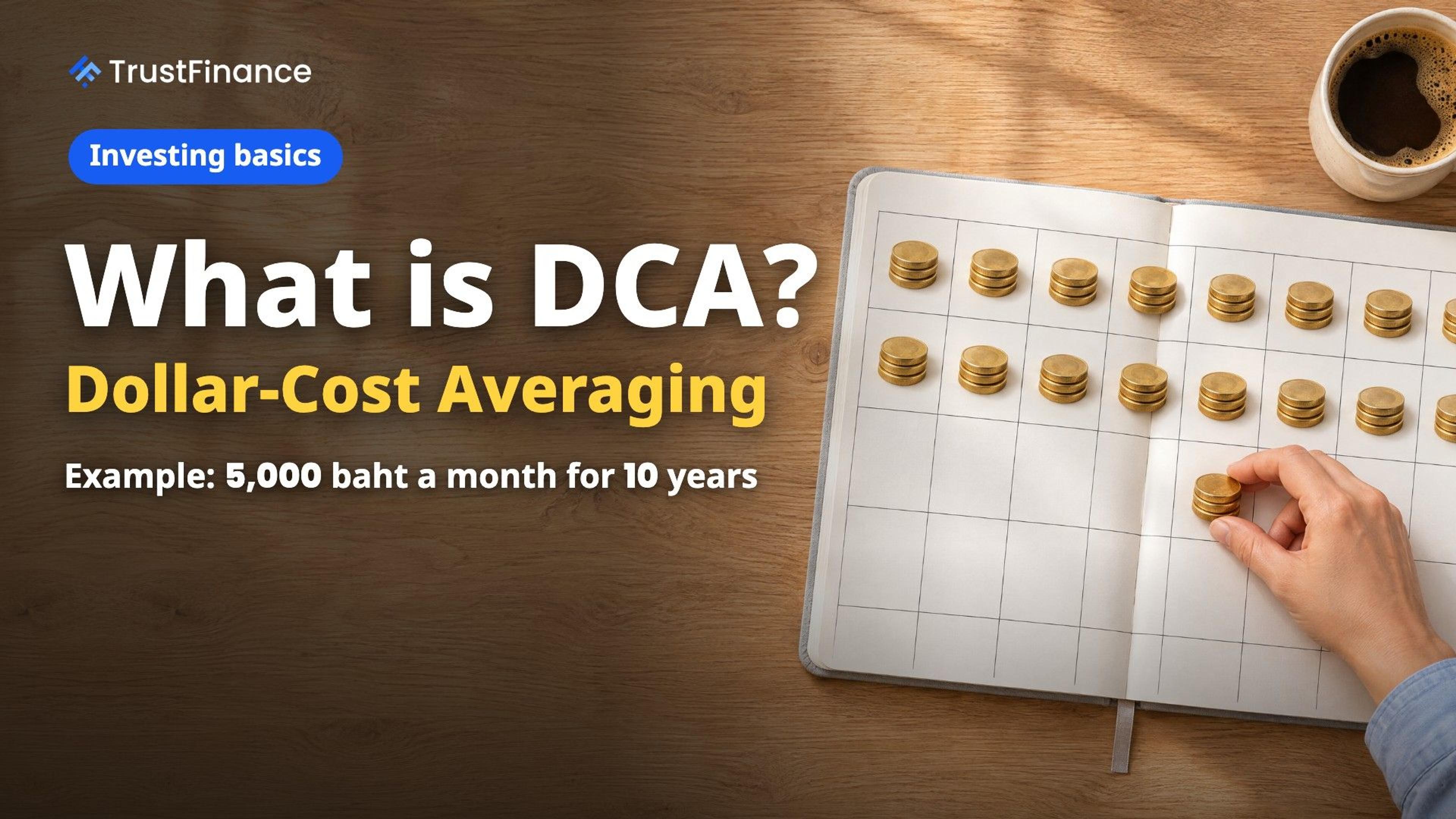
DCA (Dollar-Cost Averaging) is a strategy of consistently investing equal amounts of money at regular intervals—such as every month or quarter—regardless of whether stock prices or investment units go up or down. In Thai, it is known as "cost averaging investment."
The Stock Exchange of Thailand (SET) explains that this method focuses on the investment amount rather than market timing. When prices are low, you buy more units; when prices are high, you buy fewer units (SET: Dollar-Cost Averaging).
Summary
|
What is DCA and How Does It Work?
DCA involves setting a rule for yourself to invest in regular installments with a fixed amount per period, while the number of units received changes based on the price on the purchase date.
- What remains fixed: The amount invested per period, such as 1,000 or 5,000 THB per month.
- What changes: The purchase price on that day and the number of shares or investment units acquired.
- Investment frequency: Weekly, monthly, or quarterly—choose a schedule you can maintain consistently.
- Popular assets: Mutual funds, index funds, ETFs, and individual stocks.
If you are still unsure how ETFs differ from regular mutual funds, the article What is an ETF Fund and Why Investors Love Them explains their mechanisms and costs before you start investing.
The key metric to look at is the average cost per unit, which is calculated by dividing the total investment by the total number of units, rather than simply averaging the prices of each period.
Example: Why the Average Cost is Lower Than the Average Price
Suppose you invest 1,000 THB per month for 4 months, and the price per unit changes to 10, 8, 12, and 9 THB (hypothetical figures).
| Month | Price per Unit | Investment Amount | Units Acquired |
|---|---|---|---|
| 1 | 10 THB | 1,000 THB | 100.00 units |
| 2 | 8 THB | 1,000 THB | 125.00 units |
| 3 | 12 THB | 1,000 THB | 83.33 units |
| 4 | 9 THB | 1,000 THB | 111.11 units |
| Total | Average price 9.75 THB | 4,000 THB | 419.44 units |
Average cost = 4,000 ÷ 419.44 = 9.54 THB per unit, which is lower than the average price of 9.75 THB.
The reason is that in month 2, at a price of 8 THB, you acquired 125 units, whereas in month 3, at 12 THB, you acquired only 83.33 units. Periods with lower prices carry a greater weight.
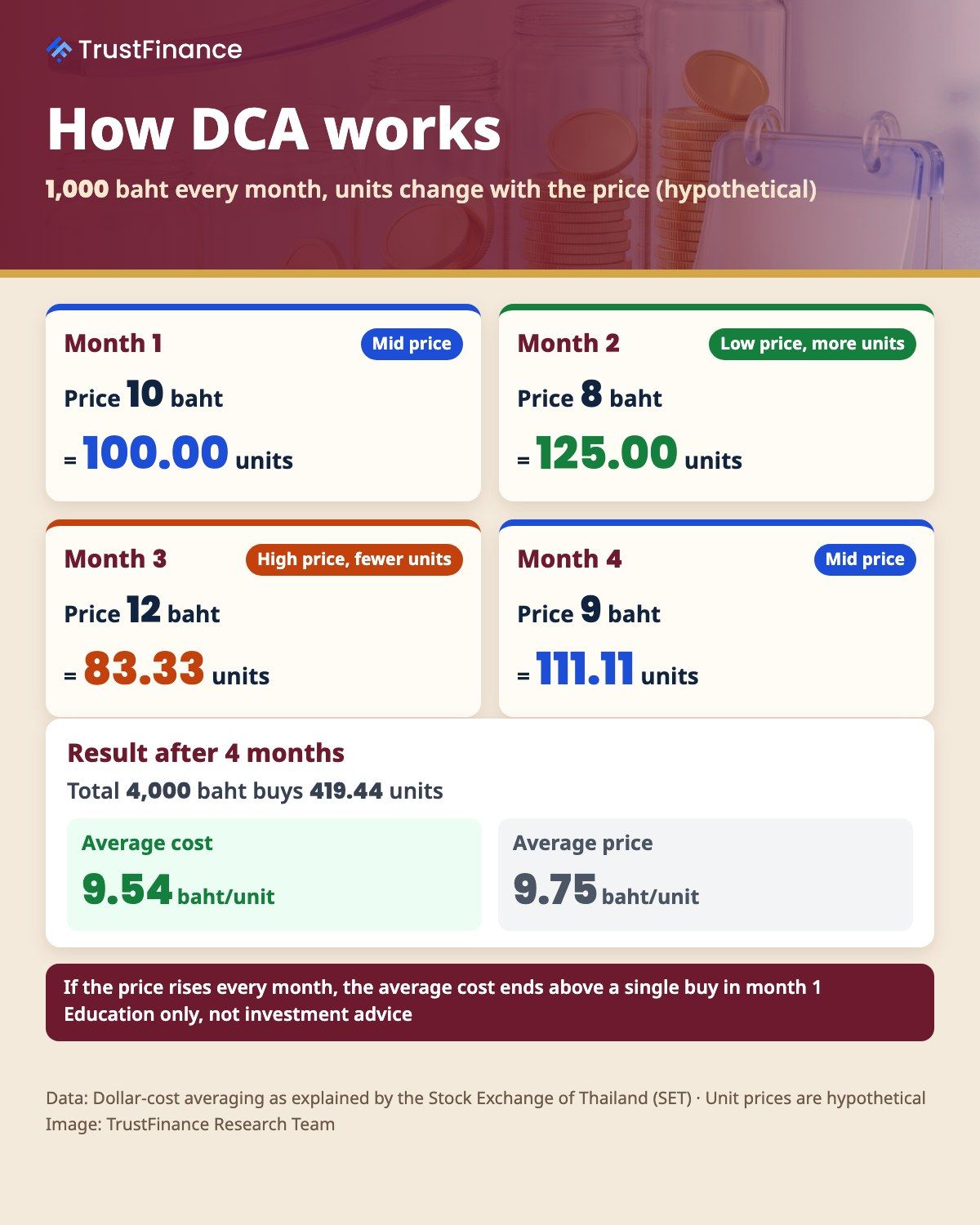
Investing 1,000 THB per month for 4 months at prices of 10, 8, 12, and 9 THB yields 419.44 units with an average cost of 9.54 THB per unit, lower than the average price of 9.75 THB (hypothetical figures).
Source: Dollar-Cost Averaging principles by the Stock Exchange of Thailand (SET) · Image: TrustFinance Research Team
Note: If prices rise every month without any pullbacks, DCA will result in a higher average cost than buying everything in the first month. The cost advantage occurs when prices fluctuate up and down.
How Much Will You Get by Investing 5,000 THB a Month via DCA for 10 Years?
Investing 5,000 THB a month for 120 months results in a total principal of 600,000 THB. The final value depends on the actual returns achieved, which no one can predict in advance.
Therefore, the table below uses various hypothetical return rates—ranging from negative to 7% per year—to illustrate a range of possible outcomes rather than a single definitive figure.
How is DCA Compound Interest Calculated?
Formula: FV = P × [((1 + r)n - 1) ÷ r] P = Investment amount per period (5,000 THB) · r = Annual return ÷ 12 · n = Number of periods (120 months) Example (Hypothetical figures): At a 5% annual return, r = 0.05 ÷ 12 = 0.004167, giving FV = 5,000 × [((1.004167)120 - 1) ÷ 0.004167] ≈ 776,411 THB. This formula assumes investments are made at the end of every month with constant monthly returns, and does not deduct fees or taxes. |
| Hypothetical Annual Return | Total Principal | Value After 10 Years | Difference from Principal |
|---|---|---|---|
| -3% | 600,000 THB | 518,920 THB | -81,080 THB |
| 0% | 600,000 THB | 600,000 THB | 0 THB |
| 3% | 600,000 THB | 698,707 THB | +98,707 THB |
| 5% | 600,000 THB | 776,411 THB | +176,411 THB |
| 7% | 600,000 THB | 865,424 THB | +265,424 THB |
All figures are calculated based on assumptions and do not represent guaranteed returns, nor do past performances guarantee future results.
In the real world, annual returns fluctuate between positive and negative, and the sequence of good and bad years can alter the final outcome. For instance, a sharp market drop in the final years heavily impacts the large accumulated lump sum.
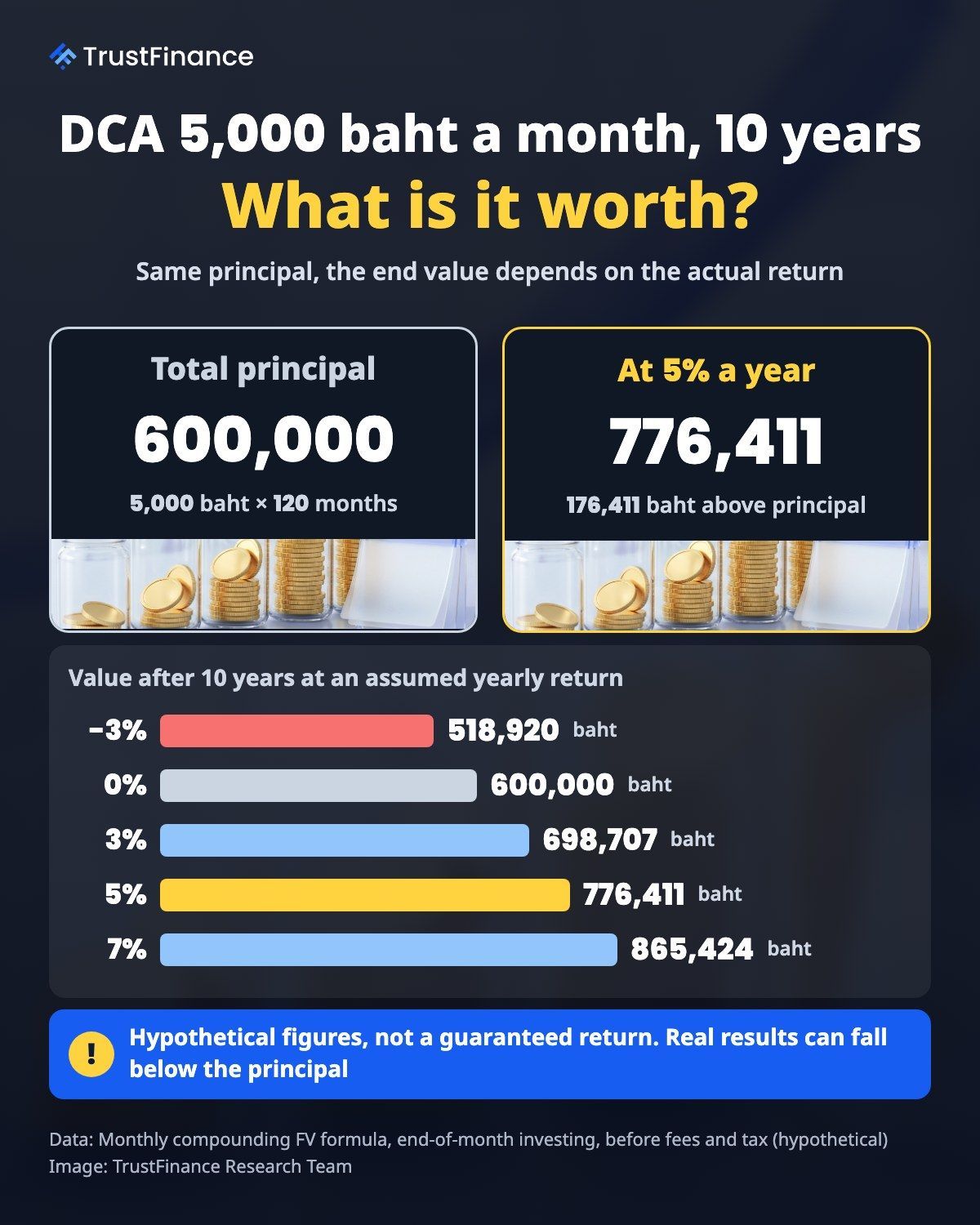
DCA of 5,000 THB per month for 10 years with a total principal of 600,000 THB. At hypothetical returns of -3% to 7% per year, the final value ranges between 518,920 and 865,424 THB (not guaranteed returns).
Source: Monthly compounding FV formula, investing at the end of each month, excluding fees and taxes (hypothetical figures) · Image: TrustFinance Research Team
The difference between the principal and the final value comes from returns compounding every month. You can learn more about the formula and the Rule of 72 in the article Compound Interest Explained: Formulas, Baht Examples, and the Rule of 72.
How Does DCA Differ from Lump-Sum Investing?
The difference lies in market entry timing. Lump-sum investing puts all the money in at once, whereas DCA spreads the investment across multiple periods.
| Topic | DCA | Lump-Sum Investing |
|---|---|---|
| Capital required | Gradually contributed from monthly income | Requires a ready lump-sum amount |
| Purchase price | Spread across multiple prices | Single price on the purchase date |
| Continuous bull market | Often yields less because some funds are not yet invested | Often advantageous because money stays in the market longer |
| Volatile or bear market | Average cost can decrease | Immediate loss if purchased at a peak |
| Decision making | No need to time the market | Requires one major decision |
| Fees | Paid multiple times if commissions apply per order | Paid only once |
Neither method is universally superior. For individuals with a salary but no large lump sum, DCA is a practical and realistic approach.
Those who already have a lump sum may choose to phase their money in over a short period to reduce the risk of buying entirely at a peak, trading off the opportunity to miss out on upward price movements.
What Are the Pros and Cons of DCA?
The strengths of DCA lie in discipline and simplicity, while its weaknesses include lower returns in strong bull markets and recurring transaction fees.
Pros
- Low barrier to entry: Uses portions of monthly income without requiring a large lump sum.
- No need to time the market: Reduces the risk of deploying all funds during market peaks.
- Builds discipline: Automated purchases ensure investing continues even during periods of heavy bad news.
- Versatile across assets: Applicable to mutual funds, ETFs, stocks, and tax-saving funds like RMFs or Thai ESGs.
Cons
- Potentially lower returns in a bull market: Uninvested cash misses out on rising prices.
- Accumulated fees: Multiple purchases with minimum commissions per order can increase total costs.
- Ineffective for poor asset selection: While cost averaging lowers the average cost of a failing business, its price may never recover.
- Requires time: The benefits of cost averaging and compounding become apparent only over the long term, not within a few months.
On the flip side, leaving cash idle to wait for the "right moment" incurs a cost from inflation eroding purchasing power every year. The article How to Invest to Beat Inflation compares the returns of various assets against inflation rates.
What Are the Risks of DCA?
DCA is a purchasing timing strategy; it does not reduce the underlying risk of the asset itself. The core risks of the purchased asset remain fully intact.
Precautions
|
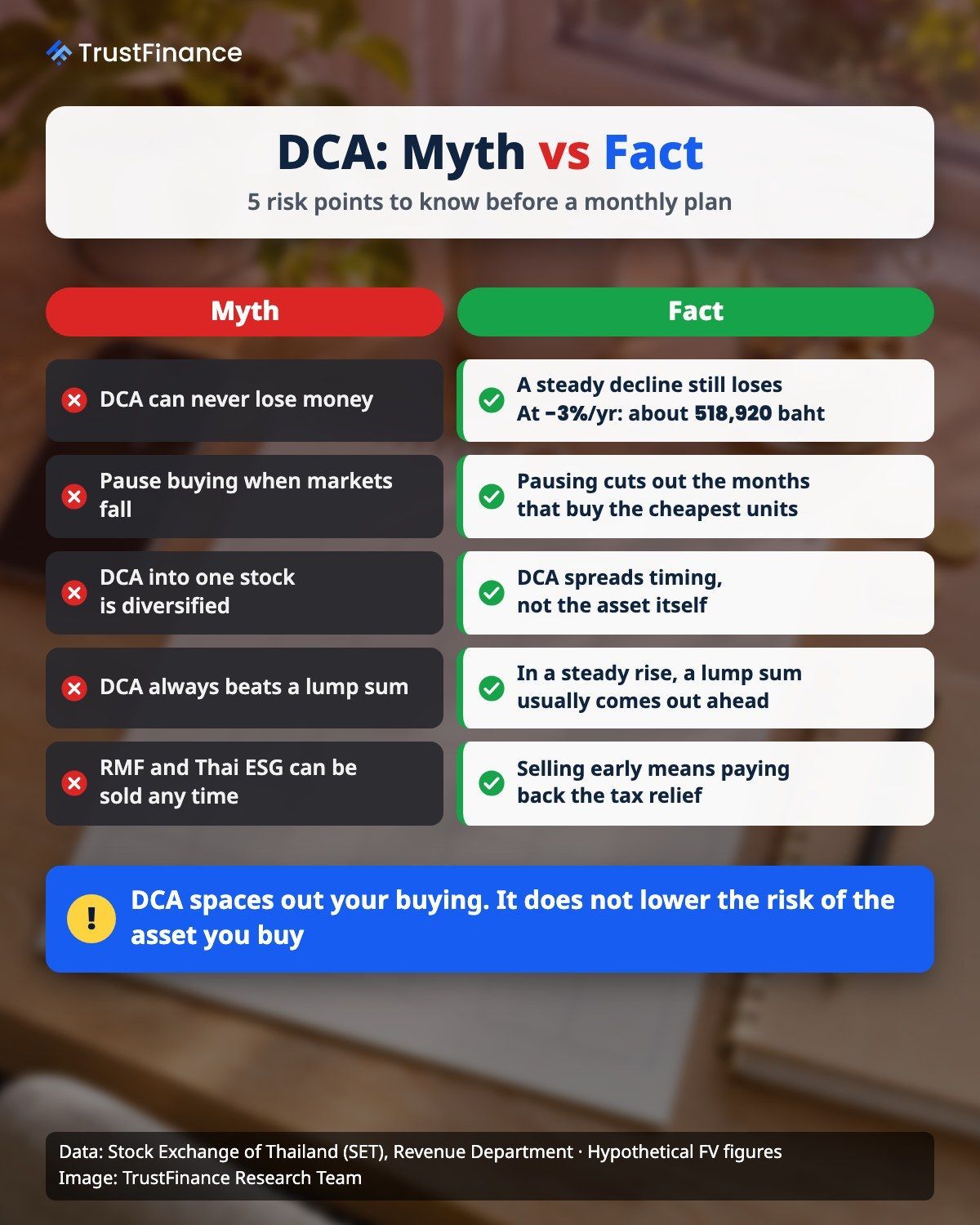
DCA organizes purchasing timing but does not eliminate asset risk. If prices drop continuously, such as a hypothetical -3% annual return, a 600,000 THB principal reduces to about 518,920 THB.
Source: Stock Exchange of Thailand (SET), Revenue Department · Image: TrustFinance Research Team
Can You DCA into Thai Stocks? How to Choose Assets
Yes, you can DCA into Thai stocks by purchasing individual stocks through a securities trading account, or by buying Thai equity mutual funds and index-tracking ETFs (such as the SET50 index).
Many brokerage firms offer automated DCA stock-order functions where you specify the amount or number of shares and frequency. For mutual funds, you can set up monthly direct-debit instructions through asset management companies (AMCs) or authorized distributors.
Conditions and fees vary by provider, so it is advisable to compare them before opening an account.
This article does not recommend individual stocks. The question "Which stock should I DCA into?" is better answered using these selection criteria:
- Diversify first: Index funds or ETFs hold multiple companies based on an index in a single order, making them better suited for monthly recurrence than a single stock.
- Check total fees: Compare management and total expense ratios for funds, or commission per order for stocks, because DCA incurs these costs every period.
- Align with your timeline: Funds needed within a few years should not be placed in highly volatile assets.
- Understand what you buy: Read the Fund Fact Sheet summary or company information before placing orders.
- If choosing individual stocks: Look at business stability, not just falling prices.
How to Start DCA in 5 Steps
You can start within a single day. Most of the work involves the initial setup, after which the system executes purchases automatically according to your schedule.
When setting up mutual fund purchases, the execution price will be the NAV of the transaction day, and orders placed after the cutoff time will use the next day's price. Details can be found in the article NAV, Fees, and Fund Cutoff Times Explained.
- Set goals and timeline: Define what the money is for and how many years away that goal is, such as retirement 20 years from now.
- Determine the per-period amount: Choose an amount you can comfortably sustain even during market downturns, after setting aside an emergency fund.
- Choose assets: Select index funds, ETFs, mutual funds, or stocks based on the criteria discussed earlier.
- Open an account and set up automation: Use a fund account with an AMC/distributor or a securities trading account, then set the debit date and amount.
- Review annually: Check fees, asset allocation, and goals, and adjust when your income or life plans change—not in response to daily price fluctuations.
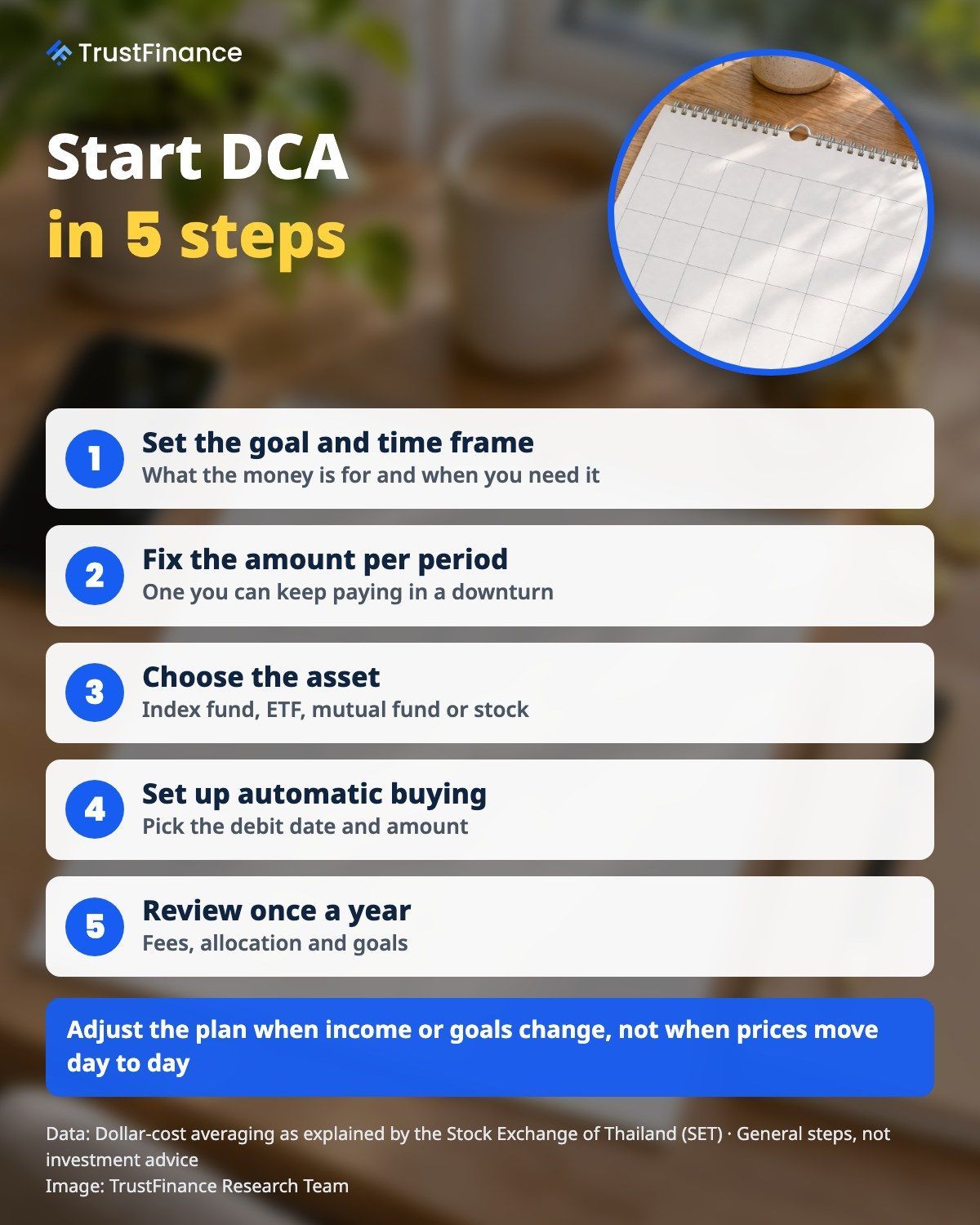
Start DCA in 5 steps: set goals, determine per-period amount, choose assets, set up automated purchases, and review annually as income or goals change.
Source: Dollar-Cost Averaging principles by the Stock Exchange of Thailand (SET) · Image: TrustFinance Research Team
Can DCA Be Used for Tax Deductions?
DCA itself is not a tax deduction right. However, if you use DCA to purchase legally qualified tax-saving funds such as RMFs (Retirement Mutual Funds) or Thai ESGs (Thailand ESG Funds), the purchase amounts can be deducted from taxes according to the rules.
Gradually purchasing every month also helps you avoid having to scramble for a large lump sum at the end of the tax year.
| Fund Type | Tax Deduction Limit (2026 Tax Year) | Key Conditions |
|---|---|---|
| RMF | Up to 30% of taxable income, which combined with other retirement savings (such as Provident Funds, GPF, National Savings Fund, pension insurance) must not exceed 500,000 THB. | Must purchase at least once a year, suspend purchases for no more than 1 consecutive year, hold for at least 5 years from the first purchase date, and redeem only when reaching at least 55 years of age. |
| Thai ESG | Up to 30% of income, maximum 300,000 THB (excluded from the 500,000 THB retirement limit). | Purchased between Jan 1, 2024, and Dec 31, 2026. Must be held continuously for at least 5 years from the purchase date (Thai ESGX launched in 2026 shares the same limit). |
| SSF | Deduction rights apply to purchases made from 2020 to 2024. | Not a valid tax-saving option for new purchases in 2026. |
Information as of November 19, 2026, from the SET Tax Planning Tool, SET's SSF guidelines (set.or.th), and the Revenue Department's P.N.D. 90 filing manual (rd.go.th).
RMFs purchased from January 1, 2022, onwards must be notified to the AMC regarding the intention to claim tax exemptions. Violating conditions later will revoke eligibility and require filing amended tax returns to pay back taxes for the years exemptions were claimed.
Conditions after the 2026 tax year may change; always check with the Revenue Department before making a purchase.
Frequently Asked Questions
How much money will I get by investing 5,000 THB a month via DCA for 10 years?
With a total principal of 600,000 THB and assuming annual returns of 3%, 5%, or 7%, the final values are approximately 698,707, 776,411, and 865,424 THB respectively. These figures are hypothetical, and actual returns can fall below the principal.
Can you DCA into Thai stocks?
Yes, you can purchase individual stocks through securities trading accounts with automated buying functions, or buy Thai equity mutual funds and ETFs via monthly direct debits.
Which stock should I DCA into?
No single stock suits everyone, and this article does not recommend individual stocks. Beginners typically start with index funds or ETFs that diversify across multiple companies, then compare fees against their own investment timeline.
Can DCA result in losses?
Yes. DCA helps with purchase timing, but if asset prices decline continuously until the selling date, the portfolio value will be lower than the principal.
Is it better to DCA every month or every week?
Frequency is not the main deciding factor. Monthly schedules align with salary cycles and incur fewer transaction fees. If commissions apply per order, the more frequently you buy, the higher your costs.
Conclusion
DCA is an investment strategy involving fixed installment amounts on a set schedule, resulting in an average cost reflecting multiple price points without needing to time the market.
The example of 5,000 THB per month for 10 years demonstrates that a 600,000 THB principal will grow or shrink depending on actual returns. What you can control are the chosen assets, fees, and consistency.
Using DCA with RMFs or Thai ESGs also grants tax deduction benefits according to the 2026 tax year rules, provided the holding requirements are fully met.
Disclaimer: This article is provided for educational and informational purposes only and does not constitute investment advice or a solicitation to buy or sell securities, digital assets, or derivatives. Readers should study the information and assess risks independently before making decisions. |
References
- Stock Exchange of Thailand: Dollar-Cost Averaging (DCA): Definition and mechanism of DCA explaining why lower prices yield more units.
- Stock Exchange of Thailand: Tax Planning Tool: Limits and conditions for RMF, Thai ESG, and Thai ESGX deductions used in the tax table.
- Revenue Department: P.N.D. 90 Tax Filing Manual for Tax Year 2025: How to report RMF purchases (Item 10) and Thai ESG purchases (Item 18) when filing taxes.
Additional Information: Stock Exchange of Thailand, Super Savings Fund (SSF) explanation (set.or.th) · Future value figures calculated by the TrustFinance Research Team using a monthly compounding FV formula (hypothetical figures).
Fact-checked by the TrustFinance Research Team · Information as of November 19, 2026
Written by
Thanakit Sutto
Content & PR Lead at TrustFinance. A finance writer who makes investing easy to understand.