Loading
Related Articles
Fed Rate Hikes Are Back in 2026: What a Return to Tightening Means for the Dollar, Gold, and Traders
Related Articles
Fed Rate Hikes Are Back in 2026: What a Return to Tightening Means for the Dollar, Gold, and Traders

Thanakit Sutto
नव. 23, 2026
14 min read
1

A Stock Exchange is a centralized marketplace for trading securities—such as stocks, mutual fund units, ETFs, and warrants—that matches buy and sell orders under the same rules. In Thailand, this is the Stock Exchange of Thailand (SET), which first opened for trading on April 30, 1975.
The stock exchange does not buy or sell stocks itself, nor does it set prices. Prices are driven by orders from a large number of investors submitted through member securities companies (brokers). The overarching regulator is the Securities and Exchange Commission (SEC).
Key Takeaways
|
A stock exchange is a physical and central digital system that enables the open trading of listed securities, ensuring everyone sees the same price and all orders are matched under identical rules.
The Stock Exchange of Thailand Act B.E. 2517 (1974) aimed to establish a "central marketplace for securities trading" to promote domestic savings and capital mobilization. Today, its main functions fall into four areas:
The products traded in the market are not limited to common stocks; they also include units of registered funds, such as ETFs that can be traded like stocks during intraday hours, as well as warrants and derivative warrants (DWs).
The primary market is where a company issues and sells new securities to investors, raising funds directly for the company. In contrast, the secondary market is where investors trade existing securities among themselves, meaning no new money flows into the company.
A clear example is an Initial Public Offering (IPO), which takes place in the primary market. Once the shares begin trading on the stock exchange board, all subsequent trades from that day onward belong to the secondary market.
| Topic | Primary Market | Secondary Market |
|---|---|---|
| Who is selling | The securities issuer (company) | Investors holding the securities |
| Where does the money go | To the company, used for business expansion or debt reduction | To the opposing investor, not the company |
| Where do prices come from | The offering price stated in the prospectus | Market supply and demand, fluctuating throughout trading hours |
| Examples | IPOs, capital increase shares, newly issued bonds | Daily trading of shares on the SET and mai boards |
The Stock Exchange of Thailand officially opened for trading on April 30, 1975, under the Stock Exchange of Thailand Act B.E. 2517 (1974) and has been regulated by the SEC since 1992.
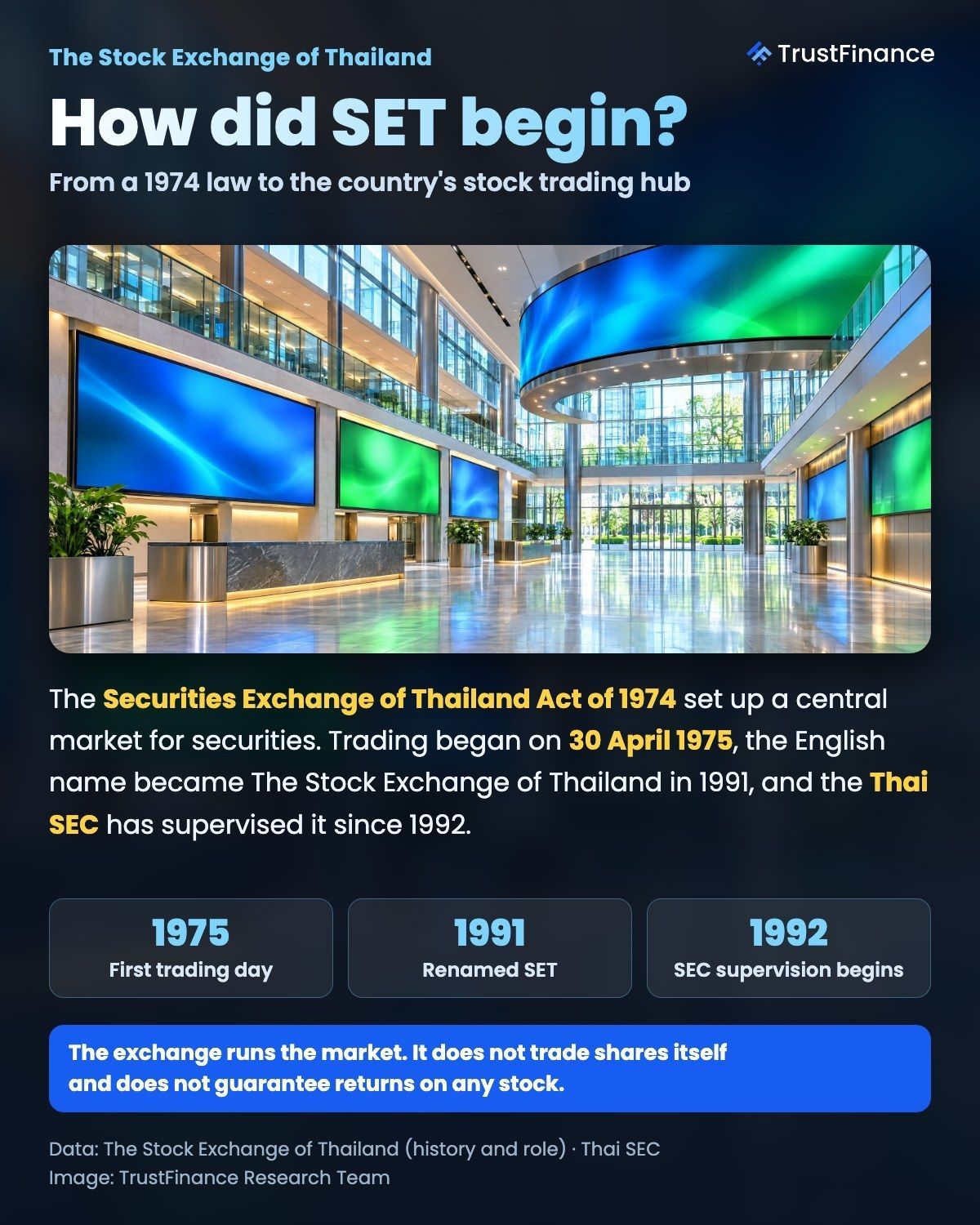
The Stock Exchange of Thailand opened for trading on April 30, 1975, adopted its English name "The Stock Exchange of Thailand" in 1991, and has been regulated by the SEC since 1992.
Data Sources: Stock Exchange of Thailand (History and Role) and the SEC · Image: TrustFinance Research Team
Before 1992, capital market regulation was fragmented across multiple agencies. The 1992 law established the SEC as a central organization overseeing both primary and secondary markets, while the stock exchange manages its own listing and trading rules. Neither agency guarantees the returns of any individual stock.
The Stock Exchange of Thailand group consists of two stock markets—SET and mai—alongside a subsidiary called TFEX for derivatives. All three operate under different sets of rules while sharing the same regulatory oversight by the SEC.

The Stock Exchange of Thailand group includes the SET and mai stock markets, while TFEX is a subsidiary trading derivatives, launching its first product on April 28, 2006.
Data Sources: Stock Exchange of Thailand and TFEX (FAQs) · Image: TrustFinance Research Team
| Market | What is Traded | Who is in the Market |
|---|---|---|
| SET | Common stocks, mutual fund units, ETFs, warrants, DWs, and registered property funds | Companies meeting the main stock exchange's listing criteria, mostly large enterprises |
| mai | Common stocks of companies listed on the mai | Medium and small businesses with growth potential, featuring lower paid-up capital requirements than the SET |
| TFEX | Futures and options referencing stocks, indices, debt instruments, and commodities | A subsidiary of the stock exchange governed by the Derivatives Act B.E. 2546 (2003) |
Stocks on the mai are typically smaller and less liquid, whereas TFEX relies on margin deposits, which can result in losses exceeding the initial deposit amount.
The Stock Exchange of Thailand operates on business days, split into morning and afternoon sessions, with pre-open and pre-close periods used to calculate prices. Actual opening and closing times are randomized within a few-minute window.
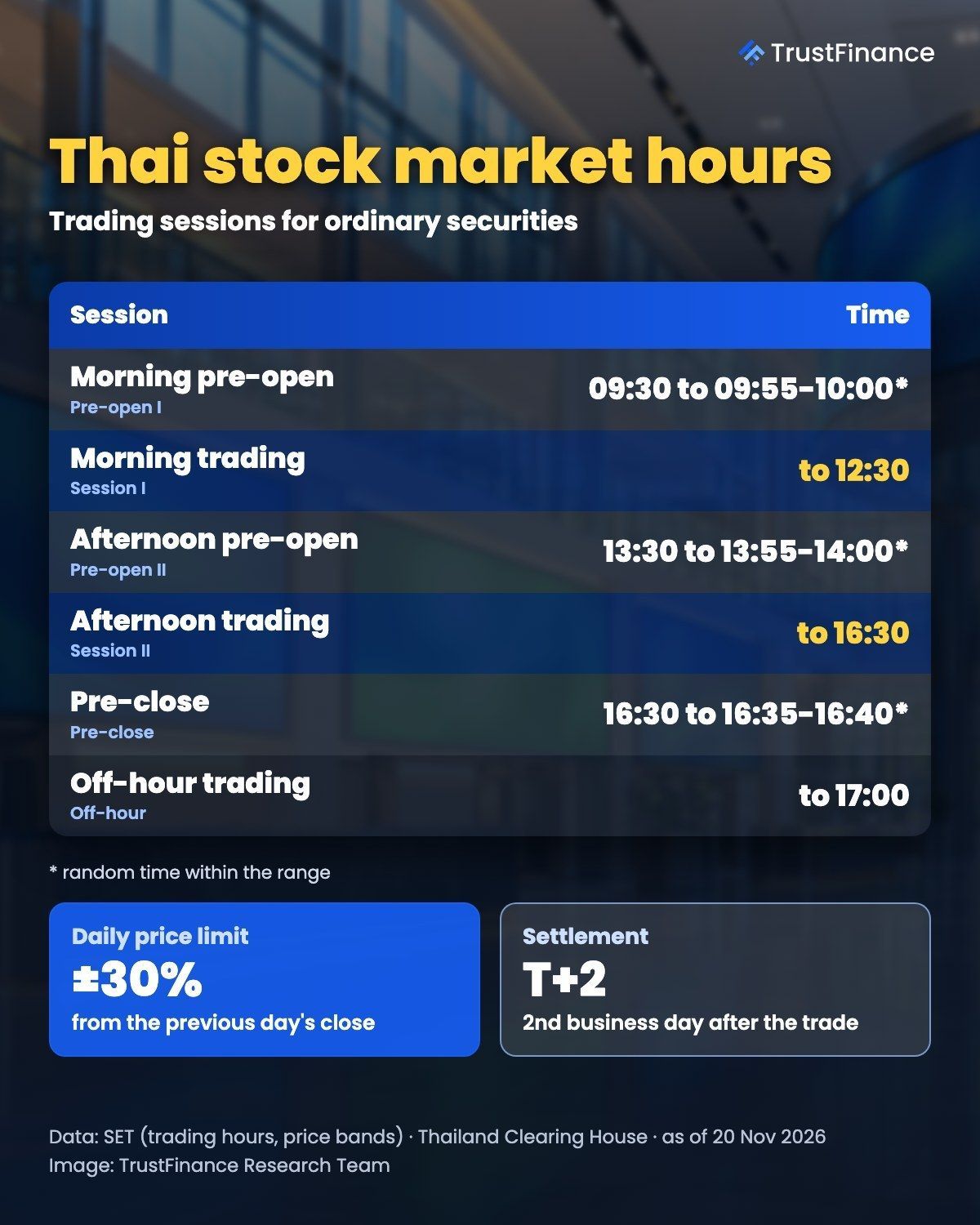
The Thai stock market opens with a morning pre-open at 9:30 AM, trades until 12:30 PM, reopens for the afternoon session from around 2:00 PM to 4:30 PM, and closes at 5:00 PM.
Data Sources: Stock Exchange of Thailand (Trading Hours) · Image: TrustFinance Research Team
| Session | Time |
|---|---|
| Morning Pre-open (Pre-open I) | 9:30 AM to a randomized time between 9:55 AM and 10:00 AM |
| Morning Trading Session | Until 12:30 PM |
| Afternoon Pre-open (Pre-open II) | 1:30 PM to a randomized time between 1:55 PM and 2:00 PM |
| Afternoon Trading Session | Until 4:30 PM |
| Pre-close | 4:30 PM to a randomized time between 4:35 PM and 4:40 PM |
| Off-hour and Market Close | Until 5:00 PM |
This schedule applies to general securities. Securities referencing foreign assets have different hours. The latest schedule can be viewed at Stock Exchange of Thailand: Trading Hours (Data as of November 20, 2026).
On normal trading days, common stock prices can rise or fall by a maximum of 30% from the previous business day's closing price, known as the Ceiling and Floor limits. IPO shares use different criteria on their first day. Prices also move in specific increments (Tick Size) based on the share price level.
Hypothetical Example: How Much Can a Stock Price Move in a Single Day? Stock A closed yesterday at 20.00 Baht. Today's Ceiling = 20.00 x 1.30 = 26.00 Baht · Today's Floor = 20.00 x 0.70 = 14.00 Baht Prices between 10 and under 25 Baht have a tick size of 0.05 Baht. Therefore, buy orders for Stock A can be placed at 20.00, 20.05, or 20.10 Baht, but cannot be placed at 20.03 Baht. If you buy 100 shares at 20.50 Baht, the total stock cost is 100 x 20.50 = 2,050 Baht, excluding brokerage fees and VAT, which vary by securities company. |
Retail investors cannot submit orders directly to the stock exchange; they must go through a securities company licensed by the SEC and holding membership with the exchange. The main process consists of 5 steps:
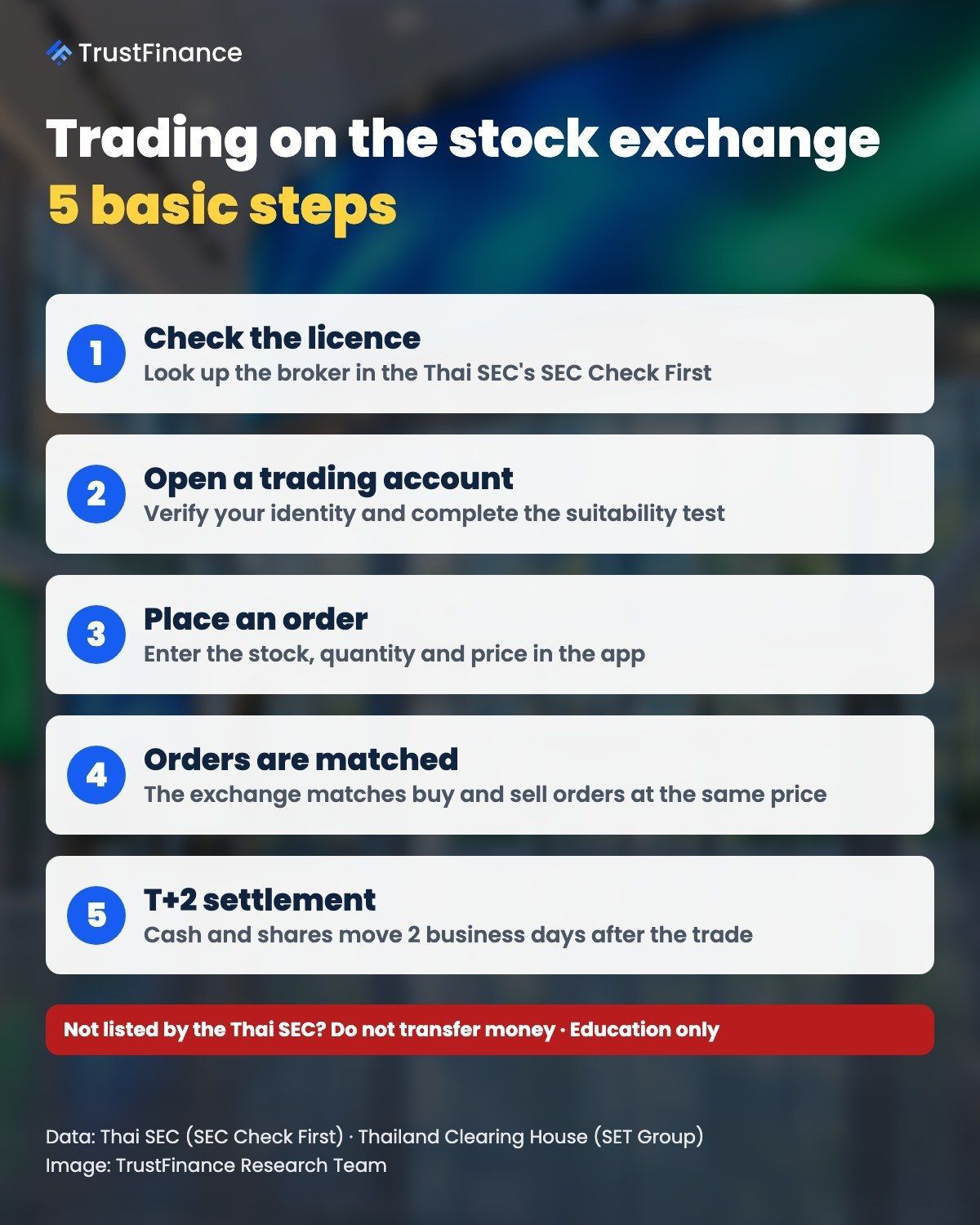
Stock trading is conducted through licensed securities companies, with price settlement and stock delivery occurring on the second business day after the trade (T+2).
Data Sources: SEC and Thailand Clearing House within the SET Group · Image: TrustFinance Research Team
Anyone claiming to facilitate Thai stock trading without a listing in the SEC system should not be trusted with money transfers, as such funds operate outside regulated channels and lack the protections outlined below.
The SET Index is a figure indicating whether the total market value of all common stocks has increased or decreased relative to the base date of April 30, 1975, which was set at an initial value of 100 points.
The basic formula is Today's Total Market Value x 100 divided by the Base Date Total Market Value. Assuming today's total market value is 14 times higher than the base date, the index will stand at around 1,400 points. The exchange adjusts the calculation baseline whenever capital increases or new listings occur to prevent the index from jumping due to those events.
The index reflects overall market direction, not whether individual stocks are good or bad. Evaluating individual businesses requires analyzing financial statements, such as Return on Equity (ROE), which shows how efficiently a company uses shareholders' equity to generate profit.
The primary protection is the Securities Investors Protection Fund (SIPF), which compensates investors if a member securities company fails to return clients' assets. It does not compensate for losses resulting from declining stock prices.
The primary risk is that stock prices may fall below purchase prices, and invested capital may not be fully recovered, regardless of how long the stock has been listed on the exchange.
Another frequently overlooked factor is purchasing power. Returns must be evaluated against inflation, which erodes the value of money every year, rather than looking solely at nominal profit figures in Baht.
This article is prepared for informational and educational purposes only and does not constitute investment advice or a solicitation to buy or sell securities, digital assets, or derivatives. Readers should study information and assess risks independently before making decisions. |
It opened for its first trading day on April 30, 1975, under the Stock Exchange of Thailand Act B.E. 2517 (1974).
They are closely related. While people generally use "stock market" interchangeably, a stock exchange trades more than just stocks, including ETFs, warrants, and DWs.
No, the stock exchange only trades on business days and closes on annual holidays announced in advance.
No, retail investors must trade through securities companies licensed by the SEC and holding membership with the exchange.
You may receive compensation from the Securities Investors Protection Fund (SIPF) based on actual damages up to 1 million Baht per member company, but this does not cover stock price losses.
A stock exchange is a central system enabling companies to raise capital and investors to trade securities transparently. In Thailand, this is the Stock Exchange of Thailand, operating since April 30, 1975, comprising the SET and mai markets alongside subsidiary TFEX, under SEC supervision.
Essential basics to know beforehand include verifying broker licenses via SEC Check First, the 30% daily price limit, and T+2 settlement. Investing carries risk, and investors should study information before making decisions.
Additional Data: Stock Exchange of Thailand (Trading Hours, Price Bands, and Tick Sizes), Thailand Clearing House (T+2 Equity Clearing Services), TFEX (FAQs), SEC (History of the SEC, Securities and Exchange Act B.E. 2535, SEC Check First)
Fact-checked by TrustFinance Research Team · Data as of November 20, 2026
Thanakit Sutto
Content & PR Lead at TrustFinance. A finance writer who makes investing easy to understand.