Loading
Related Articles

Fed Rate Hikes Are Back in 2026: What a Return to Tightening Means for the Dollar, Gold, and Traders
Related Articles
Fed Rate Hikes Are Back in 2026: What a Return to Tightening Means for the Dollar, Gold, and Traders

Thanakit Sutto
11月 23, 2026
16 min read
2

Social Security old-age benefit is the old-age fund paid by the Social Security Fund to insured persons when they reach the age of 55 and their insured status ends. It is divided into an old-age lump sum (lump sum) or an old-age pension (monthly) based on the number of months contributions were made.
The dividing line is 180 months or 15 years. Contributing less results in a one-time lump sum, while contributing the full amount grants a lifetime monthly pension (Social Security Office: Criteria and Conditions for Old-Age Cases)
Quick Summary
|
Social Security retirement money is an old-age benefit, one of the rights for insured persons who contribute to the Social Security Fund. This money is not paid every time you resign, but rather when age and status conditions are met.
Article 33 insured persons (formal employees) and Article 39 insured persons (former employees who continue making contributions themselves) use the same set of criteria. Article 40 (informal workers) has separate rules.
An old-age lump sum is a one-time payment, whereas an old-age pension is a monthly payment for life. The only dividing factor is whether contributions reached 180 months.
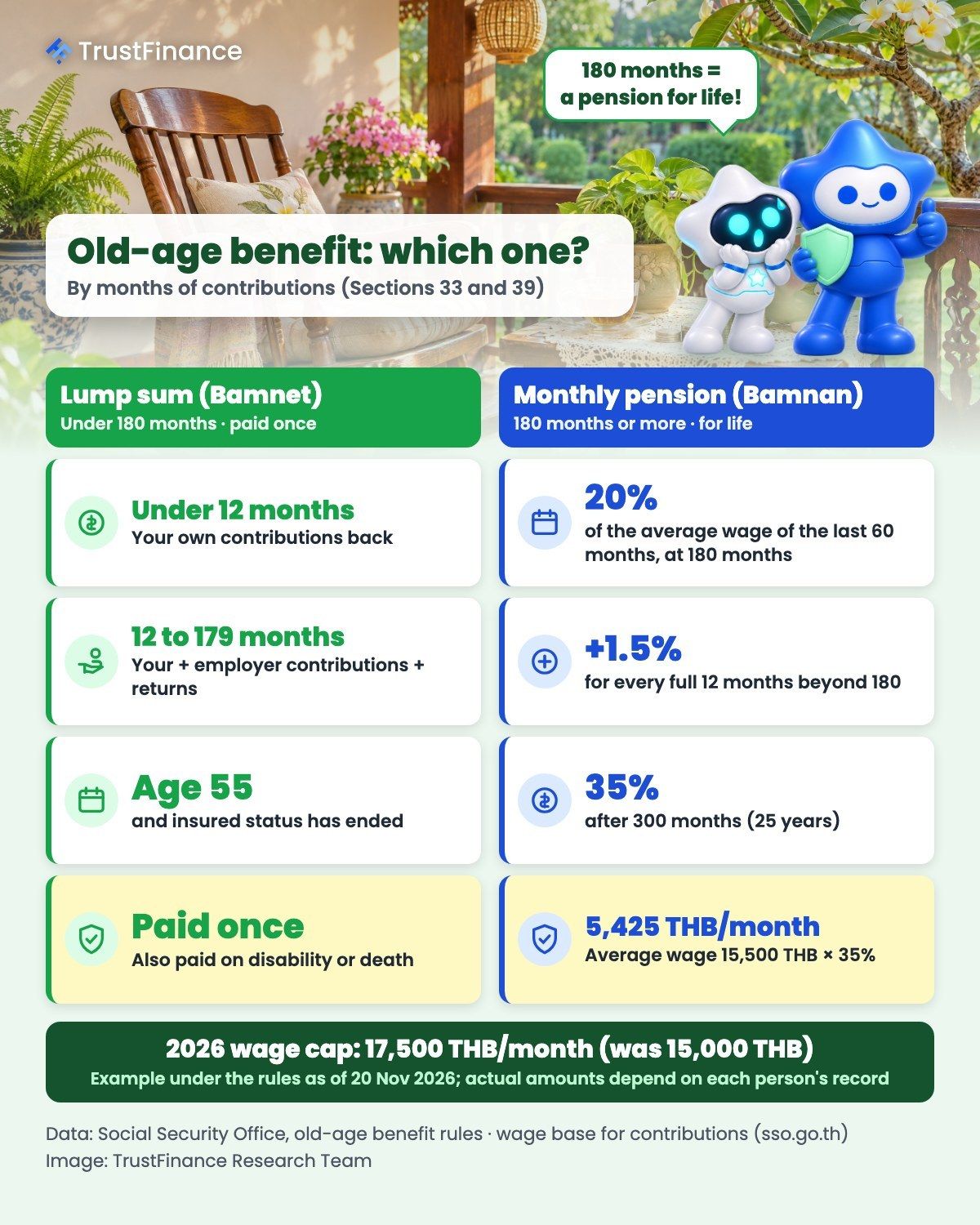
Contributing for less than 180 months grants a single lump sum; contributing for 180 months or more grants a lifetime monthly pension starting at 20% of the average wage of the last 60 months.
Source: Social Security Office Criteria and Conditions for Old-Age Cases · Image: TrustFinance Research Team
| Topic | Old-Age Lump Sum | Old-Age Pension |
|---|---|---|
| Contributions Made | Less than 180 months | 180 months or more |
| Payment Format | One-time lump sum | Monthly payment for life |
| Calculation Method | Less than 12 months: Equals insured person's contributions 12 months or more: Insured person's contributions + employer's contributions + returns according to announcements | 20% of the average wage of the last 60 months + 1.5% for every 12 months contributed beyond 180 months |
| Conditions to Receive | Age 55 and ended insured status, or disability, or death | Age 55 and ended insured status |
The pension is the same amount every month based on the formula calculated when payments begin. When goods prices rise, the purchasing power of that same amount decreases. This is explained in the What is Inflation article, which helps show why retirement planners shouldn't look at the pension figure alone.
The old-age pension is calculated from two figures: the pension rate based on the number of months contributed, and the average wage of the last 60 months before insured status ends.
Formula (Current Criteria): Monthly pension = Average wage of the last 60 months × Pension rate Pension rate: 20% when reaching 180 months, plus 1.5% for every 12 months contributed beyond 180 months. Average wage: Total wages used to calculate contributions for the last 60 months divided by 60 (each month not exceeding the ceiling of that period). |
This table shows pension rates by number of months compared to an average wage of 15,000 baht (previous ceiling) and 4,800 baht (Article 39 wage base).
| Contributions | Pension Rate | Average Wage 15,000 Baht | Average Wage 4,800 Baht |
|---|---|---|---|
| 180 months (15 years) | 20% | 3,000 baht/month | 960 baht/month |
| 240 months (20 years) | 27.5% | 4,125 baht/month | 1,320 baht/month |
| 300 months (25 years) | 35% | 5,250 baht/month | 1,680 baht/month |
| 360 months (30 years) | 42.5% | 6,375 baht/month | 2,040 baht/month |
| 420 months (35 years) | 50% | 7,500 baht/month | 2,400 baht/month |
Hypothesis: Article 33 insured person with wages higher than the ceiling throughout, total contributions of 300 months (25 years), age 55, and resigning at the end of December 2026. Average wage of the last 60 months: Jan 2025 to Dec 2028 (Note: translated context months adjusted for consistency if needed, keeping literal meaning) Jan 2022 to Dec 2025 for 48 months × 15,000 baht = 720,000 baht, and Jan to Dec 2026 for 12 months × 17,500 baht = 210,000 baht, total 930,000 baht ÷ 60 = 15,500 baht. Pension rate: Contributing 120 months beyond 180 months = 10 periods, 1.5% per period, getting 20% + 15% = 35%. Monthly pension: 15,500 × 35% = 5,425 baht per month (if the ceiling remained 15,000 baht for all 60 months, it would be 5,250 baht). This figure illustrates the calculation method according to criteria as of November 20, 2026. Actual amounts depend on each individual's contribution history. |
It can increase, but gradually. The Social Security Office set the minimum wage used for contribution calculations at 1,650 baht and not exceeding 17,500 baht starting January 1, 2026 (Social Security Office, sso.go.th).
When the wage base is higher, insured persons earning over 15,000 baht will contribute more. At a 5% rate, the maximum contribution will be 875 baht per month, up from the previous 750 baht.
News published during the announcement stated that the ceiling will be adjusted in steps: 17,500 baht (2026 to 2028), 20,000 baht (2029 to 2031), and 23,000 baht (from 2032 onwards). The next steps should be checked with Social Security Office announcements as those years approach.
Articles 33 and 39 receive lump sums or pensions according to the same formula, but their wage bases differ. Article 40 receives a lump sum at age 60 depending on the option chosen.

Articles 33 and 39 use the same lump sum and pension formula at age 55, while Article 40 Options 2 and 3 receive an old-age lump sum at age 60.
Source: Social Security Office (Old-Age Cases, Article 39 Insured Persons, Article 40 Benefits) · Image: TrustFinance Research Team
| Category | Who | Calculation Base | Old-Age Money Received |
|---|---|---|---|
| Article 33 | Employees in establishments | Actual wage 1,650 to 17,500 baht (2026) | Lump sum or pension upon reaching age 55 and ending status |
| Article 39 | Former Article 33 who contributed for 12 months or more and registered within 6 months after leaving work | 4,800 baht for everyone (contribution 432 baht/month) | Lump sum or pension, same formula as Article 33 |
| Article 40 Option 1 | Informal workers | According to selected option | No old-age coverage |
| Article 40 Option 2 | Informal workers | According to selected option | Lump sum of 50 baht per month contributed + additional savings + returns at age 60 |
| Article 40 Option 3 | Informal workers | According to selected option | Lump sum of 150 baht per month contributed + additional savings + returns, and an extra 10,000 baht if 180 months are completed |
Those who transition from Article 33 to Article 39 towards the end should know that the wage base for Article 39 is 4,800 baht. If the last 60 months are under Article 39, the average wage used to calculate the pension will decrease accordingly.
Article 40 insured persons in Options 2 and 3 can make additional savings contributions of no more than 1,000 baht per month. This savings portion and annual returns are included in the lump sum at age 60.
Not yet. As long as you are still an employee and making contributions, the right to receive old-age benefits occurs when you reach age 55 and your insured status ends simultaneously.
Those who continue working past age 55 can still make contributions as normal. The additional months contributed are added to the total count, which increases the pension rate for every 12 full months contributed beyond 180 months.
The expected pension is often insufficient for all post-retirement expenses, so many people save privately alongside it. A principle that helps understand how savings grow over a long period is compound interest and how to calculate it in Thai baht.
Common misconceptions mostly stem from reading only the numbers 55 years or 15 years without looking at other conditions that must be met simultaneously.
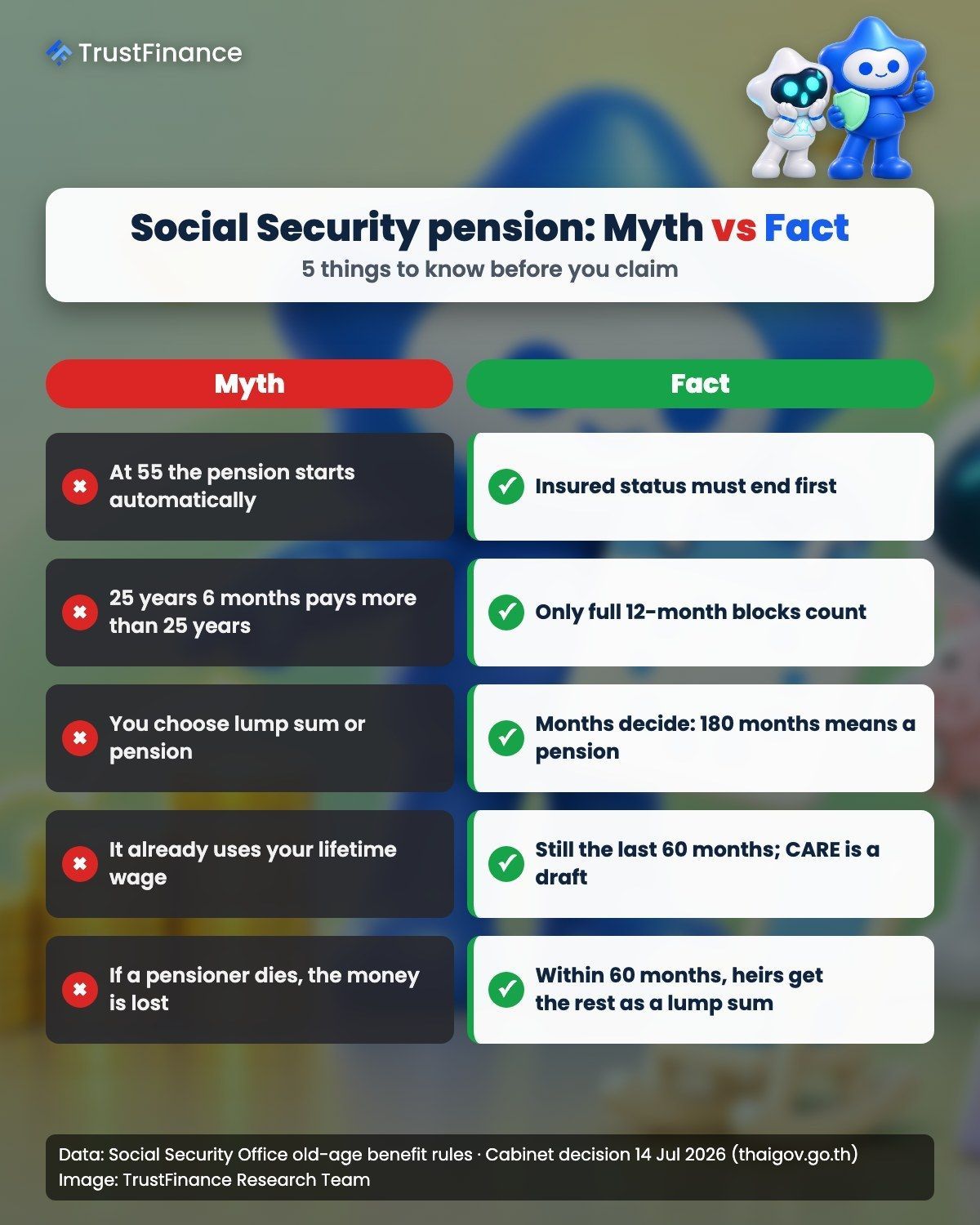
Reaching age 55 alone does not allow you to receive an old-age pension yet; insured status must end first, and amounts exceeding 180 months are counted in full 12-month increments.
Source: Social Security Office Criteria and Conditions for Old-Age Cases · Image: TrustFinance Research Team
File using the benefit claim form SSO. 2-01 along with a copy of the front page of your bank account book, or use PromptPay linked to your national ID number. File at any Social Security Office in Bangkok areas, provinces, or branches.
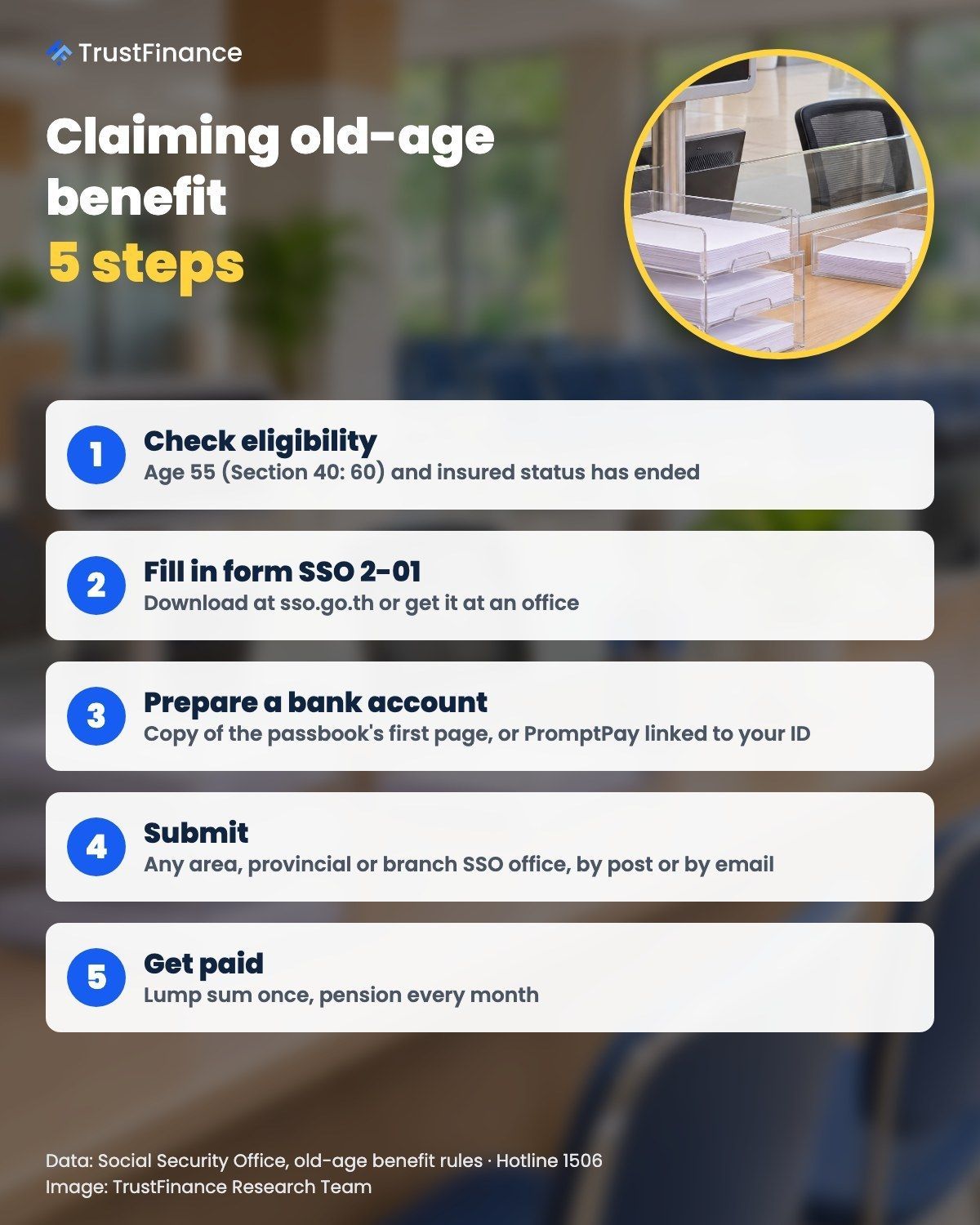
Claim old-age money using form SSO. 2-01 with a copy of your bank account book or PromptPay linked to your ID card at any Social Security Office.
Source: Social Security Office Criteria and Conditions for Old-Age Cases · Image: TrustFinance Research Team
In case a pension recipient passes away, heirs use a copy of the death certificate, ID cards and house registrations of the deceased and the claimant, marriage certificate and children's birth certificates (if any), and a designated beneficiary document (if any). Inquiries about amounts can be made via the Social Security hotline 1506.
It is not yet in effect as of November 20, 2026. The Cabinet approved in principle the draft ministerial regulation on old-age benefit payments on July 14, 2026 (Cabinet Resolution News, July 14, 2026).
TrustFinance has not found this announcement in the Royal Gazette as of the check date, so examples in this article use the existing last 60-month formula. When the ministerial regulation is published, the average wage calculation method will change, but the 180-month condition and age 55 requirement will still depend on the actually published version.
This article is prepared for informational and educational purposes only and is not personalized financial or retirement planning advice. Actual rights and amounts depend on each individual's contribution history. Readers should verify with the Social Security Office before making decisions. |
They receive an old-age lump sum if enrolled in Option 2 or 3: 50 or 150 baht per month according to the number of months contributed, plus additional savings and returns. Option 3 gets an extra 10,000 baht if 180 months are completed. Option 1 has no old-age money.
20% of the average wage of the last 60 months. For example, an average wage of 15,000 baht yields 3,000 baht per month, while Article 39 at the 4,800 baht base yields 960 baht per month.
No. According to current criteria, old-age money is paid upon reaching age 55 and ending insured status, except in cases of disability or death, which are paid as a lump sum.
If eligibility started from April 29, 2022 onwards and death occurs within 60 months, heirs receive a lump sum equal to the last monthly pension multiplied by the remaining months up to 60 months.
No. The new ceiling applies to contributions starting January 1, 2026, so it affects the average wage of those still making contributions during that period.
Social Security retirement money is divided into lump sums and pensions based on the number of months contributed. Contributing 180 months grants a pension of 20% of the average wage of the last 60 months, plus 1.5% for every 12 months contributed beyond that. A condition people often miss is that age 55 must come with the termination of insured status.
In 2026, there are two matters to follow: the 17,500 baht wage ceiling that is already in effect and the CARE formula which is still a draft. For personal savings used alongside pensions, view a comparison of interest rates and withdrawal conditions in the digital savings account comparison article.
Other supporting information: Social Security Office (Voluntarily Insured Article 39), Cabinet Office (Cabinet Resolution July 14, 2026 regarding the CARE formula ministerial regulation draft), news on stepped wage ceiling ministerial regulation announcements (Thairath, Prachachat Business December 2025).
Fact-checked by TrustFinance Research Team · Information as of November 20, 2026
Thanakit Sutto
Content & PR Lead at TrustFinance. A finance writer who makes investing easy to understand.