Loading
Related Articles
Fed Rate Hikes Are Back in 2026: What a Return to Tightening Means for the Dollar, Gold, and Traders
Fed Rate Hikes Are Back in 2026: What a Return to Tightening Means for the Dollar, Gold, and Traders
Related Articles

Thanakit Sutto
Nov 23, 2026
14 min read
0

Credit Bureau refers to the National Credit Bureau Co., Ltd. (NCB), the sole licensed credit reporting business in Thailand. It is responsible for collecting loan information and repayment history submitted monthly by member financial institutions.
The credit bureau does not approve or reject loans and does not maintain a "blacklist." What it does maintain is a factual credit report, which lenders use as one factor alongside your income and collateral (NCB: What is a credit report)
Quick Summary
|
Credit bureau is a general term for a credit reporting company. In Thailand, there is only one licensed entity: the National Credit Bureau (NCB).
Operating this business requires a license from the Minister of Finance and must comply with the Credit Bureau Business Act B.E. 2545 (2002) and its amendments, overseen by the Credit Data Protection Committee to protect data subjects' rights.
Credit data consists of two parts: identification information and loan/repayment history.
Mobile phone bills, water bills, and electricity bills are currently not required by law to have their payment history sent to the credit bureau.
Paying only the minimum amount on a credit card does not count as being overdue, but the remaining debt balance will stay high for a long time. Learn how to read balances and interest in Credit Card Minimum Payments: Understanding Balances and Interest.
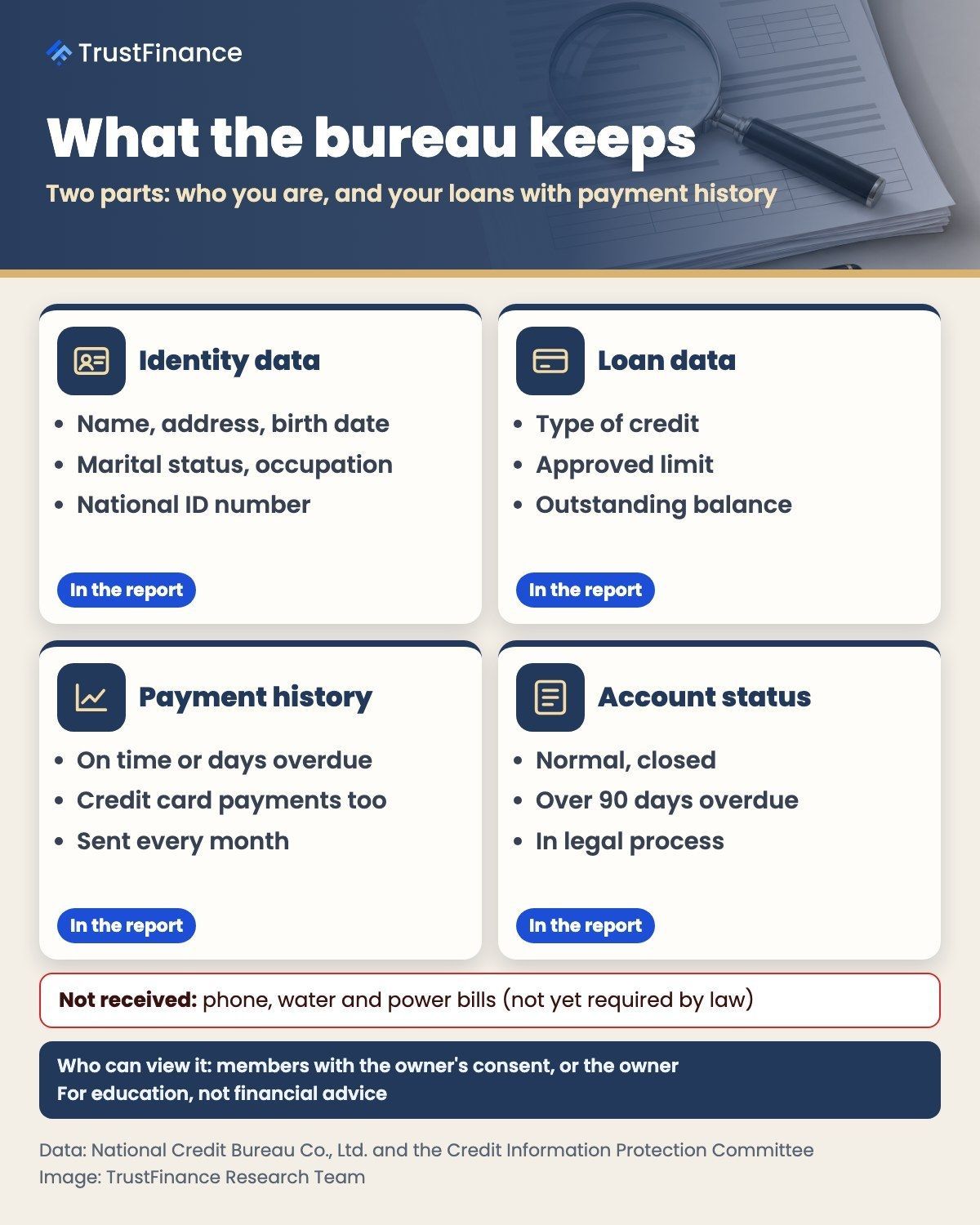
Credit data consists of two parts: identification data and loan/repayment history with account status. Phone, water, and electricity bills are not yet required by law to be reported.
Source: National Credit Bureau Co., Ltd. and Credit Data Protection Committee · Image: TrustFinance Research Team
The credit bureau only stores and reports data. The NCB explicitly states that it has no authority to approve or participate in lending decisions.
When applying for a loan, financial institutions must obtain the borrower's consent before pulling the report, using it as one factor alongside income, collateral, and internal criteria.
If a loan is denied due to credit report results, the financial institution must provide a written reason. The data subject can use this letter to request a free report from the NCB if submitted within 30 days of the date on the rejection letter.
Before applying for a loan, you should also understand how installment interest is calculated, as monthly debt obligations are a key factor reviewed by lenders. Compare the two calculation methods in Flat Rate vs. Effective Rate: What's the Difference?
Account status codes are 2-digit numbers indicating the condition of each account in the report. The system does not label anyone as having "bad debt"; it only shows days overdue and status codes.
| Code | NCB Definition |
|---|---|
| 10 | Normal, no overdue debt, or overdue by no more than 90 days. |
| 11 | Account closed, zero debt balance. |
| 20 | Overdue debt exceeding 90 days. |
| 21 | Overdue exceeding 90 days due to impacts from unusual circumstances. |
| 30 | Undergoing legal proceedings. |
| 42 | Debt transferred or sold to a corporate assignee. |
| 43 | Debt transferred/sold and fully settled. |
Source: NCB News 014/2565 and the status code correction page. Actual reports contain other codes; please read the explanations at the end of your own report.
Debt assignees that are not credit bureau members cannot report payment data into the system. Therefore, the data subject must submit a status code correction request in person at a credit inspection center.
Required documents include a status code correction request form, a debt settlement confirmation letter from the assignee, and a copy of your national ID card. The NCB will update the code from 42 to 43 within 30 days of receiving complete documents.
Debts closed directly with a member require no submission; lenders must report a zero balance and status 11 the following month.
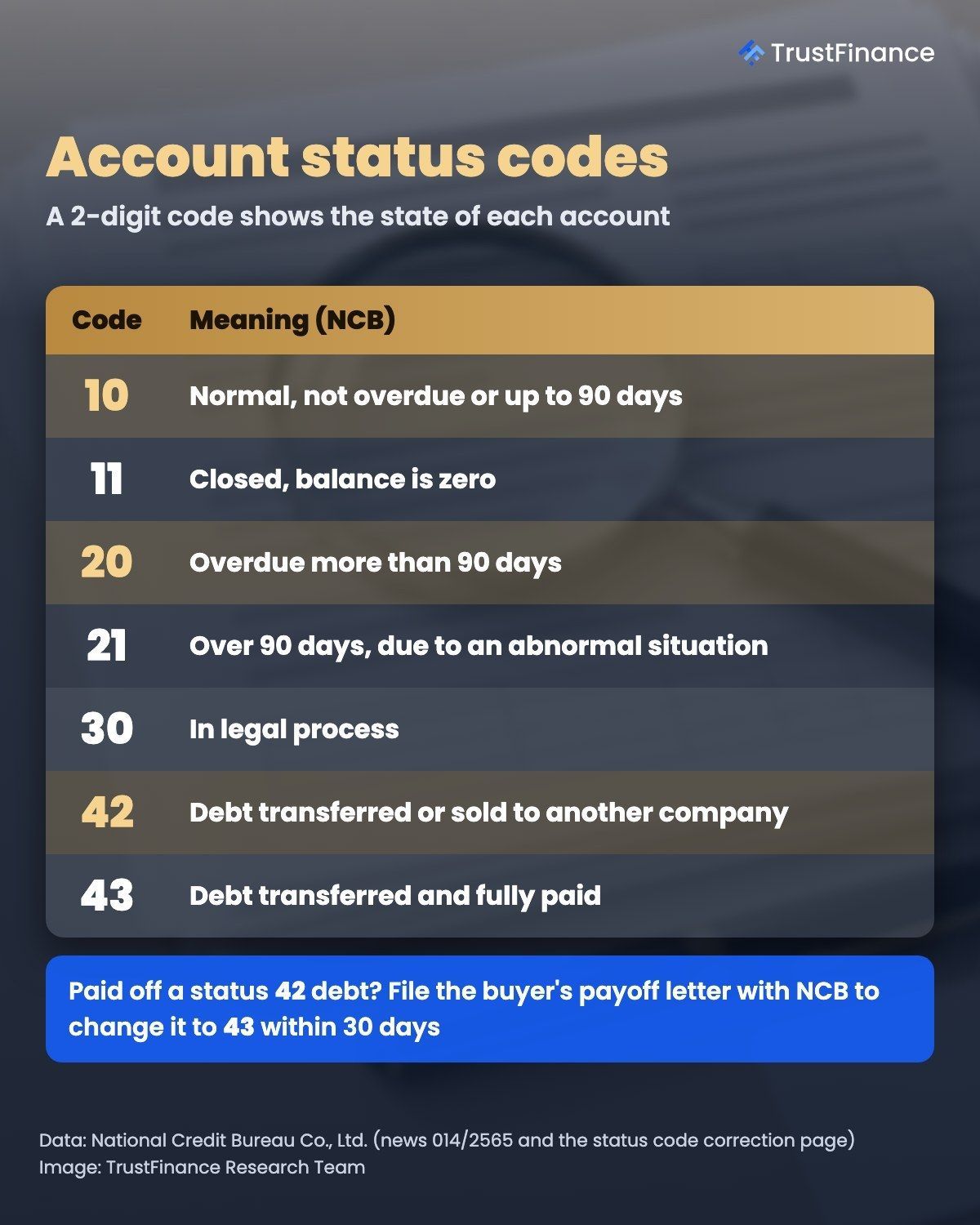
Status code 10 means a normal account overdue by no more than 90 days, code 20 means overdue over 90 days, and code 42 means debt transferred or sold to another legal entity.
Source: National Credit Bureau Co., Ltd. (News 014/2565 and status correction page) · Image: TrustFinance Research Team
The NCB retains data in its database for no more than 3 years from the date information is received from the financial institution. This 3-year period is counted from the account's latest data entry, not from the date default began.
Scenario: Personal loan with a 40,000 THB balance, overdue past 90 days in March 2026, showing code 20. Case A (Paid in full in October 2026): The lender submits an account closure update (code 11) in November 2026. Past delinquency history remains, and the account drops off the database 3 years after the final data entry—around November 2029. Case B (Never paid): The lender can continue reporting the overdue balance for up to 5 years (around March 2031), and the NCB can retain it for up to 3 more years. Thus, the account may remain visible until around March 2034. This is an example of maximum duration calculation; actual dates depend on the month of the final data submission. |
Overdue debt continues to accrue interest per the contract. Learn how balances grow exponentially from larger bases in Compound Interest Explained.
A credit score is a statistically calculated score generated by the NCB based on borrowing and repayment history to indicate the likelihood of default. Scores range from 300 to 900, categorized into levels from AA to HH.
| Score Range | Grade |
|---|---|
| 753-900 | AA (Lowest Risk) |
| 725-752 | BB |
| 699-724 | CC |
| 681-698 | DD |
| 666-680 | EE |
| 646-665 | FF |
| 616-645 | GG |
| 300-615 | Lowest range (Highest risk) |
Source: NCB Credit Scoring Infographic. Each lender sets its own criteria, so identical scores do not mean identical approval outcomes.
Factors identified by the NCB as affecting your score include:
You can check both a free summary and the full report. Checking your own credit is a fundamental right, and doing so has no impact on loan evaluations regardless of how often you check (NCB: Where to check credit data)
| Channel | What You Get | Fee and Time |
|---|---|---|
| Tang Rath App | Summary report, account count, credit limits, and total debt balance. | Free. For personal viewing only; cannot be used as official reference for third parties. |
| NCB Credit Inspection Center | Full credit bureau report. | 100 THB, ready in about 15 minutes. |
| NCB Credit Inspection Center | Credit scoring (credit score). | 200 THB. |
| Post Offices, counters, or ATMs of participating banks | Full report delivered by registered mail. | 150 THB within 7 business days. |
| Banking apps and other participating apps | Report and credit score sent via email as a file. | Varies by app; some deliver instantly, others within 24 hours or 3 business days. |
| Apply at NCB with a loan rejection letter | Full report. | Free if submitted within 30 days of the letter date (postal delivery costs 20 THB). |
Data as of November 20, 2026, from the NCB credit inspection channels page. Participating apps and branches are subject to change; check ncb.co.th before using the service.
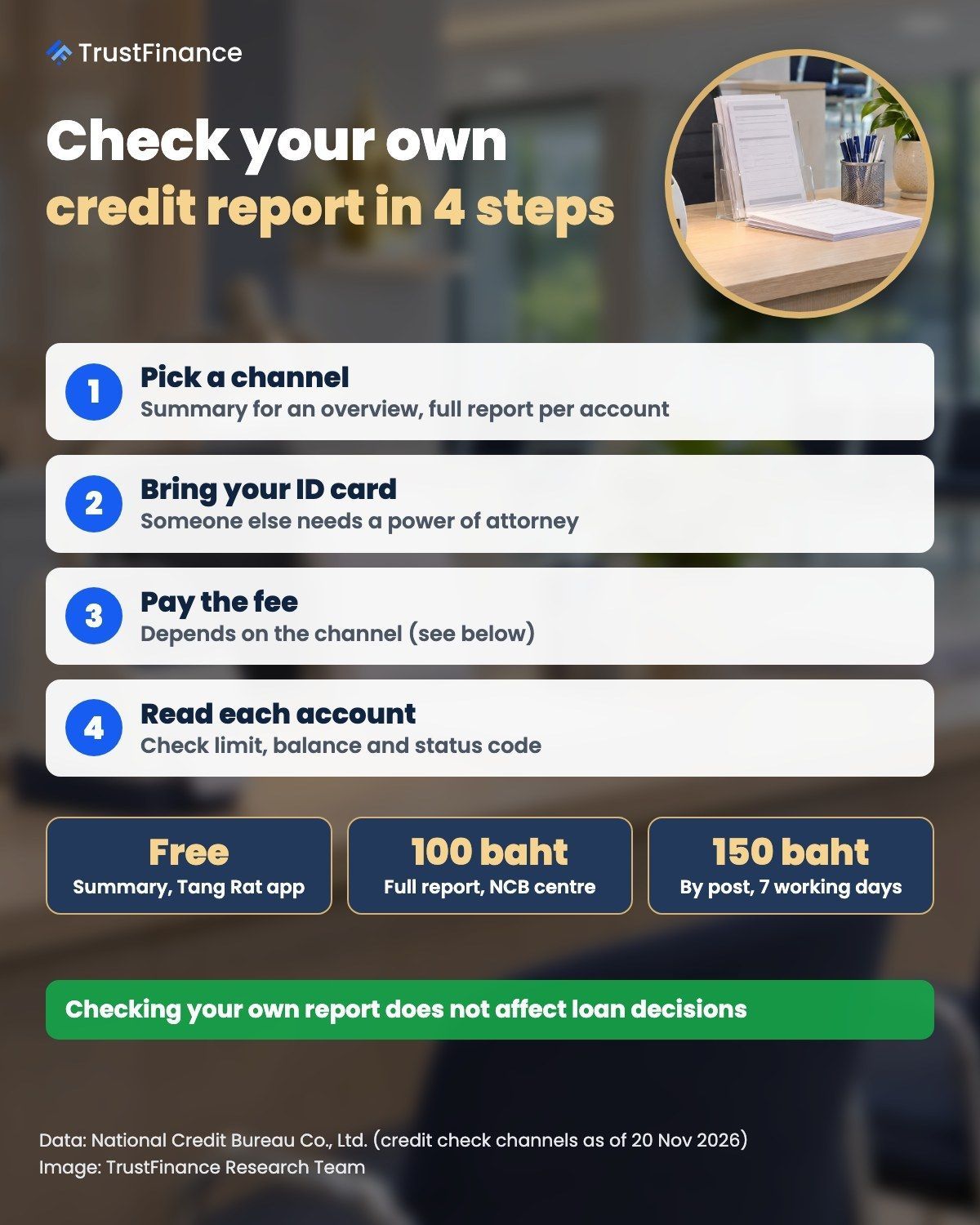
Summary reports are free via the Tang Rath app; full reports cost 100 THB at credit inspection centers, or 150 THB by mail within 7 business days.
Source: National Credit Bureau Co., Ltd. (Credit check channels as of Nov 20, 2026) · Image: TrustFinance Research Team
If data does not match reality, data subjects have the right to submit a review and correction request free of charge to both the financial institution holding the account and the NCB.
Crucially, if the data is accurate, neither the NCB nor lenders can delete or modify it prematurely (NCB: Investigation, correction, and dispute statement procedures, ncb.co.th).
The term "blacklisted" leads many to believe a literal blacklist exists. In reality, the report displays both positive history and overdue records.
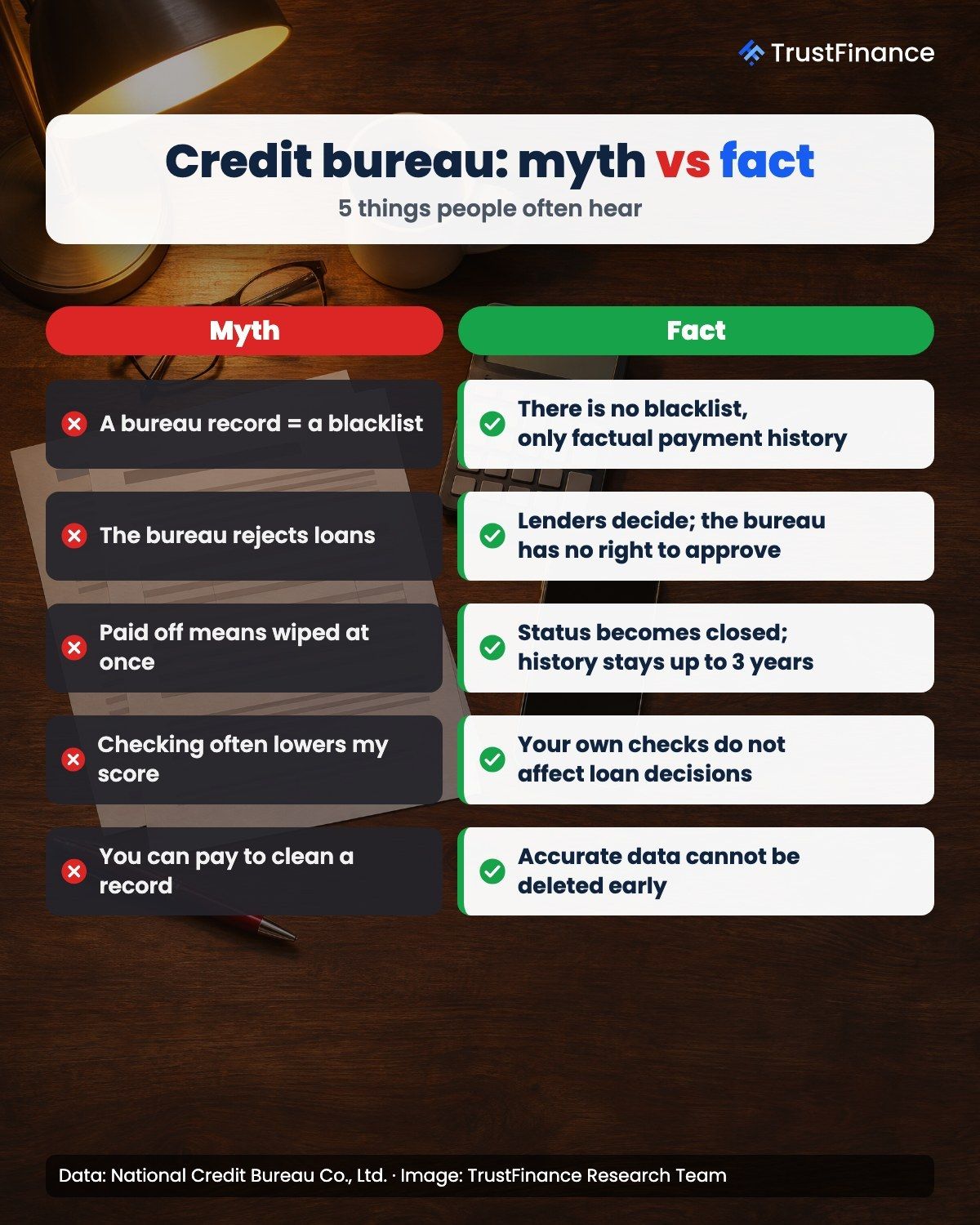
The credit bureau maintains no blacklist and has no loan approval authority. Reports show factual payment history, and checking your own credit does not affect loan assessments.
Source: National Credit Bureau Co., Ltd. · Image: TrustFinance Research Team
This article is provided for knowledge and educational purposes only and does not constitute financial advice or solicitation to use any credit services. Readers should review terms and conditions and check their own data before making decisions.
3 years from the date the NCB receives the final data entry for that account. If debt is overdue past 90 days and unpaid, lenders can report data for up to 5 more years before the 3-year clock starts.
It means the debt was transferred or sold to a corporate assignee. Once fully paid, take the confirmation letter from the assignee to the NCB to update your status to 43.
Yes. Summary reports are free via the Tang Rath app. If your loan is rejected due to credit report results, you can request a free full report within 30 days of the rejection letter date.
Yes. You can submit a request to the lender or NCB free of charge, with results provided within 30 days.
The Credit Bureau is the National Credit Bureau Co., Ltd., which stores credit histories submitted monthly by member financial institutions. It is not a loan approver and maintains no blacklist.
Data stays in the system for up to 3 years after the final entry. You can check your own summary report for free, or a full report for 100 to 150 THB, and correct erroneous data without fees.
Additional Information: National Credit Bureau Co., Ltd. (Credit check channels, status code correction, loan rejections, investigation and correction procedures, credit scoring, Tang Rath app)
Fact-checked by TrustFinance Research Team · Data as of November 20, 2026
Thanakit Sutto
Content & PR Lead at TrustFinance. A finance writer who makes investing easy to understand.