Loading
Related Articles

Fed Rate Hikes Are Back in 2026: What a Return to Tightening Means for the Dollar, Gold, and Traders
Related Articles
Fed Rate Hikes Are Back in 2026: What a Return to Tightening Means for the Dollar, Gold, and Traders

Thanakit Sutto
11月 23, 2026
14 min read
1
Economic Crisis refers to a severe economic downturn in a short period—such as a sharp currency depreciation, the collapse of financial institutions or businesses, and a contraction in production and employment—simultaneously impacting the income, debt, and savings of a large number of people.
Thailand experienced the Tom Yum Kung crisis in 1997 and was impacted by the global financial crisis in 2008. This article explains the mechanisms, types, warning signs, and lessons learned from those two events, without forecasting the future.
Executive Summary
|
An economic crisis is a period when the economic system loses its balance to the point where normal mechanisms cannot cope—capital outflows, frozen credit, business closures, and widespread job losses occurring in a short time.
On the other hand, an economic slowdown is slower growth, but growth nonetheless. If the production and income of the entire country contract continuously, it is called a Recession. The figure used to gauge the size of an economy is GDP; learn how to read these figures in What is GDP and How to Read Thailand's GDP Figures.
Two consecutive quarters of negative GDP is a simple rule of thumb, whereas the NBER (which determines US recession periods) looks at significant declines that are widespread across the system and last longer than a few months.
| Topic | Economic Slowdown | Recession | Economic Crisis |
|---|---|---|---|
| GDP | Still growing, but slower | Continuous contraction for several months | May contract sharply and rapidly |
| Financial System | Operating normally | Tightening credit | Banks or financial firms may fail |
| Impact on General Public | Slower income growth | Harder to find jobs | Job losses, bad debts, surging prices for certain goods |
Most economic crises are caused by excessive debt accumulation during seemingly prosperous times, followed by an event that shatters public confidence simultaneously. Debt that was once manageable suddenly becomes an overwhelming burden.
When the currency depreciates sharply, the prices of imported goods—such as oil and raw materials—also rise, causing the cost of living to follow suit. Understand the mechanisms behind rising product prices in What is Inflation.
They can be divided into 5 main categories based on where the problem originates. In reality, they often trigger one another in a chain reaction, such as a currency crisis causing companies that borrowed in dollars to face increased debt, eventually escalating into a banking crisis.
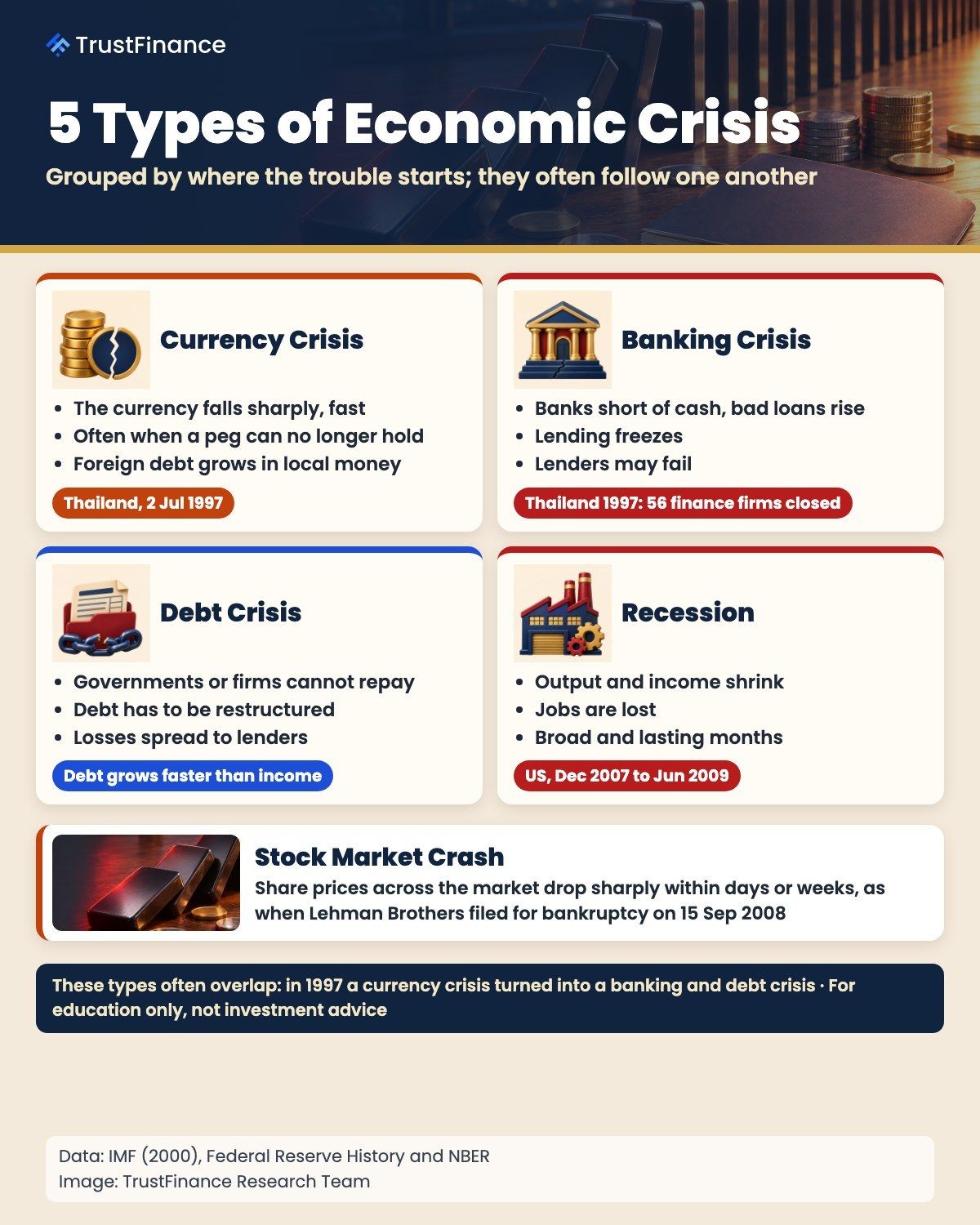
Economic crises are categorized into 5 main types based on their point of origin: currency, banking, debt, stock market, and recession, which often cascade into one another.
Data Sources: IMF and NBER (Recession Definition) · Image: TrustFinance Research Team
Economists typically look at imbalances that have accumulated over years, rather than daily news. These signs indicate that the system is fragile, but they do not predict exactly when a crisis will occur.
The presence of certain warning signs does not mean a crisis is imminent. Many countries exhibit such signs for years without experiencing a crisis.
The Tom Yum Kung crisis began on July 2, 1997, when Thailand abandoned the pegged exchange rate system for the baht and shifted to a managed float system after international reserves were depleted in defense of the currency.
Prior to that, Thailand maintained a fixed exchange rate, and the private sector borrowed heavily in foreign currencies. When the baht depreciated, the dollar-denominated debt of Thai companies surged immediately when converted into baht.
Source: IMF, Recovery from the Asian Crisis and the Role of the IMF (June 2000)
The 2008 crisis originated in the United States with widespread defaults on low-quality mortgage loans (subprime), rather than starting from the currency of a developing nation as in 1997.
US home prices fell by an average of about 30% between mid-2006 and mid-2009. Financial institutions holding mortgage-backed securities suffered heavy losses. The point of peak market panic occurred on September 15, 2008, when investment bank Lehman Brothers filed for bankruptcy.
| Topic | 1997 Tom Yum Kung Crisis | 2008 Global Financial Crisis |
|---|---|---|
| Origin | Thailand, then spreading to Asia | United States, then spreading globally |
| Key Date | July 2, 1997: Abandoned baht peg | Sept 15, 2008: Lehman Brothers files for bankruptcy |
| Main Cause | Short-term foreign debt, high deficits, currency peg | Low-quality mortgages, falling home prices |
| Crisis Type | Currency + Banking + Debt | Banking + Stock Market + Recession |
| Recorded Figures | 56 finance companies closed, total relief package of $17.2 billion USD | US recession Dec 2007 to June 2009, real GDP fell 4.3%, peak unemployment at 10% (Oct 2009) |
Source: IMF (1997 data) and Federal Reserve History (2008 data)
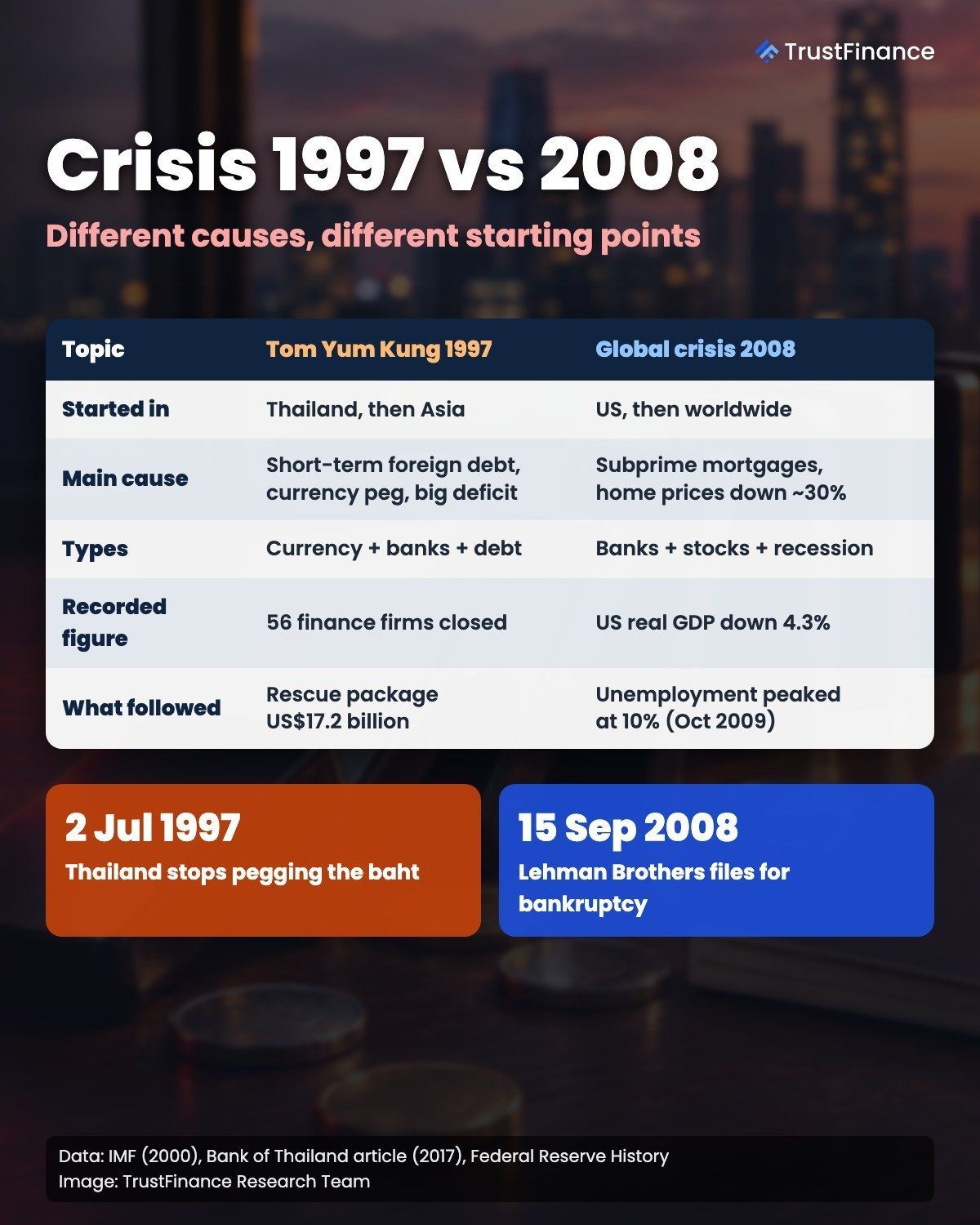
The Tom Yum Kung crisis began on July 2, 1997, when Thailand abandoned the baht peg, while the 2008 crisis reached panic mode when Lehman Brothers filed for bankruptcy on September 15, 2008.
Data Sources: IMF (2000), BOT, and Federal Reserve History · Image: TrustFinance Research Team
Economic crises impact households through 3 main channels: jobs and income, debt, and savings. These impacts usually lag behind financial market news by several months.
Regarding deposits, the Deposit Protection Agency protects up to 1 million baht per depositor per financial institution, combining all deposit accounts across all branches within the same institution (Deposit Protection Agency: Coverage Limit).
Five types of products are protected: current accounts, savings accounts, fixed deposits, certificates of deposit, and promissory notes issued against deposits. Foreign currency deposits, bills of exchange, corporate bonds, government bonds, mutual fund units, endowment insurance, e-Money, and cryptocurrencies are not covered.
Scenario: Mr. A has 700,000 baht in a savings account and 500,000 baht in a fixed deposit at Bank A, plus 300,000 baht in a savings account at Bank B. Bank A: 700,000 + 500,000 = 1,200,000 baht. 1,000,000 baht is protected, while the excess 200,000 baht is uninsured. Bank B: 300,000 baht is fully protected, as coverage is calculated per institution. Total: 1,300,000 baht is protected out of the 1,500,000 baht in deposits. This example illustrates the calculation method only; you should verify member institution lists and the latest conditions at dpa.or.th. |
These misconceptions lead people to make financial decisions out of panic.
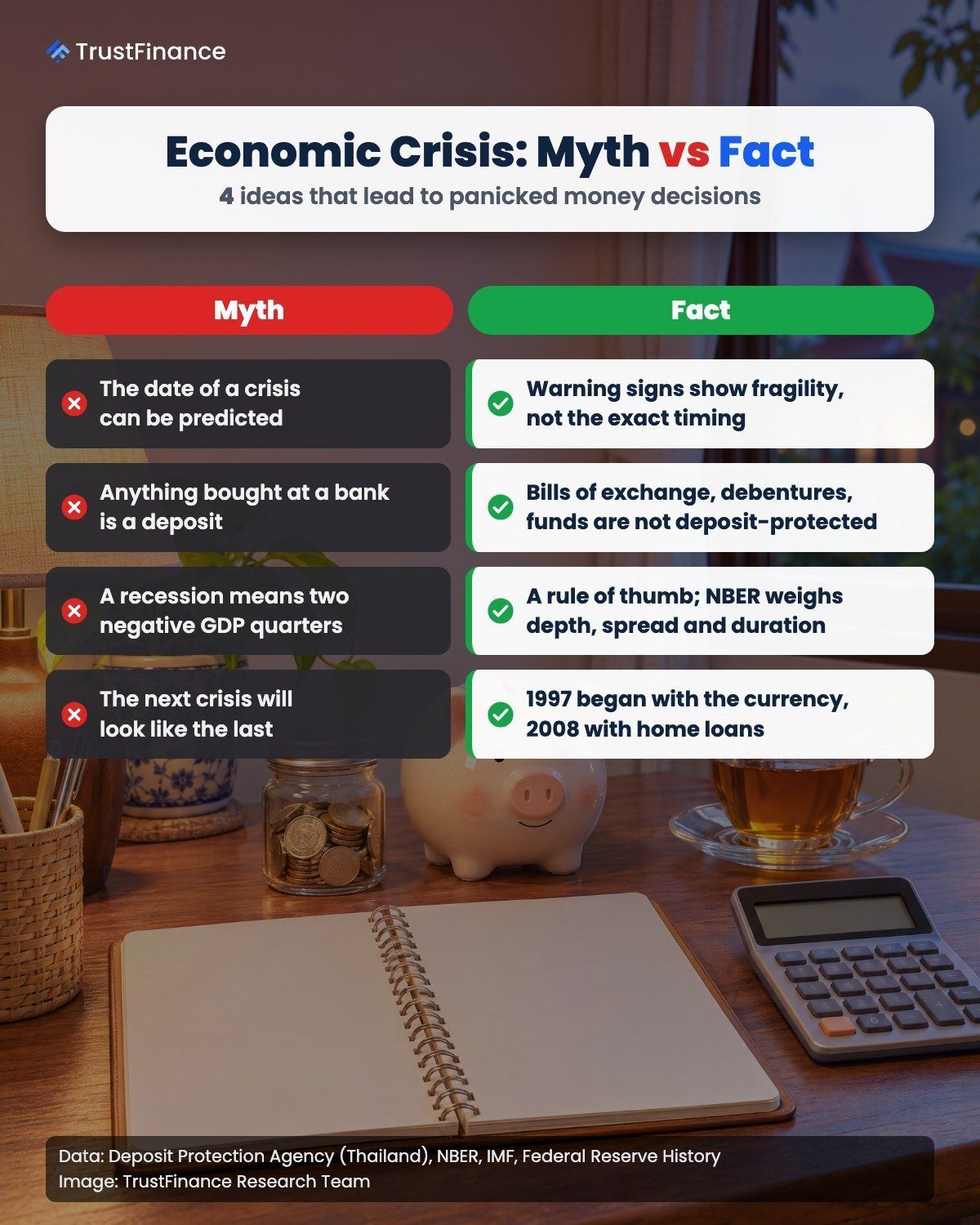
Bills of exchange, corporate bonds, mutual funds, and endowment insurance are not covered by deposit protection, and no signal can accurately predict the exact date of a crisis.
Data Sources: Deposit Protection Agency and NBER · Image: TrustFinance Research Team
The core principle is ensuring households can survive even if income is temporarily disrupted. The points below are general guidelines and are not tailored to any specific individual.
Formula: Emergency Savings = (Monthly Essential Expenses + Monthly Debt Payments) × 3 to 6 Example: Essential expenses of 15,000 baht + debt payments of 5,000 baht = total 20,000 baht per month. Emergency savings according to this rule would be 60,000 to 120,000 baht. This figure is a hypothetical case to explain the methodology; the ideal duration depends on job security and each family's obligations. |
Emergency savings must be quickly withdrawable and low in value volatility. Before choosing where to store them, understand the difference between bank deposits and money market funds, which do not carry deposit protection. Read details in How Money Market Funds Differ from Bank Deposits.
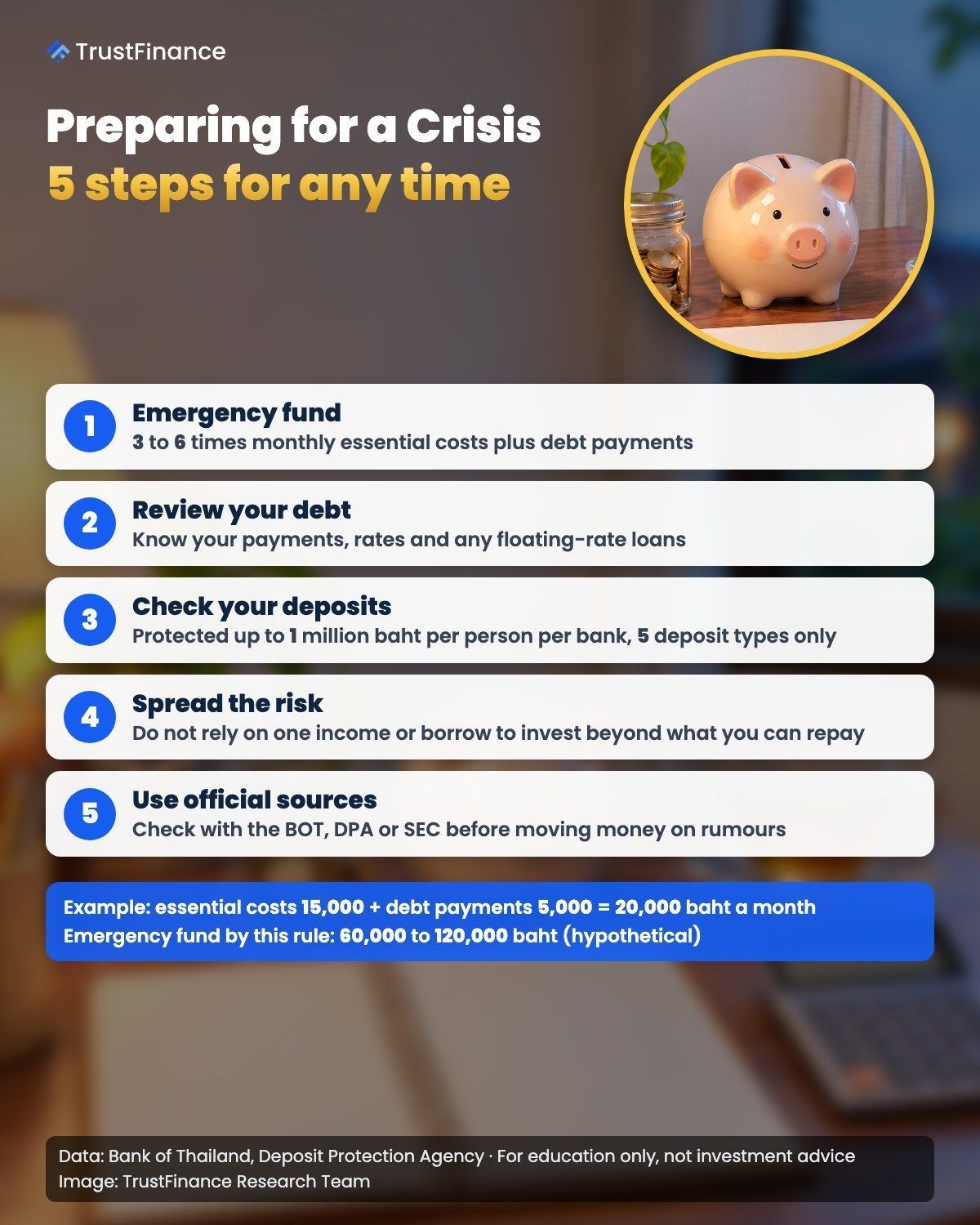
The BOT states that emergency savings should normally start at 3 to 6 times monthly essential expenses plus debt obligations, and deposits are protected up to 1 million baht per institution.
Data Sources: BOT (Reduce Risks, Increase Well-being) and Deposit Protection Agency · Image: TrustFinance Research Team
This article is prepared for informational and educational purposes only and does not constitute investment advice or a solicitation to buy or sell securities, digital assets, or derivatives. Readers should study the information and assess risks independently before making decisions.
On July 2, 1997, when Thailand abandoned the baht peg and shifted to a managed float system.
It was caused by widespread defaults on low-quality US mortgages, a roughly 30% drop in home prices, and Lehman Brothers filing for bankruptcy on September 15, 2008.
Up to 1 million baht per depositor per financial institution for baht deposits across 5 categories specified by the Deposit Protection Agency.
BOT articles state it should normally start at 3 to 6 times monthly essential expenses plus debt payments.
Not precisely. Warning signs indicate system vulnerability, but cannot specify the exact date and time a crisis will occur.
An economic crisis is a severe and rapid downturn, typically originating from debt accumulated during favorable economic times before confidence simultaneously collapses. In 1997, Thailand experienced a currency crisis that escalated into a banking crisis, whereas the 2008 crisis began with US mortgages.
Steps households can take include maintaining emergency savings, controlling debt, understanding which deposit types are protected, and verifying information with official sources prior to making decisions. This article provides educational information, not investment advice, and does not forecast future economic conditions.
Other Supplementary Information: IMF (Recovery from the Asian Crisis and the Role of the IMF, June 2000), Bank of Thailand ("Reduce Risks, Increase Well-being"), Deposit Protection Agency (Coverage Limit), Federal Reserve History (Support for Specific Institutions), and National Bureau of Economic Research (Business Cycle Dating)
Reviewed by TrustFinance Research Team · Data as of November 20, 2026
Thanakit Sutto
Content & PR Lead at TrustFinance. A finance writer who makes investing easy to understand.