Loading
Related Articles
Fed Rate Hikes Are Back in 2026: What a Return to Tightening Means for the Dollar, Gold, and Traders
Related Articles
Fed Rate Hikes Are Back in 2026: What a Return to Tightening Means for the Dollar, Gold, and Traders

Thanakit Sutto
Nov 23, 2026
17 min read
1

Corporate Bond is a debt instrument issued by private companies to borrow money from investors. Therefore, corporate bondholders hold the status of "creditors" of the company, not owners, and receive interest at a specified rate and schedule, along with the principal returned at maturity—provided the issuer is still able to fulfill its debt obligations.
The Thai Bond Market Association (ThaiBMA) explains that corporate bonds are classified as fixed-income instruments, and bondholders have a prior claim over common shareholders if the company encounters financial difficulties (ThaiBMA: Understanding Fixed Income)
Quick Summary
|
A corporate bond (or debenture) is a loan agreement split into small units so that multiple investors can purchase them.
Despite having the word "bond" in Thai (หุ้นกู้ - literally meaning "share-debt"), buying one does not make you an owner of the company. Corporate bond buyers do not have voting rights like shareholders, nor do they receive a share of profits when the company performs exceptionally well. What they receive is the agreed-upon interest.
Terms you will encounter in all corporate bond prospectuses, according to ThaiBMA definitions:
Corporate bonds operate like a time-bound loan: investors pay the money on day one, receive periodic interest payments, and get the lump-sum principal back on the maturity date.
Interest per period is calculated by multiplying the par value by the interest rate, then dividing by the number of payment periods per year. The payment schedule is set in the terms of each specific issue, such as every 3 months or every 6 months.
Formula: Interest per period = Par Value × Annual Interest Rate ÷ Number of Periods per Year Example (Hypothetical figures): Buying 100 units at 1,000 THB per unit, totaling 100,000 THB, with 4% annual interest, paid every 6 months, for a 3-year term. Interest per period = 100,000 × 4% ÷ 2 = 2,000 THB 15% Withholding Tax = 300 THB, leaving a net amount received per period of 1,700 THB, or 3,400 THB per year. Over 3 years, you receive 6 interest payments totaling 12,000 THB before tax. After deducting 1,800 THB in tax, you net 10,200 THB, plus the return of your 100,000 THB principal. |
This scenario only holds true if the company makes every single payment in full. If the company defaults, investors may receive incomplete interest payments, delayed principal repayment, or less than the full principal amount.
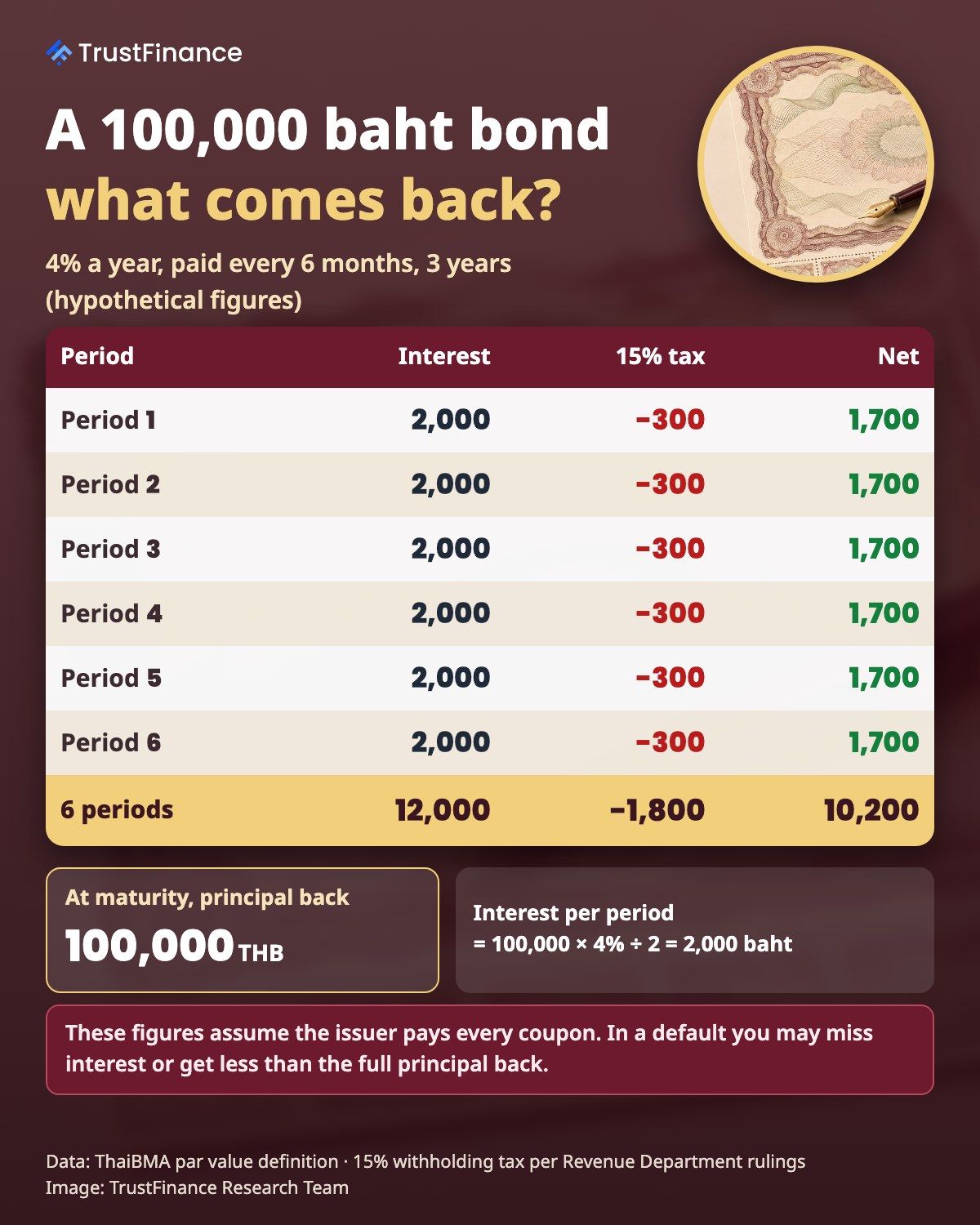
Holding 100,000 THB in corporate bonds at 4% annual interest, paid every 6 months for 3 years, yields total interest of 12,000 THB. After a 15% tax deduction, you receive 10,200 THB net, plus the return of principal (Hypothetical figures)
Data sources: ThaiBMA par value definition and 15% withholding tax per Revenue Department ruling · Image: TrustFinance Research Team
Corporate bond interest is paid out periodically and does not compound automatically. If you want to see how reinvesting interest changes the outcome, read the calculation method in What is Compound Interest? Calculation Formulas and Baht Examples
Corporate bonds are fixed-income assets, belonging to the same category as government bonds and promissory notes, unlike stocks which are equities.
Within corporate bonds themselves, they can be further categorized based on holder rights, which directly affects the likelihood of recovering your money if the company runs into trouble.

The fewer rights a holder has, the lower the chance of recovering funds if the company encounters problems; hence, higher interest rates usually come with higher risks.
Data source: Thai Bond Market Association (ThaiBMA): Understanding Fixed Income · Image: TrustFinance Research Team
For complex bonds—such as subordinated, perpetual, or specially conditioned bonds—you should thoroughly read the terms and conditions beforehand, because higher yields typically stem from fewer protections.
Some issues are offered exclusively to institutional or high-net-worth investors as defined by the SEC, rather than general retail investors. Distributors will specify this in the prospectus for that particular issue.
Look at the letters assigned by credit rating agencies. The higher the rating, the lower the default risk. The critical dividing line is BBB-.
ThaiBMA notes that the SEC requires private debt securities offered to the general public to be credit-rated (ThaiBMA: Investment Risks, thaibma.or.th). Ratings can fluctuate during the bond's lifespan, so you must also examine the rating date and outlook.
Credit ratings are the exact criteria bond funds use to select bonds for their portfolios. To learn how funds weigh credit ratings alongside instrument duration, read Duration and Credit Quality of Bond Funds
They differ in investor status, source of returns, and principal protection. This table compares 4 options that Thai investors most frequently weigh against each other.
| Topic | Corporate Bond | Stock | Bank Deposit | Government Bond |
|---|---|---|---|---|
| Investor Status | Company Creditor | Company Owner | Bank Depositor | Government Creditor |
| Returns | Contractual Interest | Dividends & Capital Gains (Uncertain) | Deposit Interest | Contractual Interest |
| Repayment Priority Upon Issuer Distress | Ahead of Shareholders | Last Priority | Protected up to DPA Limits | Government-backed Issuer |
| Protected by Deposit Protection Agency | Not Protected | Not Protected | Protected up to 1 Million THB per depositor per financial institution | Not Protected |
| Main Risks | Issuer Default, Difficult to Resell | Price Volatility, Potential Principal Loss | Interest May Fall Below Inflation | Price Fluctuates with Market Interest Rates if Sold Before Maturity |
Deposit protection information: The Deposit Protection Agency (DPA) covers 5 account types: current, savings, fixed, negotiable certificates of deposit, and certificates of deposit, while explicitly stating that investments in government bonds, corporate bonds, and mutual funds are not protected (DPA: Protected Financial Products and DPA coverage limits page dpa.or.th, as of November 19, 2026)
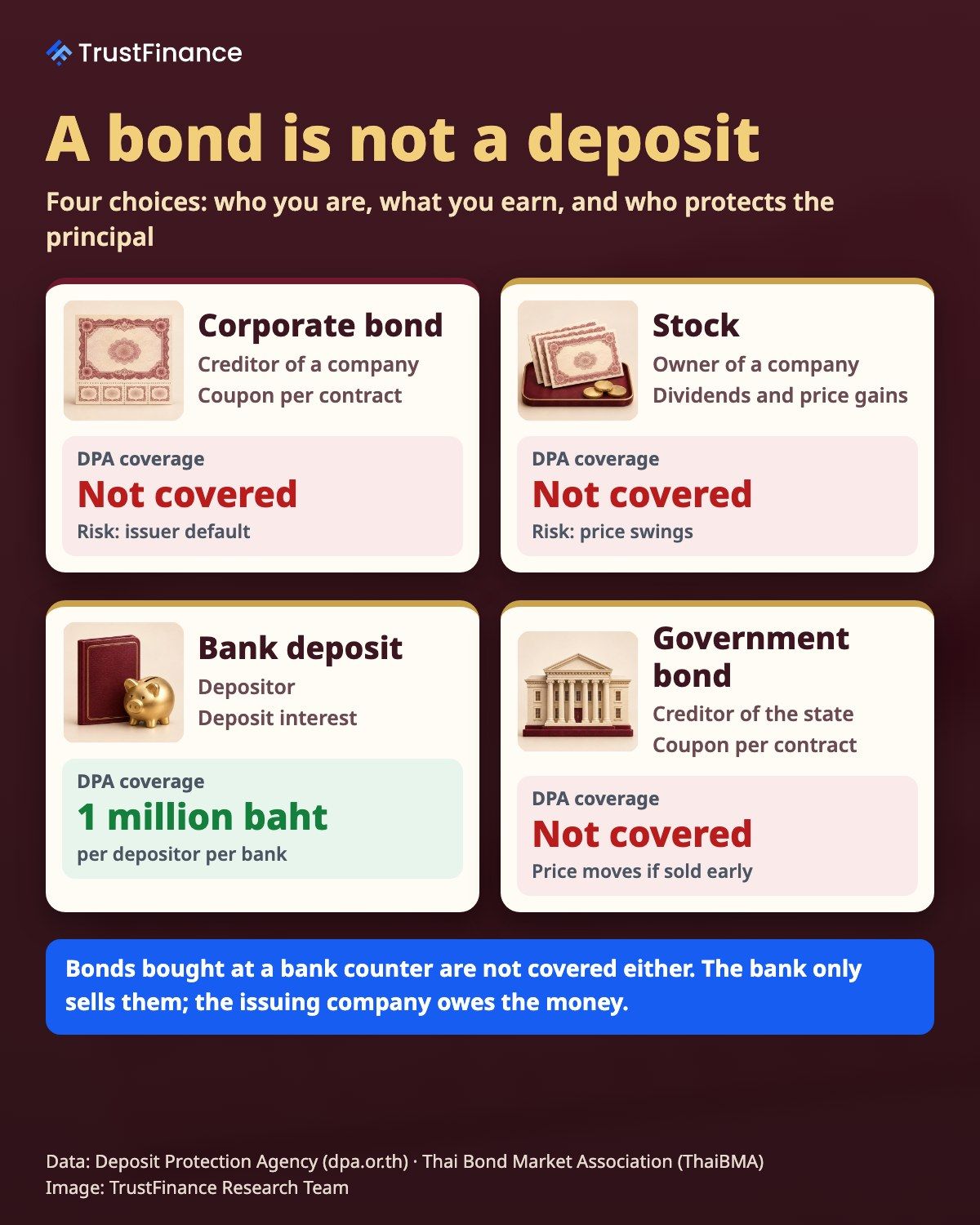
Among these four options, only bank deposits are protected by the DPA up to 1 million THB per depositor per institution. Corporate bonds receive no such protection, even when purchased through a bank.
Data sources: Deposit Protection Agency (dpa.or.th) and Thai Bond Market Association (ThaiBMA) · Image: TrustFinance Research Team
This point is critical for corporate bonds sold over bank counters. Some buyers mistakenly believe they are a form of deposit. In reality, the bank acts merely as a distributor, while the obligation to repay rests entirely with the issuing company.
Those seeking short-term cash parking options similar to deposits often compare corporate bonds with money market funds. The differences between these two are summarized in Money Market Funds, Risks, and Differences from Deposits
There is no single answer that fits everyone. Corporate bonds in 2026 are like any other year—each issue carries a different risk profile. The question you should ask is, "Is this specific issue suitable for this sum of my money?" rather than "Are bonds worth buying overall?"
This article does not recommend individual bonds or rank which ones are best. Therefore, this section outlines only the criteria you can use to make your own decision.
A bond's interest rate is the price of its risk. Issues offering yields far above the market average usually have underlying reasons, such as low credit ratings or conditions unfavorable to holders.
Corporate bonds carry 5 primary risks, with default risk having the most severe impact on retail investors. The definitions below reference ThaiBMA's investment risk and glossary pages.
This article does not name any specific issuers. Current bondholders should closely track announcements directly from the issuer and the bondholder representative for that specific series, and verify issue details via the ThaiBMA system.
Corporate bonds can be purchased in two ways: in the primary market during public offerings via distributors, and in the secondary market through commercial banks or SEC-licensed securities companies.
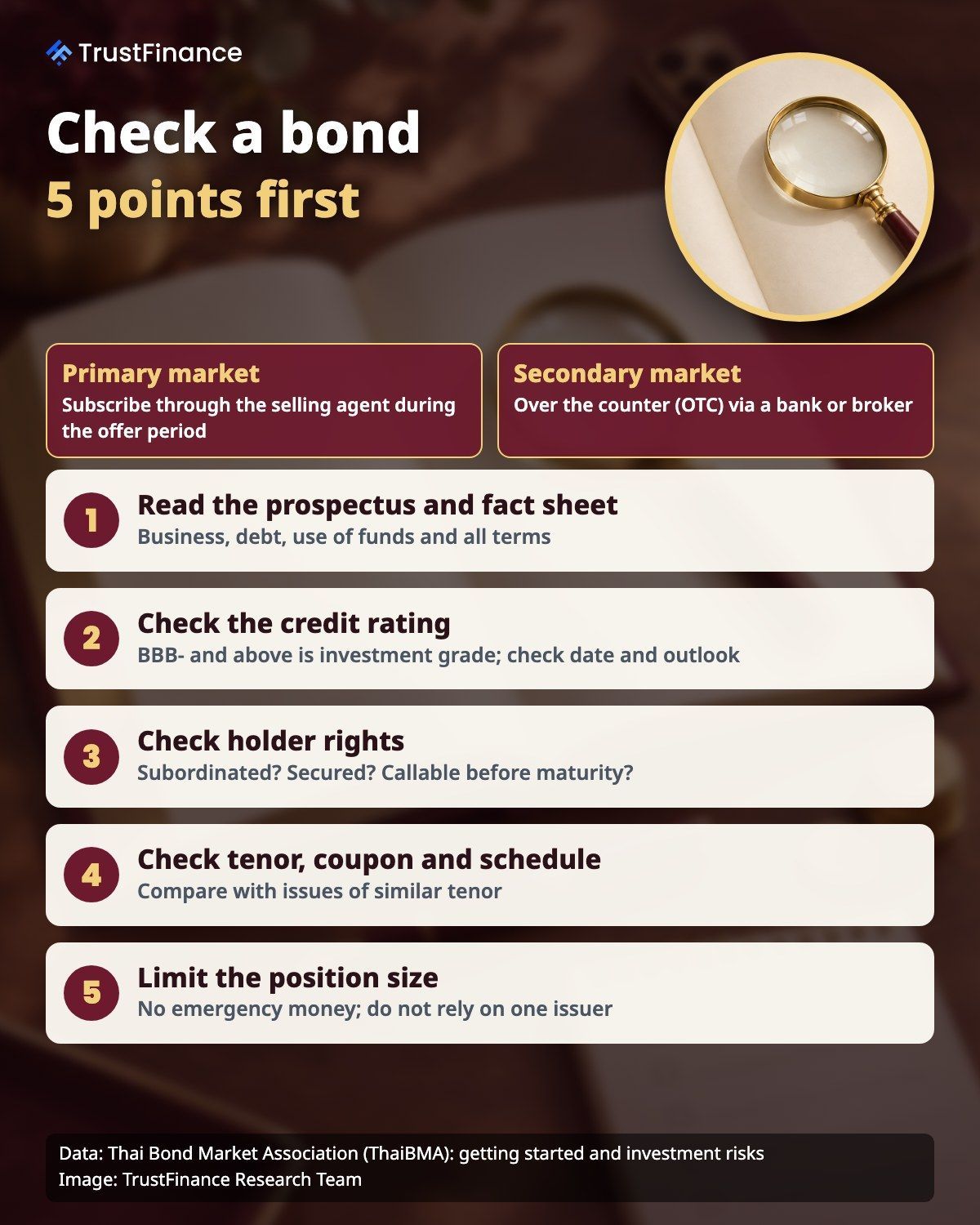
Corporate bonds can be bought in two ways: subscribing in the primary market during openings, or trading over-the-counter in the secondary market. Before buying, check 5 key points starting with the prospectus and credit rating.
Data sources: Thai Bond Market Association (ThaiBMA): Getting Started and Investment Risks · Image: TrustFinance Research Team
New corporate bonds can be subscribed to through financial institutions acting as distributors for that specific issue, either at branches or via Mobile Banking strictly during the subscription window (ThaiBMA: Getting Started, thaibma.or.th)
The secondary market for corporate bonds operates over-the-counter (OTC) without a central exchange board like stocks. Prices are negotiated between buyers and sellers through banks or securities companies. Reference prices can be checked on ThaiBMA's debt instrument pricing page (thaibma.or.th)
If you want fixed-income exposure but prefer not to select individual issues yourself, bond mutual funds or bond ETFs offer another way to diversify across multiple issuers. ETF mechanics along with their pros and cons are explained in What is an ETF Fund and Why Do Investors Use Them?
Corporate bond interest received by individuals is subject to a 15% withholding tax at the source, and taxpayers can choose whether to let it stop at 15% or include it in their annual tax calculations.
The official rulings cited above are case-specific interpretations issued prior to 2026. Tax regulations may change, so you should re-verify with the Revenue Department before filing taxes.
Taking the example from the previous section: 4,000 THB in annual interest has 600 THB withheld. If excluded from calculation, the tax liability for this interest ends at 600 THB (hypothetical figure).
Not everyone should avoid them, but corporate bonds are unsuitable for those who may need cash before maturity, cannot tolerate principal loss, or choose issues based solely on high yields without checking credit ratings. This is because corporate bonds lack deposit-style protection and issuers can default.
It depends on the issue. Most debt instruments have a par value of 1,000 THB per unit, but the minimum subscription requirement for each series is determined by the issuer and distributor and can be found in the prospectus.
It is called "หุ้นกู้" (Hun Ku), referring to debt instruments issued by private companies, distinct from Government Bonds (พันธบัตรรัฐบาล) issued by the public sector.
Yes. If the issuer defaults on debt payments, you may not get your money back in full. Additionally, if you sell before maturity during periods of rising market interest rates, your selling price may fall below your purchase price.
No. The DPA explicitly states that investments in corporate bonds do not receive protection, even when purchased through a bank, because the bank acts merely as a distributor, not the issuer.
Not necessarily. Interest has already had 15% withheld and can be excluded from total calculation. However, if your tax bracket is below 15%, including it in your calculation could yield a tax refund.
A corporate bond represents a loan to a private company where the holder acts as a creditor, receiving periodic interest and principal repayment at maturity, provided the issuer remains solvent.
Before purchasing any corporate bond, review its credit rating, holder rights, and your actual holding horizon. Keep in mind that interest is subject to a 15% withholding tax, and corporate bonds are not covered by DPA protection.
This article is prepared for educational and informational purposes only and does not constitute investment advice or a solicitation to buy or sell securities. Readers should study the information and assess risks independently before making decisions.
Additional Supporting Information: ThaiBMA: Understanding Fixed Income, Getting Started, Debt Instrument Pricing, Debt Instrument Database, and Glossary (thaibma.or.th) · Deposit Protection Agency: Protected Products and 1 Million THB Coverage Limit (dpa.or.th) · Interest and Tax Examples: TrustFinance Research Team calculated from hypothetical figures
Fact-checked by TrustFinance Research Team · Data as of November 19, 2026
Thanakit Sutto
Content & PR Lead at TrustFinance. A finance writer who makes investing easy to understand.