Loading
Related Articles
Fed Rate Hikes Are Back in 2026: What a Return to Tightening Means for the Dollar, Gold, and Traders
Related Articles
Fed Rate Hikes Are Back in 2026: What a Return to Tightening Means for the Dollar, Gold, and Traders

TrustFinance
Nov 13, 2026
19 min read
15

Try exchanging just one US dollar. In Iranian rials you would get about 1,674,550 rials, but in Japanese yen only about 157.53 yen. Even one Thai baht (THB) buys about 49,608 rials yet only about 4.67 yen (calculated from ExchangeRate-API rates as of 2 November 2026). The numbers are ten thousand times apart, but nobody says Japan is poorer than Thailand because one yen is worth less than one baht.
This is where people searching for the lowest value currency in the world often get confused. "Cheap" here means that one unit of the currency is worth very little against the US dollar. It does not mean the country's economy has collapsed, and it does not always mean that things will be cheap when you travel there.
This article lists the currencies with the lowest value per unit, with the date and source of every figure. It explains why some currencies have such small units, walks through three real cases, and shows what it means for anyone planning to travel to these countries or thinking about trading these currency pairs.
Quick summary
|
When people say a currency is "cheap", they usually mean that one unit buys very few dollars, or, the other way round, that 1 US dollar buys tens of thousands or even millions of units of that currency. This is a pure "price per unit" measure.
The problem is that this number depends on how large or small each country set its currency unit in the first place. If Thailand one day removed three zeros, so that 1 new baht equaled 1,000 old baht, the price per unit of the baht would jump overnight, even though nothing at all had changed in the economy.
A strong, or strengthening, currency is one that gains value against another currency over a period of time. For example, if 1 US dollar used to buy 36 baht and now buys 33 baht, the baht has strengthened. A weakening currency is the opposite case: you need more of that currency to buy the same amount of another currency.
To see whether the US dollar is strong or weak against a whole basket of major currencies, markets use the Dollar Index. It shows direction, not price per unit.
Think of it this way: price per unit is like a still photo taken on one day, while strengthening or weakening is like a video that shows how that picture changes. A currency with a very small unit can still strengthen in a given year, and a currency with a large unit can weaken sharply.
So the weakest currency in the world and the lowest value currency in the world do not have to be the same currency. The first should be judged by the percentage it has fallen over a set period. The second is judged by the number of units per US dollar on a given day. This article uses the second meaning.
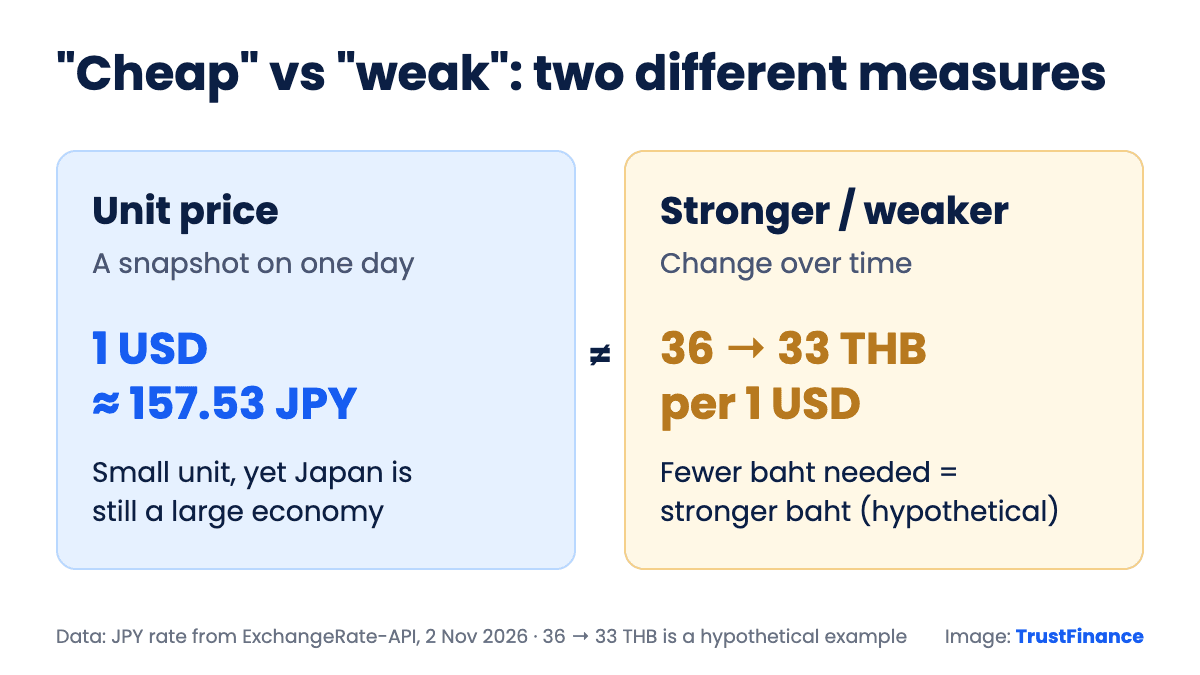
Image: Unit price and currency strength measure different things (36 → 33 baht is a hypothetical example) · Source: yen rate from ExchangeRate-API, data as of 2 Nov 2026
The figures below come from ExchangeRate-API, last updated on 2 November 2026 at 00:02 UTC. They are mid-market reference rates, not the rates a money changer or bank will actually give you. The per-baht column is calculated from the rate of 1 US dollar ≈ 33.76 baht from the same source on the same day.
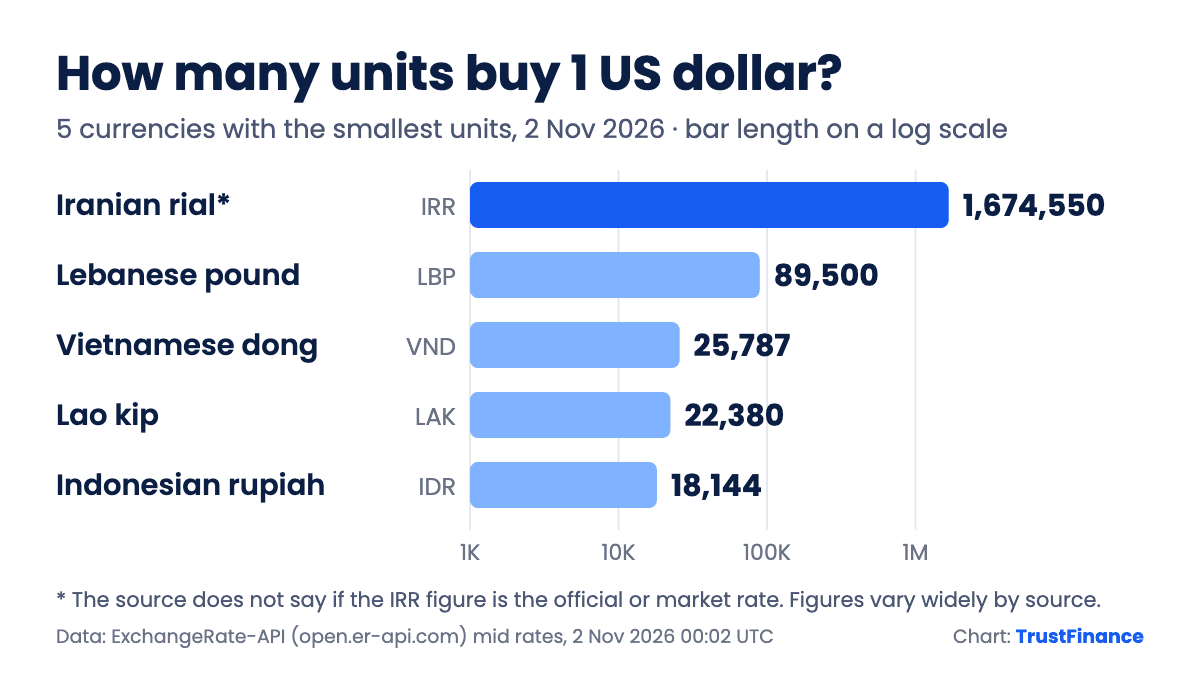
Image: The 5 currencies that need the most units to buy 1 US dollar (log scale). The source does not say whether the IRR figure is the official or the market rate · Source: ExchangeRate-API mid rates as of 2 Nov 2026, 00:02 UTC
| Rank | Currency (code) | Units per 1 USD | Units per 1 THB | Notes |
|---|---|---|---|---|
| 1 | Iranian rial (IRR) | ≈ 1,674,550 | ≈ 49,608 | Has both an official rate and a free-market rate; figures differ by source |
| 2 | Lebanese pound (LBP) | 89,500 | ≈ 2,651 | Single reference rate set by the central bank |
| 3 | Vietnamese dong (VND) | ≈ 25,787 | ≈ 764 | The central bank sets a daily central rate |
| 4 | Lao kip (LAK) | ≈ 22,380 | ≈ 663 | Thailand's neighbor; Thai baht is also used in daily life in some areas |
| 5 | Indonesian rupiah (IDR) | ≈ 18,144 | ≈ 538 | One of ASEAN's largest economies, but a small currency unit |
| 6 | Uzbekistani som (UZS) | ≈ 11,902 | ≈ 353 | |
| 7 | Guinean franc (GNF) | ≈ 8,813 | ≈ 261 |
Source: ExchangeRate-API (open.er-api.com), data as of 2 Nov 2026. Real rates change every day, so check again before you use them.
First, this table ranks the lowest value currencies in the world by price per unit. It is not a ranking of economic strength. Second, the figures for some countries depend on which rate you use, especially Iran, where the free-market price and the official rate are far apart. Different sources can therefore give very different numbers.
Third, watch out for old currency codes. Some databases still keep Sierra Leone's old code SLL, which shows about 22,870 units per dollar, so some articles still put Sierra Leone near the top of the list. But the currency actually in use now has the code SLE, at about 22.87 per dollar. We cover this in the real cases below.
No country sets out to give its money such a small unit from day one. It is usually the combined result of several things happening at the same time. Here they are one by one.
| Reason | Effect on the currency |
|---|---|
| Decades of accumulated inflation | One unit buys less and less, and banknotes keep getting larger denominations |
| Sanctions and capital flight | People prefer to hold dollars or gold instead, so the currency is pushed down from both sides, as in Iran |
| A currency peg that could not be held | Reserves run low, the peg breaks and the currency falls hard all at once, as in Lebanon |
| Capital controls | Several exchange rates appear, so the rate you see online may not match the rate you can actually get |
| Never cutting zeros | The economy has stabilized, but the currency unit stays as small as before |
If prices in a country rise faster than in its trading partners for many years in a row, one unit of the currency buys less and less, and its value against the dollar usually slides as well. Over several decades, banknotes have to be printed in ever larger denominations until the zeros run long.
When a country is under sanctions, its foreign currency income from exports falls, dealing with foreign banks becomes harder, and people at home would rather hold dollars or gold than the local currency. Demand for the local currency drops while demand for dollars rises, so the currency is pushed down from both sides. Iran is a clear example of this.
Some countries choose to peg their currency to the dollar at a fixed rate. As long as the central bank has enough reserves to sell dollars and defend that rate, everything looks stable. But if reserves run low, the announced rate and the price people actually trade at start to drift apart, and in the end the peg often has to be dropped suddenly. The currency then falls very hard all at once, as happened in Lebanon.
When a country limits money transfers abroad or the purchase of dollars, several exchange rates often exist at the same time, for example an official rate for essential goods, a rate for banks and a free-market price. The figure people see online may not match the rate they can actually get at all, and this is why the figures for some currencies in the table differ so much by source.
People often overlook this one. Some countries went through high inflation in the past, but once the economy stabilized they never redenominated their currency. The unit therefore stays small even though the currency is now fairly stable. Countries that have already cut zeros are the opposite: they drop off the list of small-unit currencies in a single day.
These three countries show all of the reasons above in action, and they are why the ranking of the lowest value currencies in the world has shifted over the past few years.
Al Jazeera reported that the Lebanese pound had been pegged at around 1,500 pounds per dollar since 1997. As the financial crisis dragged on, the Central Bank of Lebanon confirmed a new official rate of 15,000 pounds per dollar in early February 2023, which was still far from the price people actually traded at.
Later, in 2024, L'Orient Today reported that the central bank issued Circular 167, which left a single reference rate of 89,500 pounds per dollar, close to the market price. This figure matches the ExchangeRate-API rate as of 2 November 2026. The case shows how a peg that cannot be held, combined with multiple exchange rates, can move a currency from thousands to tens of thousands per dollar within a few years.
On 1 July 2022, Sierra Leone issued new banknotes with three zeros removed. Africanews reported that a new 10 leone note was worth the same as an old 10,000 leone note, and the president stressed that the value of money had not changed, only the numbers on the notes had become shorter.
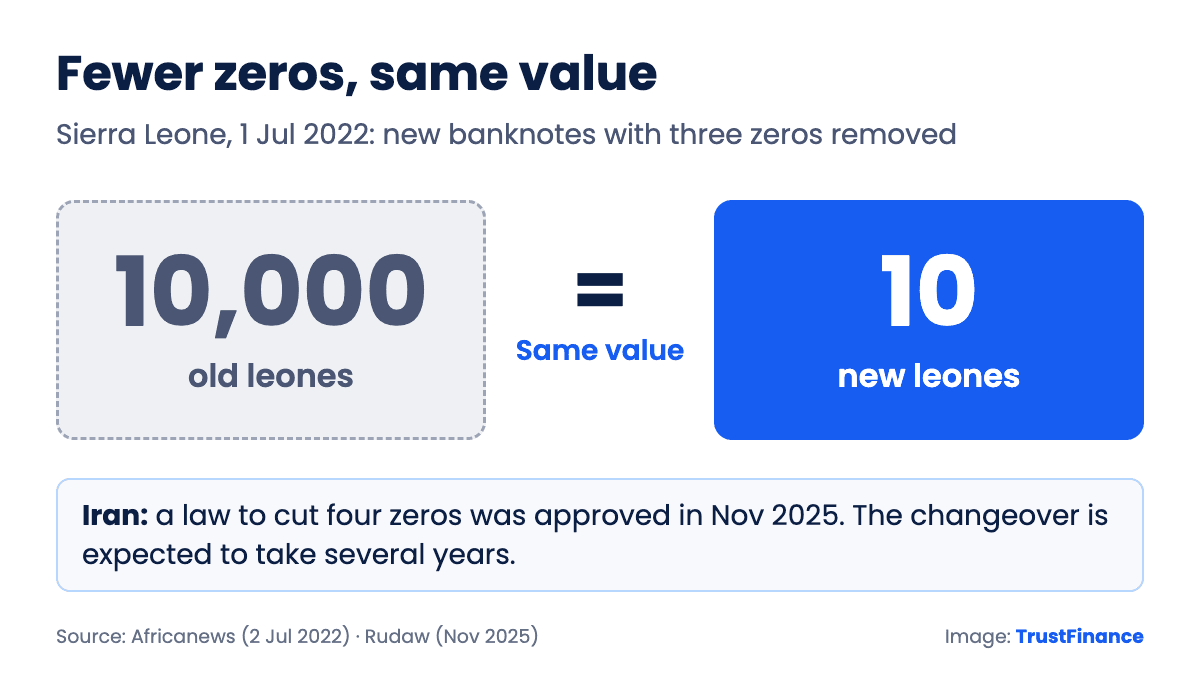
Image: Three zeros removed, shorter numbers on the notes but the same value · Source: Africanews (2 Jul 2022), Rudaw (Nov 2025)
As a result, Sierra Leone disappeared from the top of the list of the lowest value currencies in the world overnight, even though its economy did not improve overnight. This is clear proof that price per unit is as much about how the unit is defined as it is about the economy.
Rudaw reported in November 2025 that Iran's Guardian Council had approved a bill to remove four zeros from the rial, with the changeover expected to take several years. At the time of the report, the rial traded on the free market at more than 1.1 million rials per dollar, while the ExchangeRate-API figure as of 2 November 2026 is about 1.67 million rials per dollar.
If the redenomination is carried out in full, Iran could drop off the top of the table in the same way as Sierra Leone, even though its inflation and sanctions problems remain the same.
If price per unit were used to judge an economy, Japan and South Korea would have to sit in the same group as countries in crisis, since 1 US dollar buys about 157.53 yen and about 1,332.76 won (ExchangeRate-API, 2 Nov 2026), units many times smaller than the baht. Yet both are large economies with world-class export industries.
Indonesia is similar: the rupiah has a very small unit, but the country is one of the large economies in ASEAN. Where a unit is small because of a real crisis, as in Lebanon or Iran, you need to look at other signals too, such as multiple exchange rates, inflation and a broken peg. This table sums up the differences.
| Currency | Units per 1 USD (2 Nov 2026) | Main reason the unit is small | Signs of a currency crisis? |
|---|---|---|---|
| Japanese yen (JPY) | ≈ 157.53 | The unit was set small long ago | No multiple rates, freely traded |
| South Korean won (KRW) | ≈ 1,332.76 | The unit has always been small | No multiple rates, freely traded |
| Indonesian rupiah (IDR) | ≈ 18,144 | Past inflation and no redenomination | Can be volatile, but no multiple rates |
| Lebanese pound (LBP) | 89,500 | The peg broke after a financial crisis | Had multiple rates before unifying into one |
| Iranian rial (IRR) | ≈ 1,674,550 | Ongoing inflation and sanctions | Official and free-market rates are far apart |
In short, if you want to use a currency to gauge economic health, look at the direction and stability of the currency over several years and check whether there are multiple exchange rates, rather than counting the zeros.
A small currency unit affects real life very differently for someone planning a trip and for someone interested in trading currency pairs.
Feeling that you "get a lot" when you exchange money does not mean things are cheap, because prices in that country are also set in the same small unit. What really matters is the cost of living compared with your own income, not the number of zeros on the banknotes. These steps help:
Quick mental math: price in baht = price on the tag ÷ units per 1 baht Example (hypothetical figures): an item priced at 100,000 dong, at a mid-market rate of about 764 dong per baht (2 Nov 2026), costs about 100,000 ÷ 764 ≈ 131 baht. The actual counter rate will differ from this. |
Most currencies in the table fall into the group of exotic currency pairs, which have far lower liquidity than the major pairs. Spreads are therefore often wide, prices can jump sharply on news, and swap charges can be high, in line with that country's interest rates. To see how these total costs are calculated, see the worked example on calculating Forex trading costs.
Caution: Some currencies, such as the Iranian rial, are almost unavailable for trading because of sanctions and capital controls. For currencies with multiple exchange rates, the price on the screen may not reflect the rate you can actually get. The lowest value currency in the world may look like a "bargain", but that does not mean there is more chance of profit. The risk is actually higher than with the major pairs. |
Please note: For anyone interested in exotic currency pairs, Forex trading is not licensed or regulated by any authority in Thailand. The Bank of Thailand has no policy of issuing Forex business licenses for retail traders (source: Thai PBS, in Thai), and Thailand's Securities and Exchange Commission (SEC) has confirmed that the Forex business is not supervised by the SEC but falls under exchange control law instead (source: The Standard, in Thai).
This article is for general education only. It is not personal investment advice and does not promise any return. Pairs in currencies with small units carry high risk. Traders should research further and assess the risk for themselves before making any decision.
Measured by units per 1 US dollar as of 2 November 2026, it is the Iranian rial, at about 1.67 million rials per dollar according to ExchangeRate-API. Next is the Lebanese pound at 89,500. But this ranking can change if Iran cuts zeros under its new law.
No. A cheap currency in this article means a low price per unit on a given day, while a weak currency means one that has lost a lot of value over a set period. A currency with a small unit may even strengthen in a given year. When you read the news, check which measure is being used.
Calculated with rates as of 2 November 2026, 1 baht buys about 49,608 Iranian rials, followed by about 2,651 Lebanese pounds and about 764 Vietnamese dong. These are mid-market rates; the rate at a money changer will be lower.
Not always. Prices in that country are also set in the same small unit. What tells you about value is the cost of living compared with the money you bring, not the number of zeros on the banknotes.
To make everyday numbers shorter, reduce mistakes in calculating payments and keeping accounts, and hopefully restore confidence. But cutting zeros does not change the real value of money. If the root cause, such as inflation, is still there, the currency can keep weakening.
Some currencies are available to trade as exotic pairs, but spreads are wide, liquidity is low and trading may be limited by capital controls. Some, like the Iranian rial, are almost never available to trade. Study the risks fully before making any decision.
The lowest value currency in the world as of early November 2026 is the Iranian rial, followed by the Lebanese pound, the Vietnamese dong, the Lao kip and the Indonesian rupiah. But this only tells you the price per unit, not which economy is strong or weak. The Lebanon case shows that a broken peg can push a currency unit into the tens of thousands per dollar, and the Sierra Leone case shows that simply cutting zeros can change the ranking right away.
Before you trust any currency ranking, check the date of the data, the source and the currency code used every time. If you are traveling, check the real rate at the counter. If you are trading, assess the full cost and risk of exotic pairs first.
Before you trust a currency ranking, check 3 things
|
TrustFinance
TrustFinance helps financial companies build credibility and traders make safer choices through verified profiles, authentic reviews, and research-driven insights.