Loading
Related Articles
Fed Rate Hikes Are Back in 2026: What a Return to Tightening Means for the Dollar, Gold, and Traders
Related Articles
Fed Rate Hikes Are Back in 2026: What a Return to Tightening Means for the Dollar, Gold, and Traders

TrustFinance Research Team
Nov 13, 2026
18 min read
14

Swap in forex is the interest your broker credits to or debits from your account when you hold a Forex or CFD position past the market's daily cutoff (rollover). It is based on the interest rate difference between the two currencies in the pair, plus the broker's own markup. A positive swap means money comes in, a negative swap means money goes out, and on most pairs Wednesday night is charged three times.
If you close every trade within the day, swap barely matters. If you hold positions for days or weeks, it becomes a cost that quietly builds up every night. This guide explains where swap comes from, how to calculate it with worked numbers, where to find the real rates in MT4/MT5, and how a swap-free account differs from a standard one.
|
Key takeaways
|
To swap means to exchange one thing for another. In trading you will see the same charge under several names: swap, overnight interest, rollover, or rollover interest. They all mean the same thing: money added to or taken from your account because a position was still open when the market rolled over to the next day.
The name comes from the interbank currency market. A spot currency trade normally settles, meaning the actual money changes hands, within 2 business days. Retail traders do not want to receive the currencies themselves, so the broker pushes the settlement date forward every night by "swapping" the position into the next day. The bank tom-next (tomorrow-next) rate is the basis for the cost or return of that roll.
Swap is not limited to currency pairs. Other CFDs, such as gold, other metals and stock indices, also carry an overnight holding charge, although the formula can differ from the one used for currency pairs.
Every currency pair has two currencies, and each has its own central bank policy rate. When you buy a pair, in accounting terms you hold the first currency (the base currency) and borrow the second (the quote currency) to pay for it. If the currency you hold pays more interest than the one you borrow, the difference is positive. If it pays less, the difference is negative. Selling the pair reverses both sides.
Hypothetical example (round numbers, not real rates): currency A pays 4% a year in interest and currency B pays 1% a year.
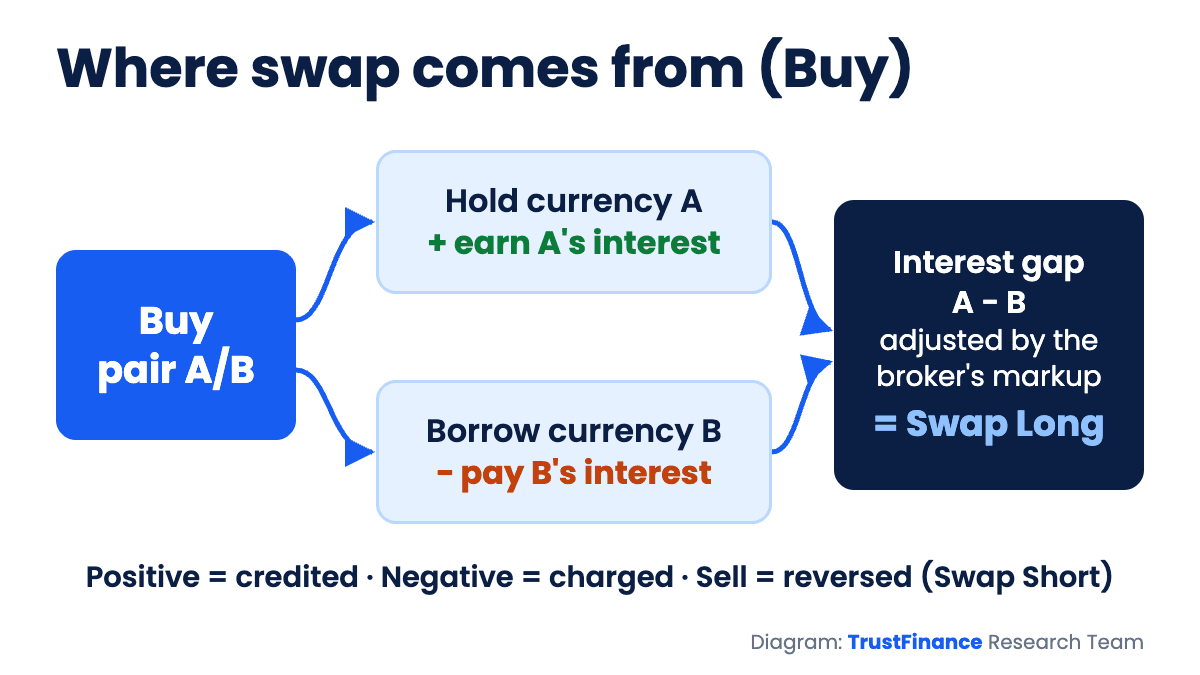
These are starting figures to show the principle only. In a real account, the rate used is not the headline policy rate you see in the news but the overnight interbank rate, and each broker sets its own Swap Long and Swap Short for every instrument, usually with its own costs or markup built in. The side that should earn interest may therefore earn less than the starting figure, or even pay, and the same pair can have different swap rates at different brokers.
Swap rates are also not fixed. When central banks raise or cut rates, the gap between the two currencies changes, and a pair that used to pay a positive swap can turn negative within a few months.
Here is a real example from official data. As of 12 Nov 2026, the upper limit of the US federal funds target range was 4.00%, while the Bank of Thailand's policy rate was 1.00% after its Monetary Policy Committee decision of 28 Oct 2026. That puts the gap at about 3 percentage points. In 2020-2022, however, the US rate fell to 0.25%, below Thailand's 0.50%. The direction of the gap really can flip, which is why the swap on the same pair changes with the interest rate cycle.
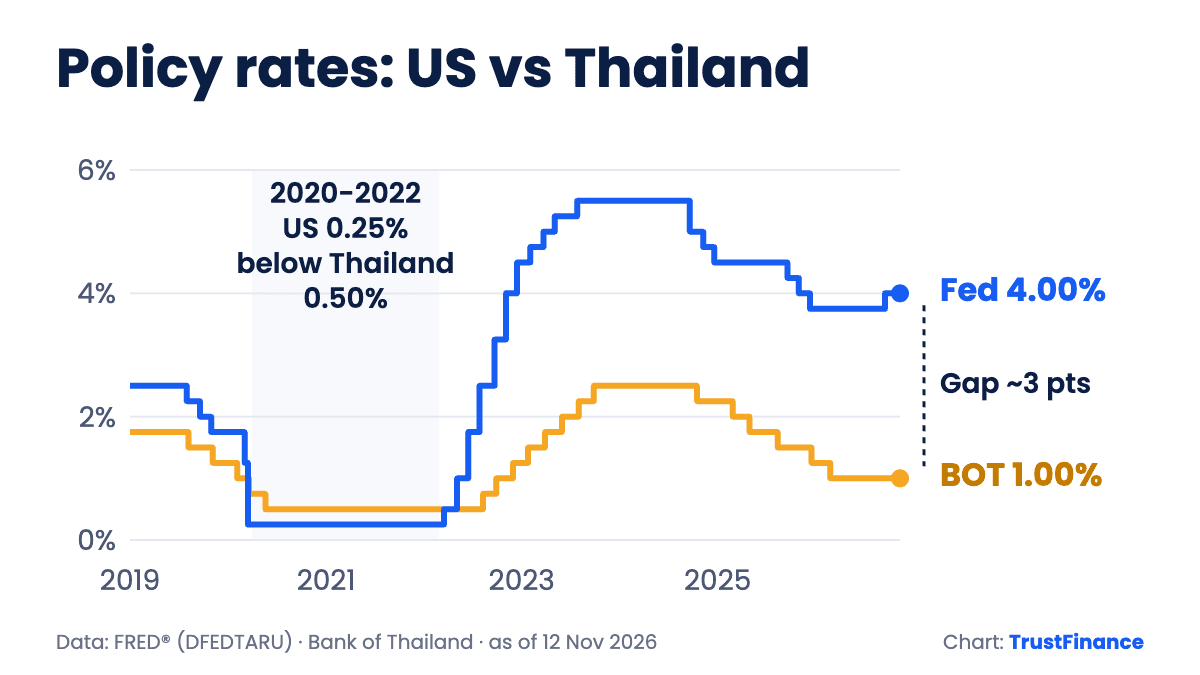
Image: US and Thailand policy rates · Source: FRED®, Federal Reserve Bank of St. Louis (DFEDTARU) and Bank of Thailand (data retrieved 13 Nov 2026) · Chart by TrustFinance
Swap Long is the swap on a Buy position and Swap Short is the swap on a Sell position. Brokers always show the two separately, because the direction of your trade decides which currency you hold and which you borrow. Before opening a trade you plan to hold for several days, look only at the value for the side you will open. Do not read one value and assume it applies to the whole pair.
| Item | Swap Long | Swap Short |
|---|---|---|
| Applies to | Buy | Sell |
| Hold and borrow | Hold the base currency, borrow the quote currency | Hold the quote currency, borrow the base currency |
| Can be positive when | The base currency's rate is high enough after the broker's markup | The quote currency's rate is high enough after the broker's markup |
| Field to check in MT4/MT5 | Swap long | Swap short |
Swap is charged once a day, at the market rollover. Many brokers use about 17:00 New York time, which is 21:00 UTC while the US is on daylight saving time and 22:00 UTC the rest of the year. In Thailand (UTC+7) that is about 04:00 and 05:00 local time. Some brokers state the rollover as 00:00 server time instead, so always check the actual cutoff with your own broker.
The key condition is simple: swap only looks at whether your position is still open at the cutoff. Open a trade five minutes before rollover and you pay for the full night. A trade opened and closed within the same day, without crossing the cutoff, has no swap at all.
| Situation | Swap charged? |
|---|---|
| Position still open at rollover | Yes, one full night |
| Opened and closed the same day, before rollover | No |
| Open at Wednesday's rollover (most pairs, T+2) | Yes, three nights at once |
| T+1 pairs such as USD/CAD, and some CFDs | The triple day may differ; check your broker |
Spot currency trades settle T+2, which means 2 business days after the trade date. A position held over Wednesday night has its settlement date pushed past Saturday and Sunday to Monday, so Wednesday's rollover has to include the weekend's interest as well. The result is three nights charged in one go.
There are exceptions. Some pairs settle T+1, such as USD/CAD, so their triple day may not be Wednesday. Some CFDs, or some brokers, also set the triple day on a different day. In MT5 you can see this in the Swap rates field, which shows the swap multiplier for each day of the week. In MT4, many brokers show a 3-days swap field that tells you which day is charged three times.
The formula depends on the unit your broker uses for swap. In MT5, the Swap type field tells you the method, for example in points, in the base currency, in the account currency, or as a percentage of the price. For Forex currency pairs, points are by far the most common.
|
Formula: Swap (in money) = swap rate (points) x value of 1 point x lots x nights Example (hypothetical figures): Swap Long -5 points x 1 USD x 1 lot x 6 = -30 USD for a Buy held from Monday night to Thursday night (4 nights, but Wednesday is charged three times, so it counts as 6) |
For a pair quoted to 5 decimal places with USD as the quote currency, 1 point is 0.00001 and 1 standard lot is 100,000 units, so 1 point on 1 lot is worth 1 USD (100,000 x 0.00001). If these units are new to you, read What is a pip, and how do you calculate profit or loss per pip?
Hypothetical example (round numbers, not the real rate of any pair): a pair has Swap Long = -5 points and Swap Short = +1 point. You open a Buy of 1 lot on Monday morning and close it on Friday afternoon, before the cutoff.
| Night held | Multiplier | Swap (Buy 1 lot, -5 points) |
|---|---|---|
| Monday night | 1 | -5 USD |
| Tuesday night | 1 | -5 USD |
| Wednesday night | 3 | -15 USD |
| Thursday night | 1 | -5 USD |
| Total, 4 nights | 6 | -30 USD |
You held for only 4 nights but paid for 6, because of Wednesday. With 0.1 lot the total would be -3 USD. On the Sell side at +1 point, the same period would earn +6 USD. These numbers look small, but if you hold for a month, or run several lots at once, a negative swap can eat a large share of your price gains.
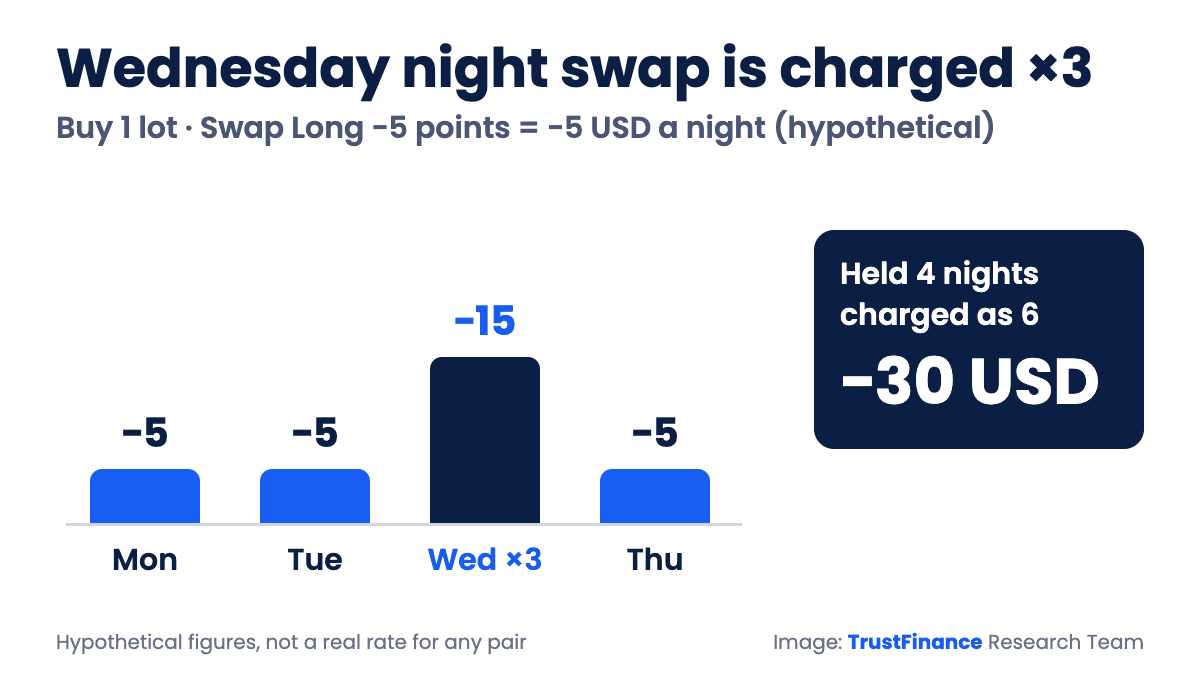
Image: Swap over one week, with Wednesday night charged three times (hypothetical figures) · Image by TrustFinance Research Team · Source (formula): MetaTrader 5 Help
Some sources write the same formula another way: Swap = (value of 1 pip x swap rate x nights) / 10. You divide by 10 because the swap rate is quoted in points and 1 pip equals 10 points. For example, if 1 pip is worth 10 USD, the swap rate is 2.5 points and you hold for 2 nights, the swap is (10 x 2.5 x 2) / 10 = 5 USD (hypothetical figures). This gives the same result as the formula above.

For some instruments, such as index or stock CFDs, some brokers show swap as a percentage of the position value. The basic formula is Swap (in money) = total position value x swap rate (%).
Hypothetical example: you hold a position worth 10,000 USD with a swap rate of -2% a year. If the broker converts this to a daily figure by dividing by 365, the swap per night is about 10,000 x 2% / 365 = -0.55 USD. How the daily figure is worked out, and which price is used (the current price or the opening price), varies by broker, so always go by the terms on your broker's contract specification page.
Swap rates differ between brokers and can change at any time. The most reliable way is to check them on the platform you trade on, every time before you open a position you plan to hold overnight.
| Field on the Specification window | What it tells you |
|---|---|
| Swap type | The unit and method, such as In points, In deposit currency or a percentage |
| Swap long | The swap on a Buy position |
| Swap short | The swap on a Sell position |
| Swap rates (MT5) / 3-days swap (MT4) | The multiplier for each day, or the day charged three times |
If you cannot open the platform, most brokers publish a Contract Specification or Trading Conditions page on their website that lists the swap for each instrument. Website figures may update later than the platform, so if the two do not match, go by the value in the platform.
The answer depends on how long you hold your trades.
Some traders deliberately hold the side that earns a positive swap, a strategy known as the carry trade. Keep in mind that a positive swap is a small amount per night, while the pair's price can move against you by hundreds of points at a time. Losses from price moves can easily wipe out the swap income, and if interest rates change, the swap itself can turn negative.
|
Risk warning: trading with leverage carries the risk of losing more than you expect. A positive swap today can turn negative when interest rates change, and no strategy guarantees a profit. Learn more in What is leverage, and how do you manage its risk? |
A swap-free account, which many brokers call an Islamic account, is an account that neither pays nor charges overnight interest. It was originally designed for Muslim traders, because Islamic principles prohibit earning or paying interest (riba), so the account lets them hold positions overnight without going against their faith. Some brokers also offer it to non-Muslim clients, depending on their terms and the client's country.
A swap-free account does not mean zero cost. Always compare the total cost.
No swap does not mean no cost. Brokers that offer these accounts usually make up for it in other ways, such as a daily administration fee once a position is held beyond a set number of days, or by adjusting other costs on the account. Terms vary widely from broker to broker. Before choosing an account, compare the total cost, including the spread, commission and overnight charges, rather than looking only at the words "swap-free".
If your broker shows swap in points, multiply the swap rate (points) x the value of 1 point x lots x nights, counting the triple night (usually Wednesday) as 3 nights. If it is shown as a percentage, multiply the position value by the swap rate, following the method your broker specifies.
The spread is the difference between the buy and sell price, paid once when you open a trade. Swap is interest charged every night you hold a position past the daily cutoff. A trade closed within the day pays only the spread (plus commission, if any). Read more in What is the spread, and how is it different from commission?
Swap Long is the swap on a Buy order and Swap Short is the swap on a Sell order. The two are usually not equal. One side may be positive and the other negative, or both may be negative once the broker's markup is included.
It means the broker pays money into your account every night you hold that side of the trade past the daily cutoff. A positive swap does not make the trade profitable, though. If the price moves against you, the loss from the price move is usually larger than the swap you earn.
Generally, yes. CFDs on currency pairs, gold, other metals and indices all carry an overnight charge. Some brokers call it an overnight fee or a funding charge instead of swap. The method and the triple day may differ from currency pairs, so check the Specification window for that instrument.
Check them on the platform you trade on. In MT5, right-click the pair in the Market Watch window and choose Specification. In MT4, do the same, or choose Symbols and click Properties. Then look at the Swap long and Swap short fields. If the platform figures do not match your broker's website, go by the platform.
No. Swap only applies to positions that are still open at the daily rollover. If you open and close a trade within the same day before the cutoff, there is no swap.
Swap is overnight interest that comes from the interest rate gap between two currencies, plus the broker's markup. It can be money in or money out, it is charged every night your position is open at the cutoff, and it is usually tripled on Wednesday night. Before holding a trade overnight, open the Specification window in MT4/MT5, check the swap for the side you plan to open, and work out in advance how much you would pay or earn if you hold as planned. Forex and CFD trading carries high risk, so only use money you can afford to lose and plan your risk management every time.
If you are comparing Forex brokers to see which offer swap-free accounts or trading costs that suit your style, read reviews on TrustFinance, a platform for checking Forex brokers and financial companies, with reviews from real users to compare before you decide. Keep in mind that in Thailand, no Forex broker is licensed by the Thai SEC to operate this business.
TrustFinance Research Team
Official TrustFinance research and editorial team, sharing insights, analysis, and best practices to help financial companies and traders build transparency, credibility, and growth.