Loading
Related Articles
Fed Rate Hikes Are Back in 2026: What a Return to Tightening Means for the Dollar, Gold, and Traders
Fed Rate Hikes Are Back in 2026: What a Return to Tightening Means for the Dollar, Gold, and Traders
Related Articles

TrustFinance
Nov 13, 2026
18 min read
14
If you have a savings account, you are already using compound interest, maybe without noticing. The Bank of Thailand explains on its Satang Story financial-literacy pages that Thai savings accounts usually calculate interest every day but pay it twice a year, in June and December, and the interest paid is added to the principal for the next round. Put simply, your interest starts earning interest of its own.
That sounds small, but over a long period the gap becomes large. Take THB 100,000 at 5% a year for 30 years. With simple interest you end up with THB 250,000. With interest compounded once a year you end up with about THB 432,194, at the same rate and from the same principal. (These figures are calculated to show the principle; they are not the return of any product.)
This article walks through how the mechanism works, the formula, how much compounding frequency matters, how to use the rule of 72 to estimate time, and the part many articles leave out: compounding works just as hard on debt, fees and losses.
Quick summary
|
Compound interest is a way of calculating interest in which the interest already earned is added to the principal, so the base for the next round of interest keeps growing. The Bank of Thailand's page on deposit interest simply calls it "interest on interest", which is easy to understand and to the point.
You may also see it called "compounding" or "interest on interest". The meaning is exactly the same.
Say you deposit THB 100,000 at 5% a year. In the first year you earn THB 5,000 in interest, so the balance becomes THB 105,000. In the second year interest is calculated on THB 105,000, not THB 100,000, so you earn THB 5,250. That extra THB 250 is the interest earned by the first year's interest.
The same thing repeats every year after that. Each year's interest is always a little bigger. In the early years you can barely see the difference, but after 15 to 20 years the curve starts to bend upward clearly, because the balance has grown so much that the yearly interest is several times the first year's.
Simple interest, sometimes called flat interest, is always calculated on the original principal and never adds the interest back, so the interest is the same every year. With compound interest the base keeps growing. This table compares THB 100,000 at 5% a year, compounded once a year.
| Period | Simple (THB) | Compound (THB) | Difference (THB) |
|---|---|---|---|
| 1 year | 105,000 | 105,000 | 0 |
| 5 years | 125,000 | 127,628 | 2,628 |
| 10 years | 150,000 | 162,889 | 12,889 |
| 20 years | 200,000 | 265,330 | 65,330 |
| 30 years | 250,000 | 432,194 | 182,194 |
Figures calculated to show the principle, rounded to the nearest baht, before tax and fees.
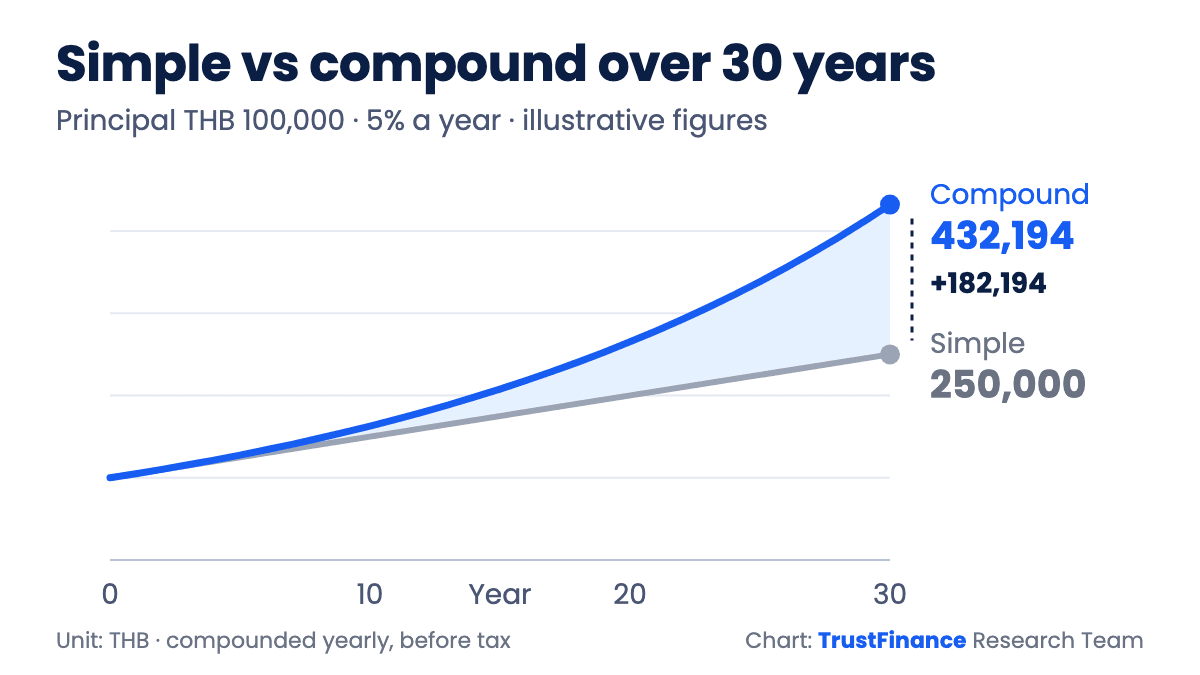
Image: THB 100,000 at 5% a year, simple vs compound interest over 30 years · Source: calculation by TrustFinance Research Team using A = P(1 + r/n)^(nt) (illustrative figures)
Notice that the first year shows no difference at all, and almost all of the gap appears in the later years. That is why people say compound interest needs time.
The standard compound interest formula is A = P(1 + r/n)^(nt). It looks complicated, but there are only five variables.
If you only want the interest earned, subtract P from A.
Formula: A = P(1 + r/n)^(nt) Compound interest step by step, using a principal of THB 100,000 at 5% a year, compounded monthly for 10 years (illustrative figures)
|
Total interest over 10 years is therefore about THB 64,701. Compounded once a year instead, you would get THB 162,889, a difference of about THB 1,812. In Excel, type =100000*(1+0.05/12)^(12*10) to get the same answer.
The more often interest compounds, the sooner it becomes part of the principal, so the rate you actually earn per year (the Effective Annual Rate, or EAR) is slightly higher than the stated rate. This table uses THB 100,000 at 5% a year for 10 years.
| Compounding frequency | n per year | Effective annual rate | Balance after 10 years (THB) |
|---|---|---|---|
| Yearly | 1 | 5.000% | 162,889 |
| Twice a year | 2 | 5.063% | 163,862 |
| Quarterly | 4 | 5.095% | 164,362 |
| Monthly | 12 | 5.116% | 164,701 |
| Daily | 365 | 5.127% | 164,866 |
Figures calculated to show the principle; they are not the rate of any product.
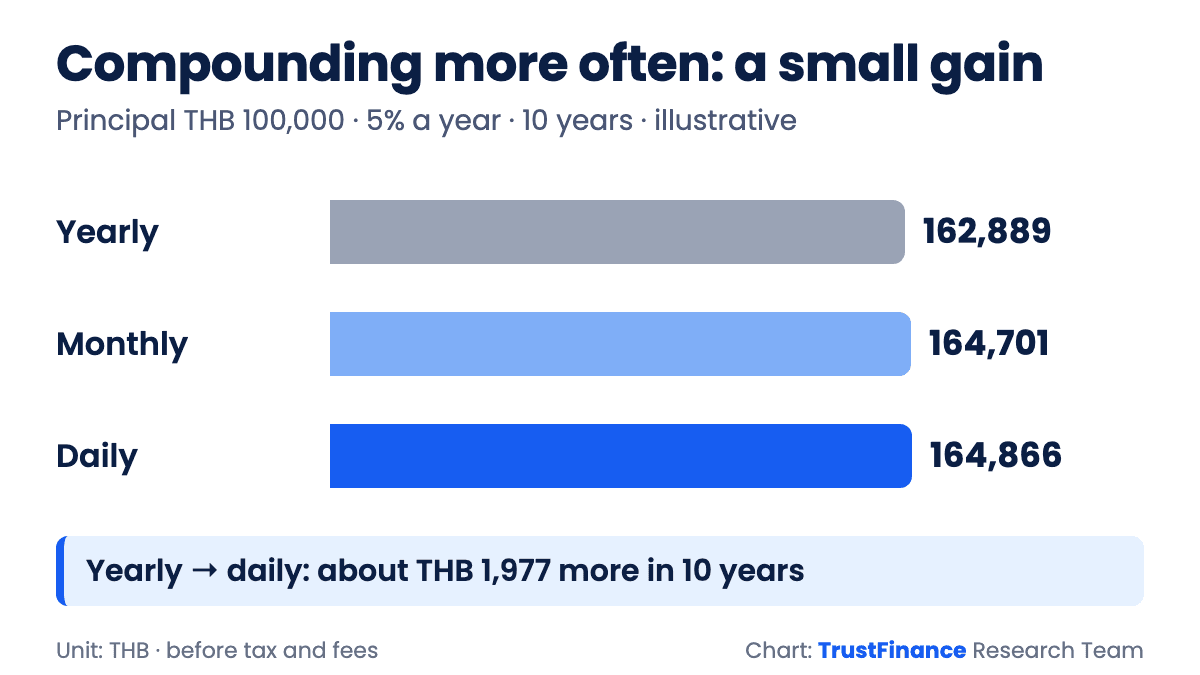
Image: Balance after 10 years when interest compounds yearly, monthly and daily · Source: calculation by TrustFinance Research Team using A = P(1 + r/n)^(nt) (illustrative figures)
Going from yearly to daily compounding adds about THB 1,977 over ten years. It is a real effect, but it does not change the game. The interest rate and the length of time move the result far more. When you compare two offers, compare the effective annual rate rather than only the advertised rate.
In real life most people do not deposit one lump sum and leave it. They save a little every month. For this case you use the future value of a series of payments: FV = C x [(1 + i)^N - 1] / i, where C is the amount saved each period, i is the rate per period (the annual rate divided by 12 for monthly saving) and N is the total number of periods.
Regular savings formula: FV = C x [(1 + i)^N - 1] / i Worked example: save THB 5,000 a month at 4% a year, compounded monthly for 15 years. Then i = 0.04/12 and N = 180 periods. The final amount comes to about THB 1,230,452, from THB 900,000 you actually paid in. The remaining THB 330,452 or so is interest that built up and kept compounding (illustrative figures, before tax). If you also start with a lump sum, calculate the two parts separately and add them together: the main formula for the lump sum, and this formula for the monthly savings. |
Excel has a built-in FV function. Type =FV(0.04/12, 180, -5000) to get the same figure. The minus sign in front of the savings amount is there because Excel treats it as money paid out of your pocket.
The rule of 72 is a shortcut for estimating how many years it takes money to double. Just divide 72 by the annual rate of return (as a percentage number, not a decimal). For example, at 6% a year, 72 divided by 6 is 12 years.
| Annual rate | Rule of 72 (years) | Exact, compounded yearly (years) |
|---|---|---|
| 2% | 36.0 | 35.0 |
| 4% | 18.0 | 17.7 |
| 6% | 12.0 | 11.9 |
| 8% | 9.0 | 9.0 |
| 12% | 6.0 | 6.1 |
Exact values calculated as ln(2) divided by ln(1 + r)
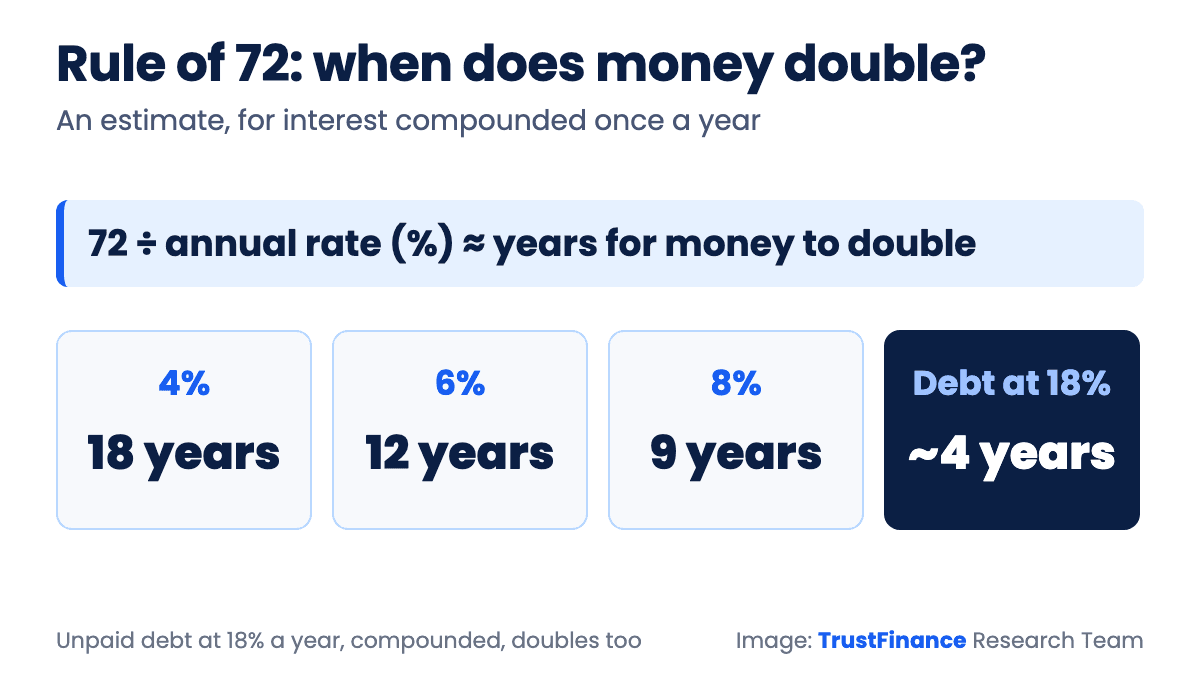
Image: The rule of 72 estimates the years it takes money to double · Source: calculation by TrustFinance Research Team using the rule of 72 (estimates)
For rates between 4 and 10%, the rule is off by less than half a year, so it works well for mental maths. At very low or very high rates the error grows. It is also useful in reverse: a debt charging 18% a year, compounded and never paid, doubles in about 4 years.
The same rule works for inflation. If prices rise by an average of 3% a year, they double in about 24 years (the exact figure is about 23.4 years). Put another way, cash left sitting idle buys only half as much over the same period. This shows why keeping money with no return at all has a hidden cost.
One more thing to know: the rule of 72 is mainly for rates compounded once a year. With monthly or daily compounding, money doubles slightly faster than the rule suggests, so some textbooks use 69 or 70 for frequent compounding. For mental maths, though, 72 divides more easily.
Compounding is not only in maths textbooks. It is built into the financial services we use every day, both those that earn money for us and those that take money from us.
According to the Bank of Thailand's guide to savings account interest (in Thai), savings interest in Thailand is calculated daily and paid every 6 months, and the interest paid becomes new principal. In the formula, that is n = 2. If you do not withdraw the interest, the money compounds on its own with nothing more to do. If you withdraw the interest to spend every six months, the result gets closer to simple interest. The same page also notes that if savings interest across all your accounts at one Thai bank exceeds THB 20,000 in a tax year, the bank withholds 15% tax. That tax makes the base that compounds smaller. Accounts that pay different rates on different balance bands have their own method, explained in how to calculate tiered savings interest.
Most bonds pay interest in instalments. If you take the interest and spend it, that money does not compound. If you use the interest to buy more bonds or deposit it again, compounding happens because of your own decision. The same idea applies to accumulating mutual funds, which keep gains inside the unit value, or to reinvesting stock dividends. The key difference is that fund and stock returns go up and down; they are not a fixed rate like a deposit. The numbers in the formula are only an illustration, not something you are certain to get.
On the debt side, the same principle works against you. If a contract adds unpaid interest to the balance used to calculate the next period's interest, the debt grows by compounding. Each type of loan calculates interest differently, so read the terms of your own contract to see which balance interest is charged on. One thing holds for all of them: the longer a balance stays unpaid, the more interest you pay in total.
Watch out: Picture the deposit example in reverse. If a THB 50,000 debt is charged 15% a year, compounded, and nothing is repaid, after 5 years the balance becomes about THB 100,568, nearly double (illustrative figures to show the principle, not the rate of any real loan). This is why paying only the minimum for a long time brings the balance down more slowly than you expect. |
Most articles on this topic only cover the side where money grows, but the same maths applies to things that eat into your money.
Prices also rise by compounding. With average inflation of 3% a year for 10 years, something that used to cost THB 100 will cost about THB 134. If a deposit earns 1.5% a year over the same period, THB 100,000 grows to about THB 116,054, but its real purchasing power compared with day one is only about THB 86,355 (illustrative figures). For ideas on how to adjust a portfolio, see how to beat inflation.
An annual fee is taken out of the return every year, so its effect compounds as well. Compare THB 100,000 over 30 years. At a net 6% a year, the final amount is about THB 574,349. With a 1% annual fee that leaves a net 5%, the final amount drops to about THB 432,194, roughly THB 142,155 less, or about a quarter of the final amount (illustrative figures). When you look at a financial product, always put the annual fee into the formula.
Losses also compound, but in reverse. If a THB 100,000 portfolio falls 50% to THB 50,000, getting back to THB 100,000 takes a 100% gain, not 50%, because the base is now smaller.
| Loss | Gain needed to get back to the start |
|---|---|
| 10% | 11.1% |
| 20% | 25.0% |
| 30% | 42.9% |
| 50% | 100.0% |
| 75% | 300.0% |
These numbers explain why traders put so much weight on limiting the loss on each trade. The deeper the fall, the steeper the climb back.
|
This article is for general education only. It is not personal investment advice, and no return is guaranteed. Traders should do their own research and assess the risks themselves before making any decision. |
It is interest calculated on the principal plus the interest already earned, not only on the original principal, so each round of interest gets bigger. If you do not withdraw the interest, the effect becomes much clearer as the period stretches to ten years or more.
If interest compounds once a year, the formula becomes A = P(1 + r)^t. For example, THB 50,000 at 4% a year for 10 years gives 50,000 x (1.04)^10, about THB 74,012. If interest compounds more than once a year, use the full formula with n.
At the same rate and over the same period, compound interest always pays the same or more. The first year is equal if interest compounds once a year, and after that compound interest pulls further ahead every year. For a borrower, though, compound interest means paying more interest in total.
It is accurate enough for mental maths at rates of about 4 to 12% a year, off from the exact figure by less than half a year. At very low rates the rule of 72 gives a slightly longer time than the real one: at 2% the rule says 36 years, while the exact figure is about 35 years.
DCA (dollar-cost averaging) means investing the same amount at regular intervals, while compounding means letting returns become part of the principal. The two work together if you invest regularly and leave the returns in. Remember that volatile assets do not deliver a fixed return like the one in the formula.
Not by much. At 5% a year on THB 100,000 for 10 years, monthly compounding gives about THB 164,701 and daily gives about THB 164,866, a difference of about THB 165. The interest rate and time matter far more than frequency.
Because each year's interest is calculated on the balance built up so far, and in the early years that base is still small. In the example of THB 100,000 at 5% a year, the first ten years earn about THB 62,889 in total interest, but the last ten years (years 21 to 30) earn about THB 166,864, at the same rate. Many people give up halfway because they see small gains early on, while the period of big gains has not arrived yet.
Compounding is not magic. It is the repeated multiplication of three things: rate, frequency and time, and time carries more weight than many people think. The same THB 100,000 at 5% a year ends up almost THB 200,000 apart between simple and compound interest after 30 years. |
But the same maths applies to debt, fees, inflation and losses. Understanding compounding is not only about knowing how much your money will grow; it is also about knowing what is quietly compounding against you. Try putting your own numbers into the formula, and the picture will be clearer than any example from someone else.
TrustFinance
TrustFinance helps financial companies build credibility and traders make safer choices through verified profiles, authentic reviews, and research-driven insights.