Loading
Related Articles
Fed Rate Hikes Are Back in 2026: What a Return to Tightening Means for the Dollar, Gold, and Traders
Related Articles
Fed Rate Hikes Are Back in 2026: What a Return to Tightening Means for the Dollar, Gold, and Traders

Thanakit Sutto
नव. 23, 2026
17 min read
1

Compulsory Motor Insurance (Phor Por Bor) is a mandatory motor insurance policy required by the Protection of Motor Vehicle Accident Victims Act B.E. 2535 (1992). Every vehicle owner must purchase it to cover medical expenses and compensation for anyone injured or killed in a vehicle accident, whether they are a driver, passenger, or pedestrian.
Most people refer to it simply as "Phor Por Bor" or "Compulsory Insurance." The Office of Insurance Commission (OIC) summarizes its core principle as "repairs people, not cars," meaning it covers life and physical body injuries and does not pay for vehicle or property repairs (OIC: Car Insurance).
Summary
Data as of November 19, 2026 |
Compulsory Motor Insurance is the insurance policy mandated by Section 7 of the Protection of Motor Vehicle Accident Victims Act, requiring vehicle owners who use or possess vehicles for use to purchase it from an insurance company (Protection of Motor Vehicle Accident Victims Act B.E. 2535 [1992]).
All of these scopes derive from the explanatory summary of the law published by the Office of Insurance Commission (OIC: Summary Explanation of the Protection of Motor Vehicle Accident Victims Act).
Compulsory Motor Insurance pays out in two stages. The first stage consists of preliminary compensation paid immediately without waiting to determine fault. The second stage covers additional indemnity after liability has been established.
| Case | Limit per Person |
|---|---|
| Injury: Actual medical expenses | Up to 30,000 THB |
| Loss of limb or permanent disability | 35,000 THB |
| Death (funeral and burial expenses) | 35,000 THB |
| Injury followed later by disability or death | Combined total not exceeding 65,000 THB |
The company must disburse preliminary compensation within 7 days of receiving the claim, and victims must file within 180 days from the date of the incident (Protection of Motor Vehicle Accident Victims Fund: Motor Vehicle Protection Insurance Policy, Clauses 4 and 5).
| Case | Limit per Person |
|---|---|
| Injury: Actual medical and other damages | Up to 80,000 THB |
| Death or total permanent disability | 500,000 THB |
| Loss of limb or permanent disability (as specified in the policy) | 200,000 to 500,000 THB |
| Daily compensation during inpatient hospitalization | 200 THB per day, up to 20 days |
| Maximum total limit | 504,000 THB per person and 20 million THB per accident event |
These figures come from the policy schedule format mandated by the OIC Registrar under the 2025 order, setting a total limit per accident of 20 million THB for all vehicle types.
Preliminary compensation is counted as part of the total limit and is not paid as an additional separate amount.
Per-person limits and per-event limits are calculated differently. To understand how each cap applies, see examples in Insurance Limits per Event, per Disease, and Annual Limits.
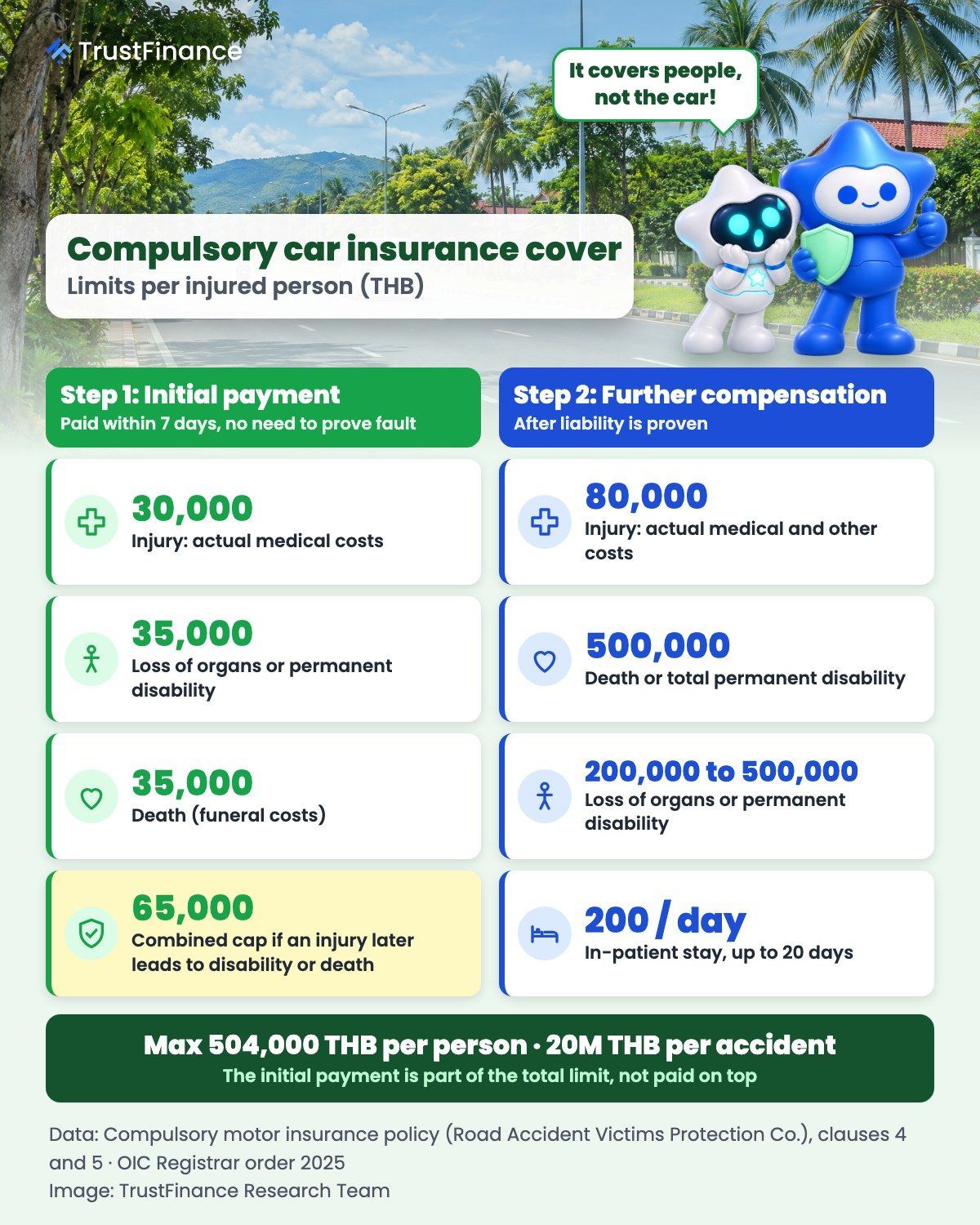
Compulsory Motor Insurance pays preliminary damages before fault determination, with all stages combined not exceeding 504,000 THB per person
Source: Motor Vehicle Protection Insurance Policy (Protection of Motor Vehicle Accident Victims Fund) and 2025 OIC Registrar Order · Image: TrustFinance Research Team
They receive only preliminary compensation: medical expenses up to 30,000 THB, or 35,000 THB in cases of death or disability, combined up to a maximum of 65,000 THB. The policy schedule specifies that drivers of the insured vehicle are covered up to preliminary compensation limits only (OIC: Policy Schedule Item 4, Clause 5).
Example (Hypothetical Scenario): A pedestrian is struck by a sedan with Compulsory Insurance. Actual medical expenses are 45,000 THB. Stage 1: Receives actual preliminary compensation up to 30,000 THB within 7 days of submitting complete documents, without waiting for case outcomes. Stage 2: If the car driver is proven negligent, the remaining 15,000 THB can be claimed since it does not exceed the 80,000 THB injury limit, totaling 45,000 THB. If medical expenses exceed 80,000 THB, the excess must be claimed from the vehicle's voluntary insurance (if any) or from the tortfeasor. |
Personal sedans or passenger cars with up to 7 seats pay 645.21 THB per year because the OIC sets compulsory insurance premiums at a single fixed rate based on vehicle type and usage. Insurance companies cannot charge differently (OIC: Compulsory Insurance Premium Rates).
| Vehicle Type (Personal Use) | OIC Premium | Stamp Duty | VAT 7% | Total Annual Payment |
|---|---|---|---|---|
| Motorcycles up to 75 cc | 150 THB | 1 THB | 10.57 THB | 161.57 THB |
| Motorcycles over 75 up to 125 cc | 300 THB | 2 THB | 21.14 THB | 323.14 THB |
| Motorcycles over 125 up to 150 cc | 400 THB | 2 THB | 28.14 THB | 430.14 THB |
| Motorcycles over 150 cc | 600 THB | 3 THB | 42.21 THB | 645.21 THB |
| Passenger cars up to 7 seats (sedans, including EVs) | 600 THB | 3 THB | 42.21 THB | 645.21 THB |
| Trucks weighing not over 3 tons (pickups) | 900 THB | 4 THB | 63.28 THB | 967.28 THB |
| Passenger vehicles up to 15 seats (vans) | 1,100 THB | 5 THB | 77.35 THB | 1,182.35 THB |
The premiums in the second column are derived from the OIC table, which states they exclude taxes and duties. Commercial or rental vehicles use higher rates, such as passenger cars up to 7 seats for hire at 1,900 THB before tax (OIC: Premium Rate Table).
Total Calculation Method: Actual payment = Premium + Stamp duty + 7% VAT of (Premium + Stamp duty) Casualty insurance stamp duty is 1 THB per every 250 THB or fraction of 250 THB of the premium (Revenue Department: Stamp Duty Schedule, Category 6). Meanwhile, the 7% VAT rate has been extended until September 30, 2027, per the Cabinet resolution of July 27, 2026 (Revenue Department: PR News 18/2026). Sedan Example: Premium 600 THB, stamp duty 3 THB (600 ÷ 250 = 2.4 rounded up to 3), VAT = 603 × 7% = 42.21 THB, totaling 645.21 THB. |
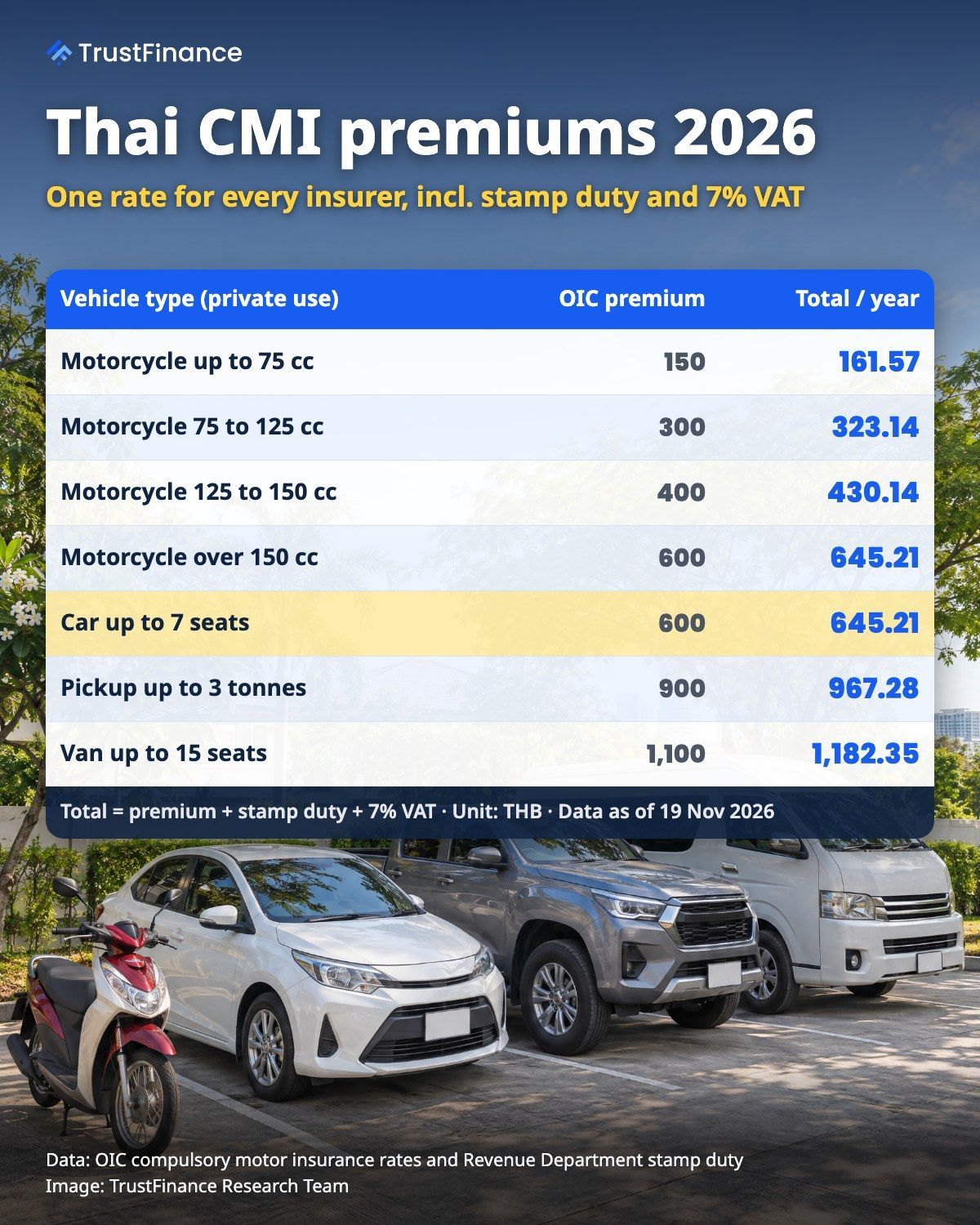
Compulsory insurance premiums are identical across all companies. Personal sedans total 645.21 THB per year including stamp duty and 7% VAT (Data as of Nov 19, 2026)
Source: OIC and Revenue Department · Image: TrustFinance Research Team
The Compulsory Insurance policy schedule clearly separates columns for insurance premiums, direct insurance discounts, net premiums, stamp duty, and value-added tax, which can be used to verify actual amounts paid.
Compulsory Insurance covers life and physical body damages up to statutory limits, whereas voluntary insurance covers amounts exceeding Compulsory Insurance and adds property and vehicle damage coverage according to the chosen tier.
| Coverage | Compulsory | Class 1 | Class 2 | Class 3 |
|---|---|---|---|---|
| Legally required? | Required | Voluntary | Voluntary | Voluntary |
| Victims' life and body | Up to Compulsory limit, max 504,000 THB/person | Excess over Compulsory | Excess over Compulsory | Excess over Compulsory |
| Third-party property | Not covered | Covered | Covered | Covered |
| Our vehicle theft, fire | Not covered | Covered | Covered | Not covered |
| Damage to our vehicle | Not covered | Covered | Not covered | Not covered |
| Price | Fixed rate per OIC | Highest in group | Lower than Class 1 | Lowest in voluntary |
The coverage categories for each tier originate from motor vehicle insurance policy templates under OIC Registrar Order No. 46/2024.
Plans commonly known in the market as 2+ or 3+ are Class 2 or 3 policies with specified-risk coverage that add vehicle damage protection only for specific events, such as car-to-car collisions.
Effective January 1, 2026, voluntary insurance must provide third-party bodily injury and life liability of at least 500,000 THB per person and 20 million THB per event, as an excess over Compulsory Insurance (OIC: Registrar Order 2025, Clause 4).
Vehicle owners who fail to purchase Compulsory Insurance face a fine of up to 10,000 THB under Section 37, and the Department of Land Transport registrar will not accept annual vehicle tax payments until insurance is obtained under Section 19 (Protection of Motor Vehicle Accident Victims Act, Sections 19 and 37).
Precautions
|
Details regarding the fund and the 20% surcharge originate from OIC explanation Clause 2.4 (OIC: Summary Explanation)
Victims or legal heirs must submit a claim to the insurance company of the vehicle they were riding in or the vehicle that caused the accident within 180 days from the date of the incident, along with case-specific documents.
This document list is outlined in Motor Vehicle Protection Insurance Policy, Clauses 5 and 9.
If multiple vehicles collide, individuals claim from the insurance of the vehicle they were riding in, while pedestrians claim equally divided amounts from all involved vehicles. Inquiries can be made via the OIC Hotline 1186 or Protection of Motor Vehicle Accident Victims Fund at 1791.
If you need to claim voluntary insurance following Compulsory Insurance, the reporting sequence and required documents are similar. Check the checklist at How to Prepare Insurance Claim Documents: From Incident Reporting to Tracking Results.
Renew Compulsory Insurance first, then pay your annual vehicle tax at eservice.dlt.go.th, as the Department of Land Transport system automatically verifies Compulsory Insurance against the OIC database. If not found, you cannot proceed (Department of Land Transport: Online Tax Payment Steps).
Taxes can be paid up to 90 days in advance of the due date. Gas-powered vehicles cannot pay online, and vehicles with 3 consecutive years of unpaid tax will have their registration suspended (Department of Land Transport: Online Tax Payment Conditions).
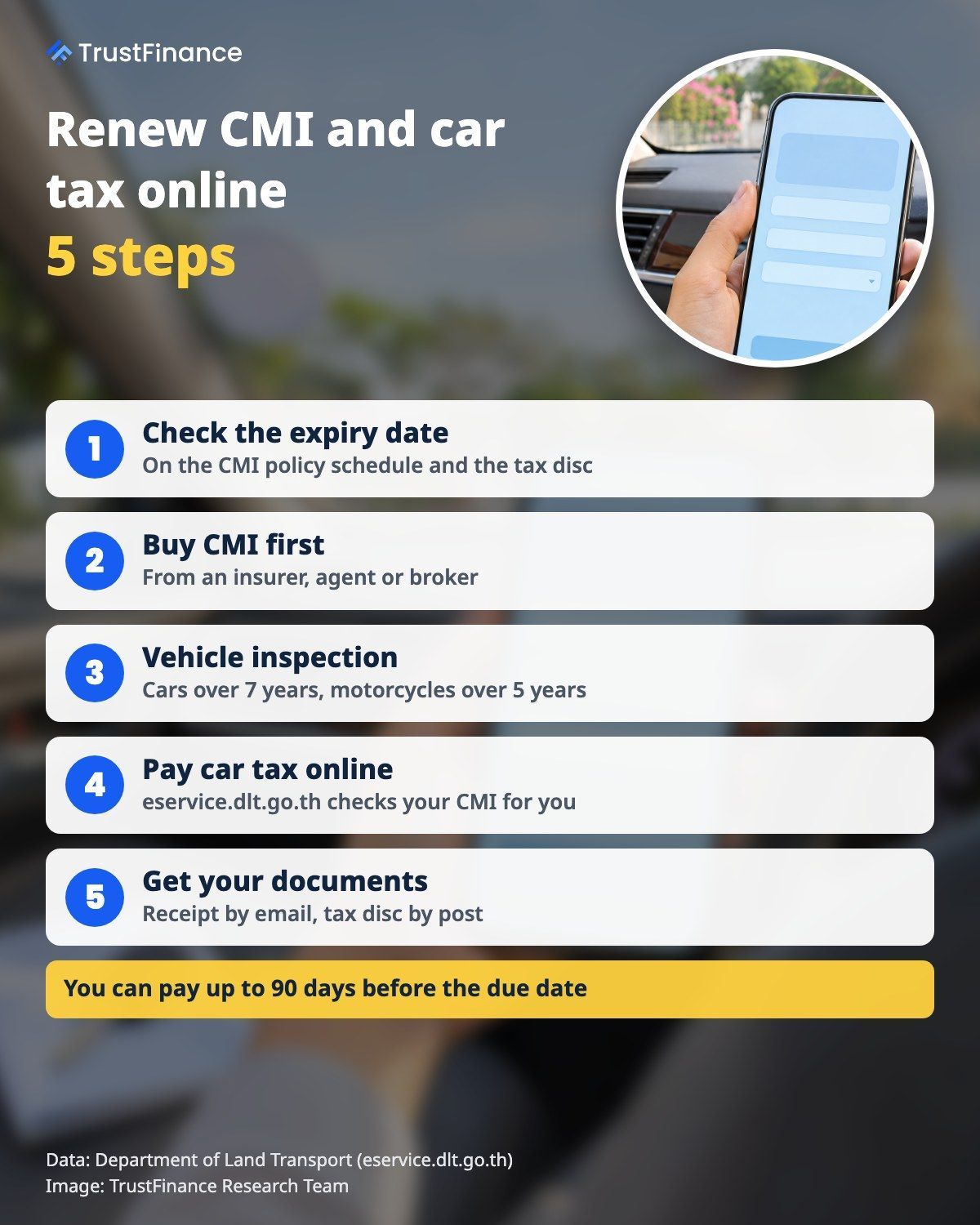
Renew Compulsory Insurance before paying vehicle tax online, as the Department of Land Transport system verifies Compulsory Insurance data prior to accepting tax payments
Source: Department of Land Transport (eservice.dlt.go.th) · Image: TrustFinance Research Team
If you bundle voluntary insurance, be sure to read the deductible and exclusion terms thoroughly, as these determine out-of-pocket expenses, explained in Deductibles, Copayments, and Waiting Periods.
Yes. Vehicle tax can be paid online at eservice.dlt.go.th, where the system retrieves Compulsory Insurance data from the OIC automatically. Compulsory Insurance itself can be purchased through insurance companies, agents, or brokers, many of which offer online channels. If Compulsory Insurance has already lapsed, it should be renewed before operating the vehicle, as driving without insurance incurs fines.
It exclusively covers life and physical body injuries. Pedestrians or passengers in other vehicles sustaining injuries receive preliminary compensation up to 30,000 THB, and when your vehicle is proven at fault, total compensation reaches up to 504,000 THB per person. Vehicle damage or third-party property damage is not included under Compulsory Insurance.
Section 11 of the Protection of Motor Vehicle Accident Victims Act B.E. 2535 (1992) prohibits operating uninsured vehicles under Section 7, with violations carrying a fine of up to 10,000 THB under Section 39. The Motor Vehicle Act B.E. 2522 (1979) is a separate law regarding vehicle registration and taxes, and that specific text should be consulted directly before citation.
645.21 THB per year for personal sedans with up to 7 seats, 967.28 THB for pickup trucks up to 3 tons, and 323.14 THB for motorcycles over 75 up to 125 cc. These prices already include stamp duty and 7% VAT.
Premiums are identical across all companies because the OIC sets fixed rates. Policy schedules feature separate columns for direct insurance discounts and net premiums. If prices appear different, compare net premiums, stamp duty, and VAT on the receipt.
It is not mandatory. Voluntary insurance is optional. If you want your own car repairs or third-party property damage covered, you must purchase additional coverage tailored to your needs.
Compulsory Motor Insurance is mandatory insurance required for every vehicle, covering people rather than cars. Accident victims receive preliminary compensation within 7 days without waiting for case outcomes and can receive total indemnity up to 504,000 THB per person once liability is proven.
Personal sedans pay 645.21 THB per year uniformly across companies. Failure to buy it incurs a fine up to 10,000 THB and blocks vehicle tax renewal. Renew Compulsory Insurance first, then pay vehicle tax online with the Department of Land Transport.
This article is prepared for informational and educational purposes only and does not constitute insurance purchasing advice. Premium rates and limits may change according to registrar orders. Readers should study information and verify the latest conditions with the OIC or insurance companies independently before making decisions.
Other Supporting Information: OIC Summary Explanation of the Protection of Motor Vehicle Accident Victims Act (oiceservice.oic.or.th) · OIC Registrar Order No. 46/2024 on Motor Vehicle Insurance Policies · Protection of Motor Vehicle Accident Victims Fund Policy (rvp.co.th) · Revenue Department Stamp Duty Schedule Category 6 and PR News 18/2026 regarding 7% VAT through September 30, 2027 (rd.go.th) · Department of Land Transport online vehicle tax payment steps and conditions (eservice.dlt.go.th) · Total prices including duty and VAT calculated by TrustFinance Research Team
Fact-checked by TrustFinance Research Team · Data as of November 19, 2026
Thanakit Sutto
Content & PR Lead at TrustFinance. A finance writer who makes investing easy to understand.