Loading
Related Articles
Related Articles
Fed Rate Hikes Are Back in 2026: What a Return to Tightening Means for the Dollar, Gold, and Traders
Fed Rate Hikes Are Back in 2026: What a Return to Tightening Means for the Dollar, Gold, and Traders

TrustFinance
Nov 13, 2026
17 min read
15
Every day, the Bitcoin network releases roughly 450 new BTC. The math is simple: a new block is found every 10 minutes on average, which gives about 144 blocks a day, multiplied by the current block reward of 3.125 BTC (Bitcoin Wiki). What makes this interesting is that the number barely moves, no matter how many tens of thousands of extra mining machines are switched on around the world. Put another way, the cake stays the same size. More people want a slice, so each slice gets smaller.
That idea sits at the heart of the question "what is Bitcoin mining", and it explains why many people buy a machine and end up with results that fall short of what they expected. This article walks through the mechanism behind mining, the reward that shrinks with every halving, the equipment actually in use, and finally the costs and the warning signs of mining services to watch out for.
|
In short
|
Think of a bank. Every time you transfer money, the bank's central system records which account the money left and which account it went into. Bitcoin, however, has no central bank or company holding that ledger. The ledger is shared by everyone on the network. So the question is: who writes the new pages?
The answer is miners. So if you ask what Bitcoin mining is, the everyday answer is that miners are paid to write new pages in a shared ledger, and they must first prove they have done real work. They are paid in newly created bitcoin, plus the fees that senders attach to their transactions. The word "mining" is a comparison with gold mining, where you have to put in the effort before you get anything of value.
A Bitcoin miner does three main jobs. First, it gathers transactions that are waiting to be confirmed and groups them into a block. Second, it checks that those transactions are valid, for example that the sender really owns the coins and is not spending the same coins twice. Third, it races to find a hash that meets the condition. The first miner to succeed announces the block so the whole network can check it and add it to the end of the chain.
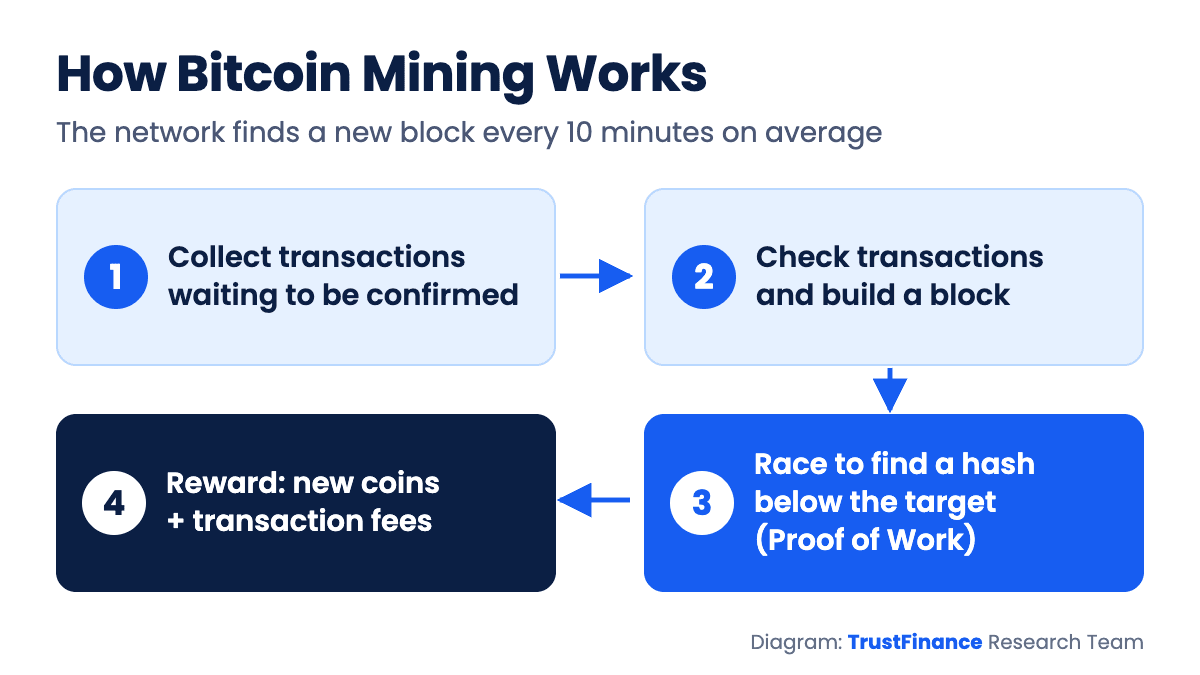
Image: The 4 steps of Bitcoin mining · Source: Diagram by TrustFinance Research Team, based on the mechanism described in Bitcoin Wiki, Controlled supply
A system that uses computing effort as its proof like this is called Proof of Work. For how it differs from systems that lock up coins as a stake instead, see the summary in Proof of Work vs Proof of Stake.
Imagine if anyone could write new pages in the ledger for free. Cheaters would flood it with fake transactions until the system broke. Forcing miners to burn electricity and computing time before they can write makes cheating very expensive, because rewriting past history would mean re-mining all of those blocks faster than the rest of the network. As a result, Bitcoin's security is tied to the combined mining power (hash rate) of miners worldwide, and the reward is the incentive that makes people willing to pay that cost.
This section is the real engine of Bitcoin mining. Once you understand the three topics below, you will see for yourself why the question "how much can I mine per day?" has no fixed answer.
Every block has a header that holds summary data, such as the hash of the previous block, a summary of all the transactions in the block, a timestamp, and a field called the nonce. Miners run this header through the SHA-256 function and get a long number called a hash.
The condition is that the hash must be lower than a target set by the network. The problem is that a hash cannot be predicted at all. Change the input slightly and the output changes completely. The only way is to change the nonce and try again, trillions of times. It is like rolling an enormous number of dice until you get a low enough score. That is why guessing speed, or hash rate, is everything for a mining machine.
If one day twice as many machines were switched on, blocks would be found twice as fast and coins would flow out faster than planned. So Bitcoin adjusts its difficulty every 2016 blocks to keep the average time between blocks at about 10 minutes (Bitcoin Wiki).
The effect miners feel directly is this: when total mining power rises, difficulty rises with it, and your existing machine earns a smaller share while using the same amount of power. The reverse is also true. When many miners switch off, for example after a price drop, difficulty goes down and those still mining get a bigger share. This system means each miner's income always depends on everyone else.
When a miner finds a block, the first transaction in that block is a special one that pays the reward to the miner. The reward has two parts. The first is the block subsidy, the new coins created by the system. The second is the fees users paid with the transactions in that block.
When the network is busy, total fees rise because everyone wants their transaction in the next block. The subsidy, on the other hand, follows a fixed schedule and will slowly shrink to zero over the long term. When that happens, miners will earn from fees alone (Bitcoin Wiki).
|
Formula: Miner's reward per block = block subsidy (new coins) + transaction fees in that block Example: A new block is found every 10 minutes on average, so about 144 blocks a day × 3.125 BTC = roughly 450 new BTC per day for the whole network (fees not included) |
The new-coin reward started at 50 BTC per block and is cut in half every 210,000 blocks, or about every 4 years. This event is called the halving. Its effect on the market and on price is a separate topic, covered in What Is Bitcoin Halving. For miners, the direct effect is that subsidy income drops by half overnight while the electricity bill stays the same.
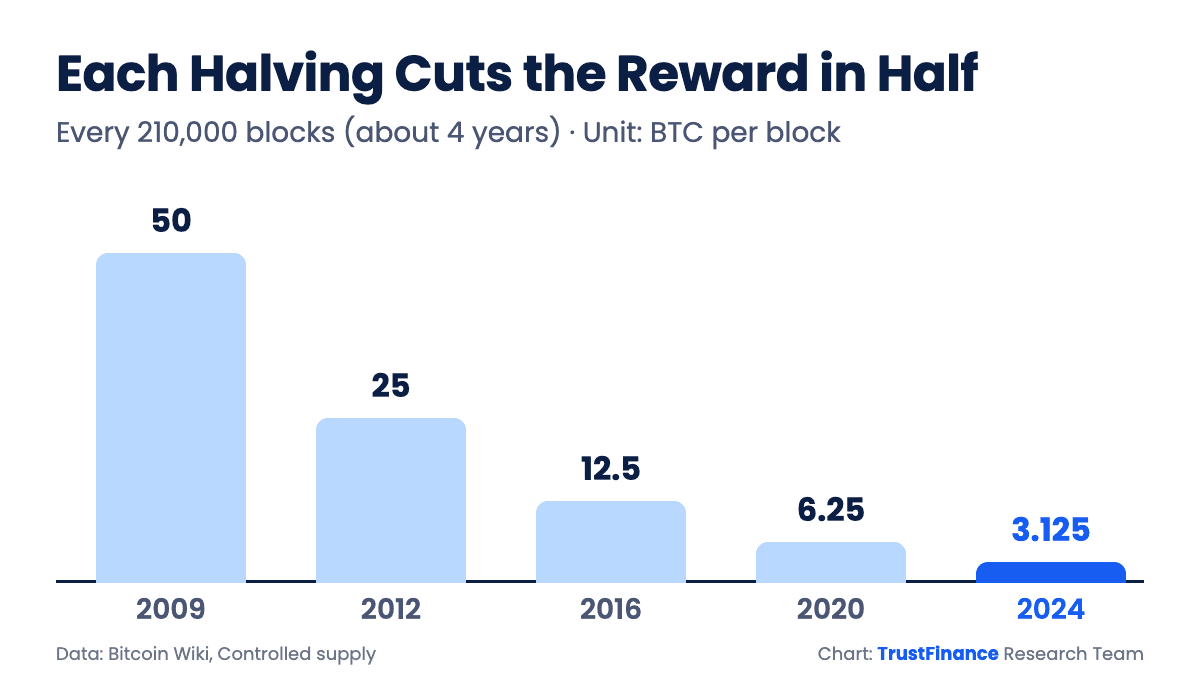
Image: Block reward per halving era, 2009-2024 · Source: Bitcoin Wiki, Controlled supply
| Reward era | Starting block | Start date | Reward per block | BTC mined at start of era |
|---|---|---|---|---|
| Era 1 | 0 | 3 Jan 2009 | 50 BTC | 0 |
| Era 2 | 210,000 | 28 Nov 2012 | 25 BTC | 10,500,000 |
| Era 3 | 420,000 | 9 Jul 2016 | 12.5 BTC | 15,750,000 |
| Era 4 | 630,000 | 11 May 2020 | 6.25 BTC | 18,375,000 |
| Era 5 (current) | 840,000 | 20 Apr 2024 | 3.125 BTC | 19,687,500 |
| Era 6 | 1,050,000 | Not yet reached (about 4 years after the previous halving) | 1.5625 BTC | 20,343,750 |
Table: Block reward by era · Source: Bitcoin Wiki, Controlled supply
What does this table tell us? First, at the start of the current era, about 93.75 percent of the cap of roughly 21 million BTC had already been mined. The remaining coins will come out more and more slowly. Second, the miners who survive each halving are those with a low enough cost per unit, or enough fee income to make up the gap. Miners with high costs often have to switch off or sell their machines.
In Bitcoin's early days, people could mine with the CPU of an ordinary computer because there were few miners and difficulty was low. Later, people found that graphics cards (GPUs) could do this kind of repetitive calculation much faster, so mining moved to GPUs. Eventually, specialised chips called ASICs (Application-Specific Integrated Circuits) were designed. They can do only one thing, compute SHA-256, but they do it many times faster and with far less power per unit than CPUs and GPUs.
| Device type | Can it still mine Bitcoin in practice? | What to consider |
|---|---|---|
| CPU | Technically yes, but the chance of finding a block is close to zero | Electricity costs exceed income in almost every case |
| GPU (graphics card) | Cannot compete with ASICs on the Bitcoin network | Usually used for other coins with a different design |
| ASIC | The main machine in today's competition | Expensive, loud, very hot, and older models become outdated quickly |
Even with one ASIC, your chance of finding a block on your own is still very small. You could wait a year and get nothing. So small miners usually join a mining pool, which combines the power of thousands of machines. When the pool finds a block, it splits the reward among members in proportion to the work each one submitted (called shares), minus the pool fee. The benefit is steadier income, but you have to trust the pool operator to calculate and pay out correctly.
Cloud mining means paying a provider to rent mining power. You do not look after any machines yourself and simply wait for your share. It sounds convenient, but you can hardly verify whether the machines really exist or whether the power you rented is actually connected to a pool. Most contracts are also hit by difficulty and halvings in the same way. That is why many scams hide behind the name cloud mining, as covered in the warning signs section below.
The cost of Bitcoin mining has several layers, not just the price of the machine.
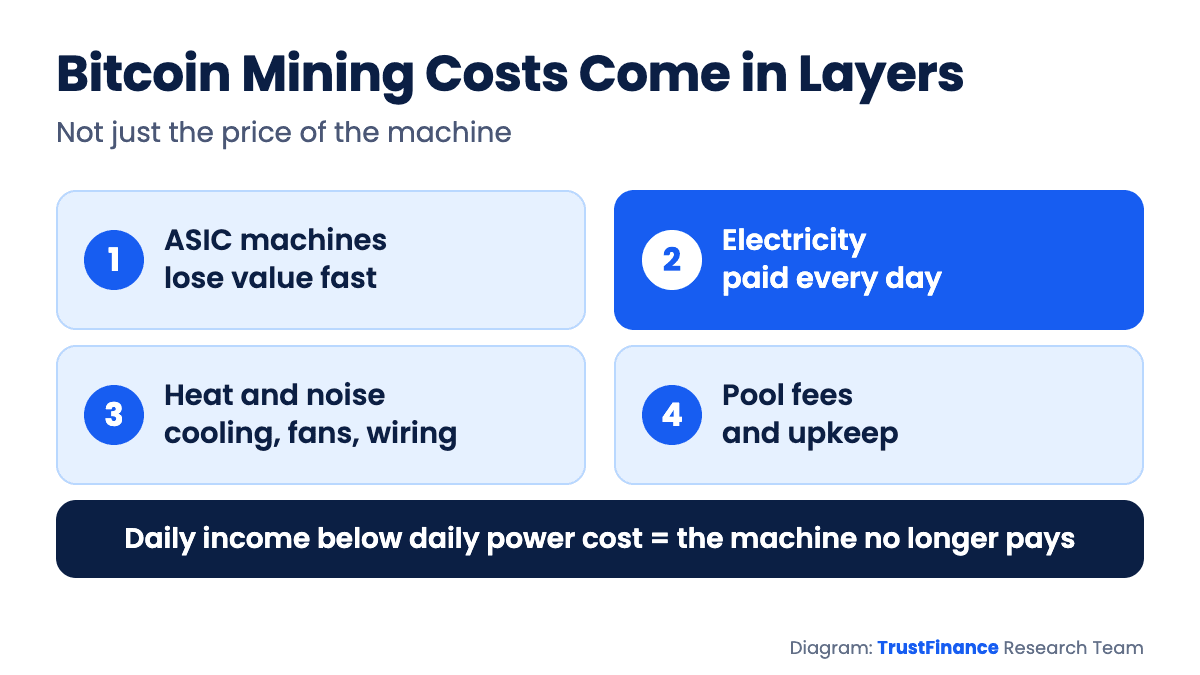
Image: The 4 cost layers of Bitcoin mining · Source: Diagram by TrustFinance Research Team, based on this article
A rough way to estimate it is to take your share of hash rate compared with the network's total hash rate and multiply it by the coins issued per day plus fees. That gives your approximate income. Then subtract your daily electricity cost. But every variable moves all the time, including the BTC price, difficulty, fees and electricity rates, so a figure you work out today may no longer hold in a few weeks. If you earn income from mining, check the tax rules with your tax authority directly (in Thailand, the Revenue Department), because the details depend on the type of income each person has.
Another point beginners often overlook is the "economic life" of a machine. An ASIC may keep running for years, but once its daily income falls below its daily electricity cost, it no longer pays for itself, even if it still works normally. The resale price of a used machine therefore depends on whether it can still make a profit at that time, not just on its condition.
|
Rough formula: Daily income ≈ (your hash rate ÷ the network's total hash rate) × (new coins per day + fees), then subtract electricity and pool fees Example (hypothetical figures): Suppose your mining machine has one millionth of the whole network's hash rate (a hypothetical figure for illustration, not the rate of any real model). If the whole system releases about 450 new BTC per day, your share would be about 0.00045 BTC per day, before transaction fees and before the pool fee is deducted. |
Now change one variable at a time. If total global mining power doubles, your share drops to one in two million, and your income halves while your machine keeps working exactly as before. And when the next halving arrives, the reward per block falls to 1.5625 BTC, cutting your new-coin income in half again, while your electricity bill does not fall with it. That is why looking only at "today's income" is not enough. You need to look at the machine's whole working life.
From the mechanism explained above, you can see that mining income moves with price, difficulty and halvings. So any service that makes the claims below deserves questions first.
| What you see in the ad | Why it does not fit how mining works |
|---|---|
| Fixed daily returns, or "guaranteed" income | Real income depends on price and difficulty, which change all the time |
| Multi-level commissions for inviting friends | The income comes from new members' money, not from mining |
| No verifiable proof of machines or a pool | There is no way to check that any mining is happening |
| Pressure to transfer money before a promotion ends | Urgency is used to cut short your time to check |
| Withdrawals only after you top up more, or a very high minimum withdrawal | Money may go in but never come out |
|
Caution: If you see several of these signs at once, stop and check before you transfer any money, no matter whether someone you know invited you or how good the reviews look. |
|
Please note: Thailand's Securities and Exchange Commission (SEC) warns that cryptocurrencies and digital tokens are high risk, investors may lose their entire investment, and past returns do not guarantee future returns (SEC Thailand reference, in Thai). Bitcoin mining carries the same risk, because the income is paid in a digital asset whose price is volatile. |
This article is for general education only. It is not personalised investment advice, and no returns of any kind are guaranteed. Readers should do further research and assess the risks themselves before making any decision.
It is the use of computers to race to find a hash that meets a condition, in order to earn the right to record a new block of transactions on the Bitcoin blockchain. The first to succeed receives a reward of new coins plus the transaction fees in that block.
There is no fixed answer, because it depends on your share of mining power compared with the whole network. The network as a whole gets a new block every 10 minutes on average, but a small miner with only a few machines mining solo may go a long time without finding a single block. That is why most join a pool to receive a small but steady share instead.
There is no single number. Income depends on your machine's hash rate, difficulty, the BTC price and the fees on each day, and you still have to subtract electricity and pool fees. Be careful with any website that quotes a fixed daily figure without stating its assumptions.
The basics are an ASIC machine, a power supply that can handle it, a wallet to receive coins, and an account with a mining pool. Before you start, compare your electricity cost with your expected income, allow for difficulty rising and the price falling, and factor in the next halving, when the reward drops to 1.5625 BTC.
Technically you can run the software, but you cannot compete with ASICs, so the chance of earning a reward is almost nil. Most phone apps that claim to "mine Bitcoin for you" do not actually mine on the Bitcoin network. Check what an app really does before you grant it permissions or pay anything.
Bitcoin's supply is designed to stay below roughly 21 million BTC, and the new-coin reward falls with every halving until it reaches zero over the long term. At that point, miners will earn from transaction fees alone, which means whether mining pays will depend more on how much the network is used.
Some providers do operate for real, but renters find them very hard to verify, and many scams use the name. If you see a promise of fixed returns, or a commission system for recruiting people, treat it as a serious warning sign.
If you had to answer in a few words what Bitcoin mining is, it is a system that hires people around the world to help confirm transactions and secure Bitcoin, paying them in new coins and fees. Every rule is written into the protocol: the roughly 10-minute block pace, the difficulty adjustment every 2016 blocks, and the halving every 210,000 blocks.
What the protocol does not set is your costs, or the price of the coin on the day you receive it. Bitcoin mining is therefore a business that needs careful calculation, not automatic income. Before putting money into any machine or service, make sure you understand the mechanism fully, check the provider thoroughly, and assess how much volatility you can handle.
TrustFinance
TrustFinance helps financial companies build credibility and traders make safer choices through verified profiles, authentic reviews, and research-driven insights.