Loading
Related Articles
Fed Rate Hikes Are Back in 2026: What a Return to Tightening Means for the Dollar, Gold, and Traders
Fed Rate Hikes Are Back in 2026: What a Return to Tightening Means for the Dollar, Gold, and Traders
Related Articles

Thanakit Sutto
11月 23, 2026
7 min read
2

The US dollar (USD) is the official currency of the United States, issued by the Federal Reserve System, and the world's main currency: central banks hold more of it in reserves than any other, and it is used in more foreign exchange trades than any other.
IMF data for the second quarter of 2026 show the dollar at 56.70% of allocated global foreign exchange reserves, and the BIS survey of April 2025 found the dollar on one side of 89% of all foreign exchange trades.
Key points
|
The US dollar is the currency of the United States, with the symbol $ and the international code USD. The Federal Reserve (Fed) sets monetary policy and the policy interest rate, which move the dollar and financial markets worldwide.
Besides its use in the US, the dollar prices key commodities such as oil and gold, so the Thai gold price follows world gold in dollars. See how gold ETFs track that price in what a gold ETF is.
The dollar became the main currency after the Second World War, under the 1944 Bretton Woods agreement, which tied the dollar to gold at 35 dollars an ounce and other currencies to the dollar. Even after the US ended dollar-gold convertibility in 1971, the dollar kept its leading role for four reasons.
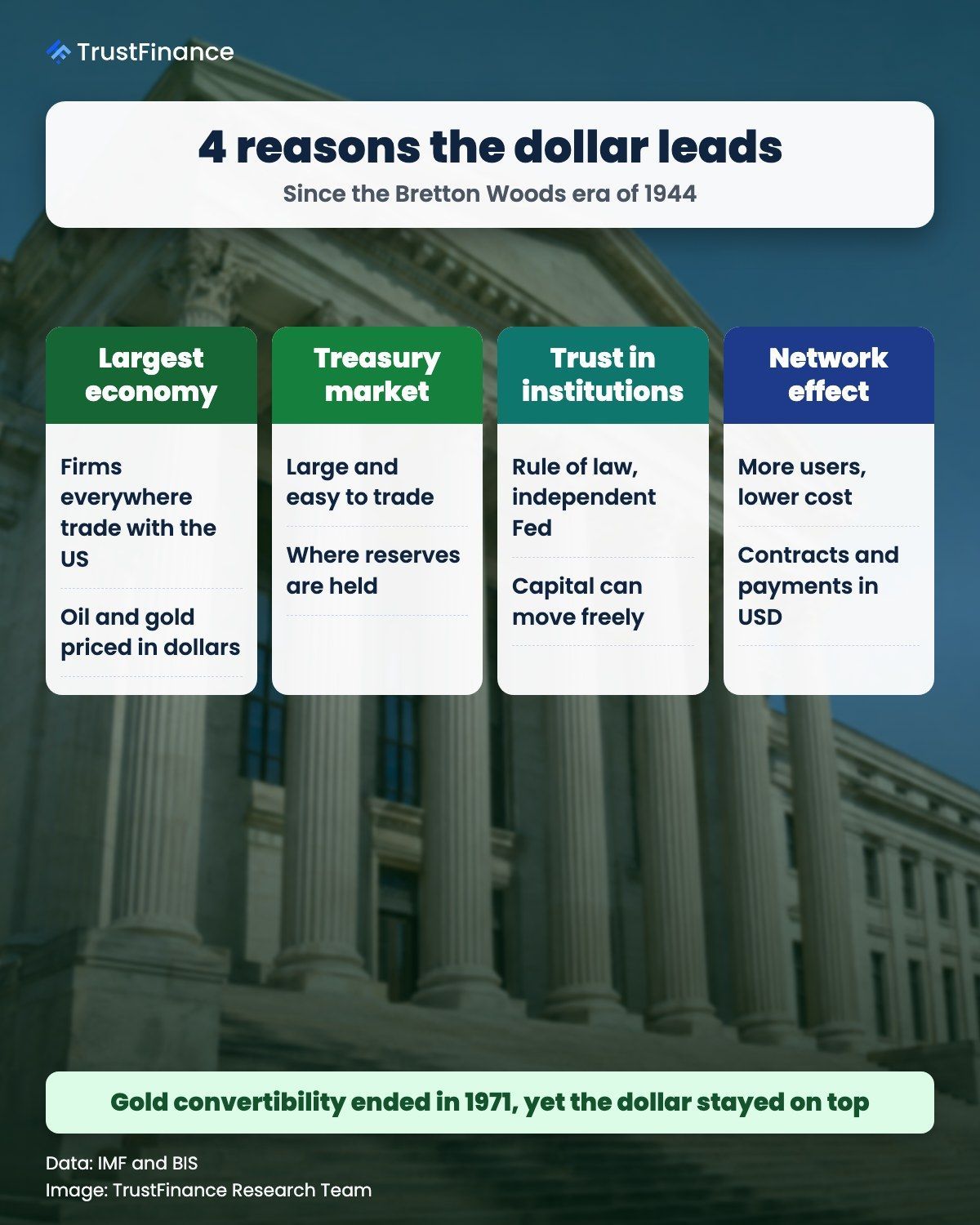
The dollar leads because of the size of the US economy, its large government bond market, trust in its institutions and its network of users
Data: IMF and BIS · Image: TrustFinance Research Team
Figures from two international bodies show the dollar's role clearly: its share of central bank reserves and its share of the currency market.
| Indicator | Figure | Period | Source |
|---|---|---|---|
| World foreign exchange reserves | 13.22 trillion dollars | Q2 2026 | IMF COFER |
| Dollar share of reserves | 56.70% (previous quarter 57.18%) | Q2 2026 | IMF COFER |
| Euro share of reserves | 20.60% | Q2 2026 | IMF COFER |
| FX trades with the dollar on one side | 89% | April 2025 | BIS Triennial Survey |
| World FX turnover per day | 9.6 trillion dollars | April 2025 | BIS Triennial Survey |
Reserve data come from the IMF COFER release of 30 Sep 2026 (IMF); FX market figures come from the BIS three-yearly survey (BIS).
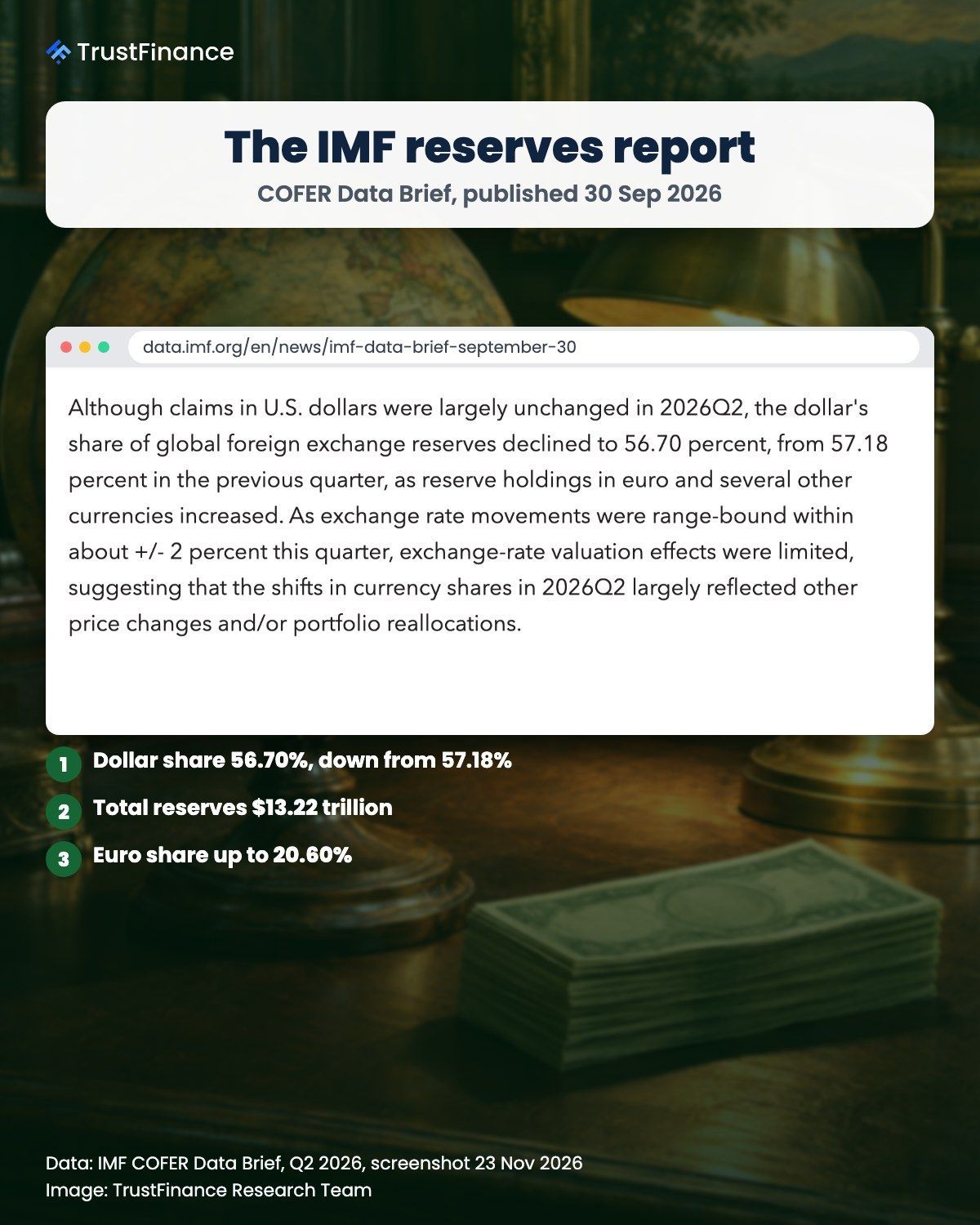
In Q2 2026 the dollar made up 56.70% of world foreign exchange reserves, down from 57.18% the quarter before
Data: IMF COFER Data Brief, published 30 Sep 2026 · Image: TrustFinance Research Team
When the dollar strengthens against major currencies, the baht often weakens with it: imports priced in dollars cost more in baht, while exporters earn more baht.
Countries with large dollar debts have faced crises when their currencies fell sharply, as Thailand did in 1997; read the lessons in what an economic crisis is.
The dollar's share of world reserves has been falling slowly over the long run as central banks hold more euros, renminbi and other currencies. But no currency yet has a bond market and network large enough to replace the dollar in the short term.
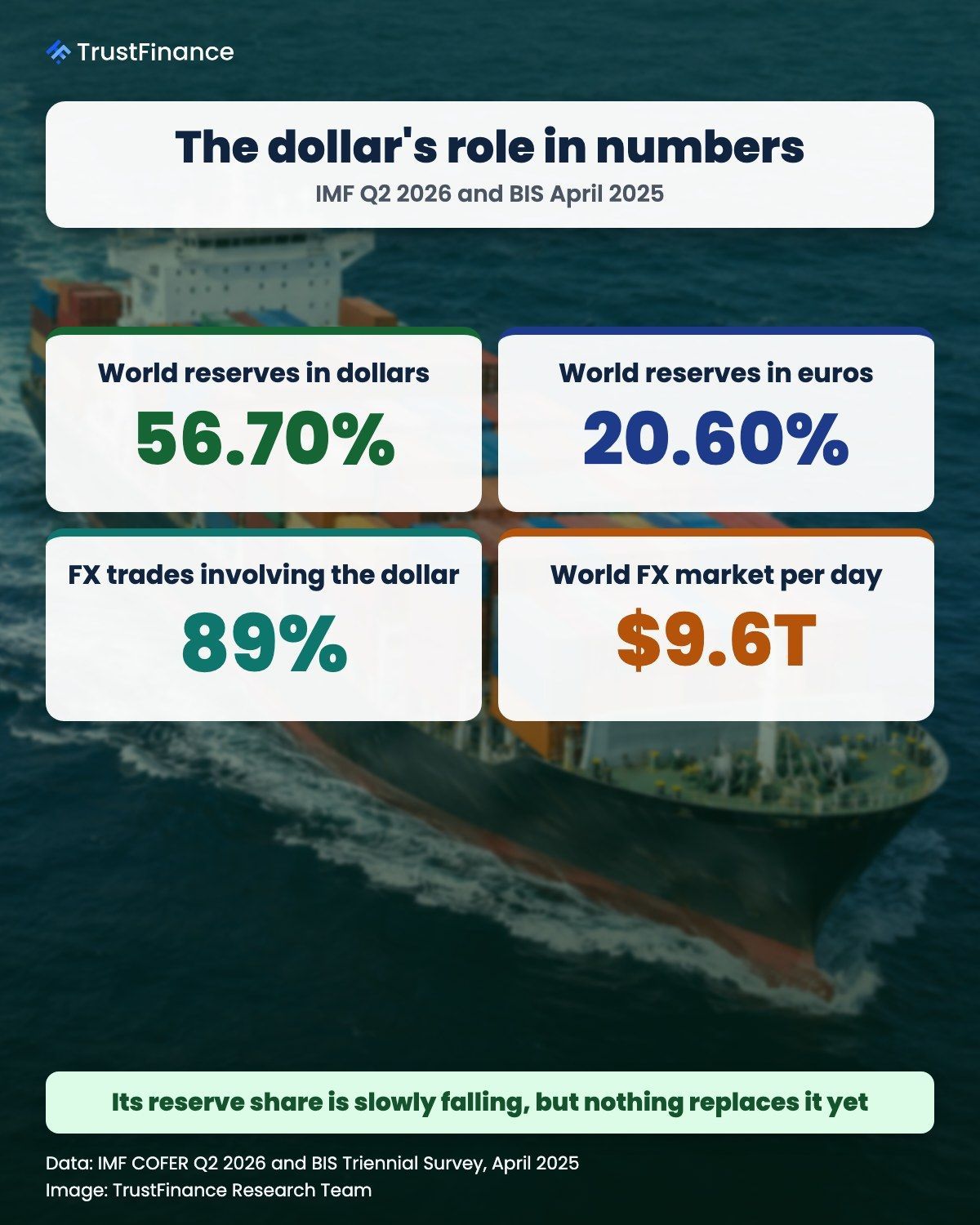
The dollar is on one side of 89% of world FX trades, while its reserve share is 56.70% against 20.60% for the euro
Data: IMF COFER Q2 2026 and BIS Triennial Survey, April 2025 · Image: TrustFinance Research Team
Disclaimer: This article is for general education only. It is not investment advice or a solicitation to trade foreign currency, securities or derivatives. Readers should study the information and assess the risks themselves before making any decision. |
After the Second World War, under the 1944 Bretton Woods agreement, which tied other currencies to the dollar and the dollar to gold.
56.70% of allocated reserves in Q2 2026, according to IMF COFER data, down from 57.18% the quarter before.
The euro, with 20.60% of world reserves in Q2 2026; it is also the second most traded currency in the FX market.
Both. Importers and consumers pay more, while exporters and tourism businesses earn more baht.
The Fed sets the policy rate; higher US rates tend to draw capital into the US and strengthen the dollar.
The US dollar is the world's main currency because of the size of the US economy, its large government bond market, trust in its institutions and a network the whole world already uses. In Q2 2026 it made up 56.70% of world reserves, and it is part of 89% of FX trades. Its reserve share is slowly falling, but no currency can replace it in the short term.
Other references: the 1944 Bretton Woods agreement and the end of dollar-gold convertibility in 1971 (monetary history described by the IMF and the Federal Reserve)
Reviewed by TrustFinance Research Team · Data as of 23 November 2026
Thanakit Sutto
Content & PR Lead at TrustFinance. A finance writer who makes investing easy to understand.


