Loading
Related Articles
Fed Rate Hikes Are Back in 2026: What a Return to Tightening Means for the Dollar, Gold, and Traders
Fed Rate Hikes Are Back in 2026: What a Return to Tightening Means for the Dollar, Gold, and Traders
Related Articles

Thanakit Sutto
Nov 23, 2026
9 min read
0

Investing (การลงทุน) means putting money into an asset or a business in the hope of a return later, such as interest, dividends or a higher price, while accepting that its value can fall. Saving, by contrast, focuses on keeping the principal safe.
The Stock Exchange of Thailand explains that return and risk always travel together: assets with a higher expected return usually swing more in price. Beginners should understand this trade-off before choosing any asset.
Key points
|
Investing differs from saving because it accepts risk in exchange for a higher expected return. Saving, such as a bank savings account, protects the principal and keeps money easy to reach, but the interest is usually low.
Deposits at Thai banks are protected by the Deposit Protection Agency up to 1 million baht per depositor per financial institution (Deposit Protection Agency). Stocks, mutual funds and gold have no such protection; their value moves with market prices.
Many people mix up investing and trading. Investing usually means holding assets for the long term so their value can grow, while trading means buying and selling often to profit from short-term price moves. The difference is covered in detail in what trading is and how it differs from investing.
| Topic | Saving | Investing |
|---|---|---|
| Goal | Keep the principal, have cash for emergencies | Grow money over the long term |
| Return | Deposit interest, fairly low | Interest, dividends, capital gains |
| Risk to principal | Low, deposits insured up to 1 million baht | Yes, value can fall |
| Liquidity | Withdraw quickly | Depends on the asset, some sell slowly |
Investment returns come from two main sources: income while you hold the asset, and gains from a change in price. Some investors get both at once.
The key force in long-term investing is compounding: returns earn further returns, and the longer the time, the clearer the effect. See the formula and examples in compound interest explained.
Investment assets fall into 4 main groups, generally from lower to higher risk: deposits and money market, fixed income, equities, and alternative assets. Each pays a different kind of return.
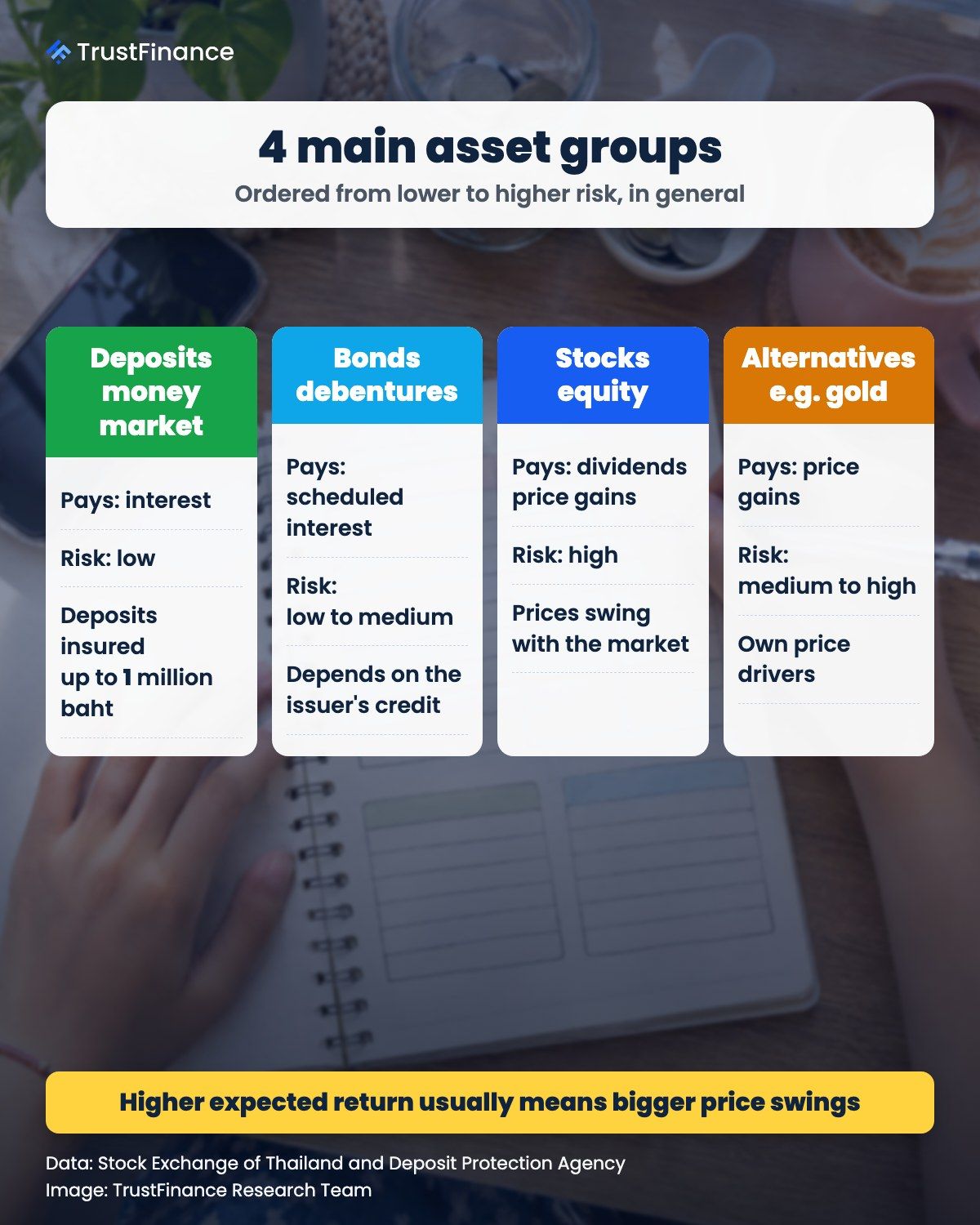
Investment assets fall into 4 main groups; the higher the expected return, the more the price tends to swing
Data: Stock Exchange of Thailand and Deposit Protection Agency · Image: TrustFinance Research Team
Every type of investment carries risk; only the kind and level differ. Knowing which risks you face helps you match assets to your goals better than looking at returns alone.
A simple example: 100,000 baht earning an average 3% a year for 10 years becomes about 134,392 baht, but if prices fall an average 3% a year it shrinks to about 73,742 baht. These are assumptions that show how much the direction of prices changes the outcome.
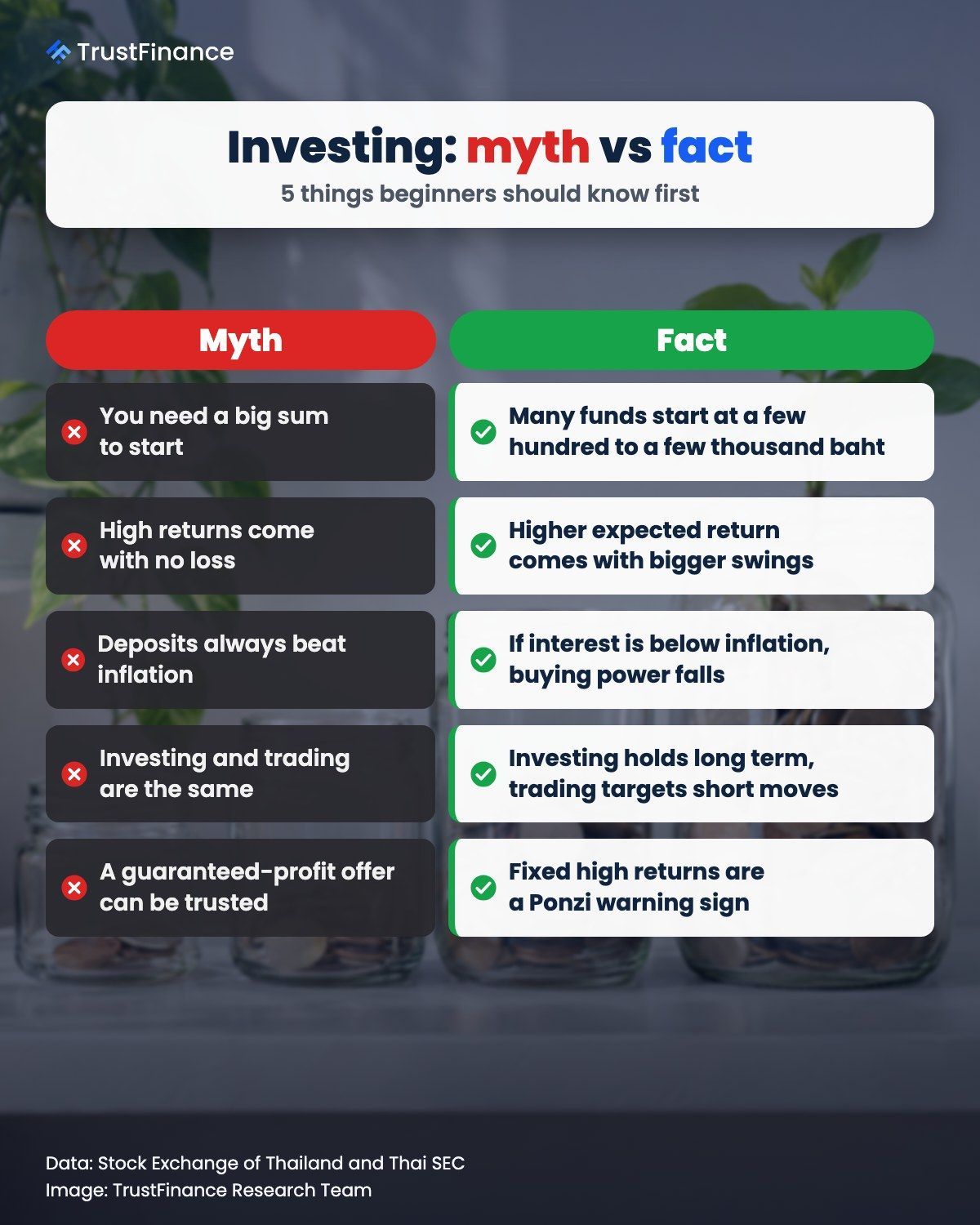
Every investment carries risk; offers that claim unusually high returns and promise no loss are a warning sign
Data: Stock Exchange of Thailand and Thai SEC · Image: TrustFinance Research Team
Yes, you can start with a few hundred or a few thousand baht. Many mutual funds set a low minimum, and stocks on the Thai exchange trade in board lots of 100 shares, with odd lots allowed under exchange rules.
Here is an example of investing 2,000 baht a month for 10 years (assumed figures, not the real return of any asset).
Example: investing 2,000 baht a month for 10 years Total principal = 2,000 × 120 months = 240,000 baht At an assumed 0.5% a year (close to savings interest): about 246,049 baht At an assumed 3% a year: about 279,483 baht At an assumed 5% a year: about 310,565 baht Carry on for 20 years at 5% a year: about 822,067 baht from 480,000 baht of principal |
Investing the same amount every month like this is called DCA. It builds discipline and removes the need to time the market. Read how it works and its limits in what is DCA, dollar-cost averaging.
Starting in a structured way helps avoid common mistakes. The usual order has 5 steps.
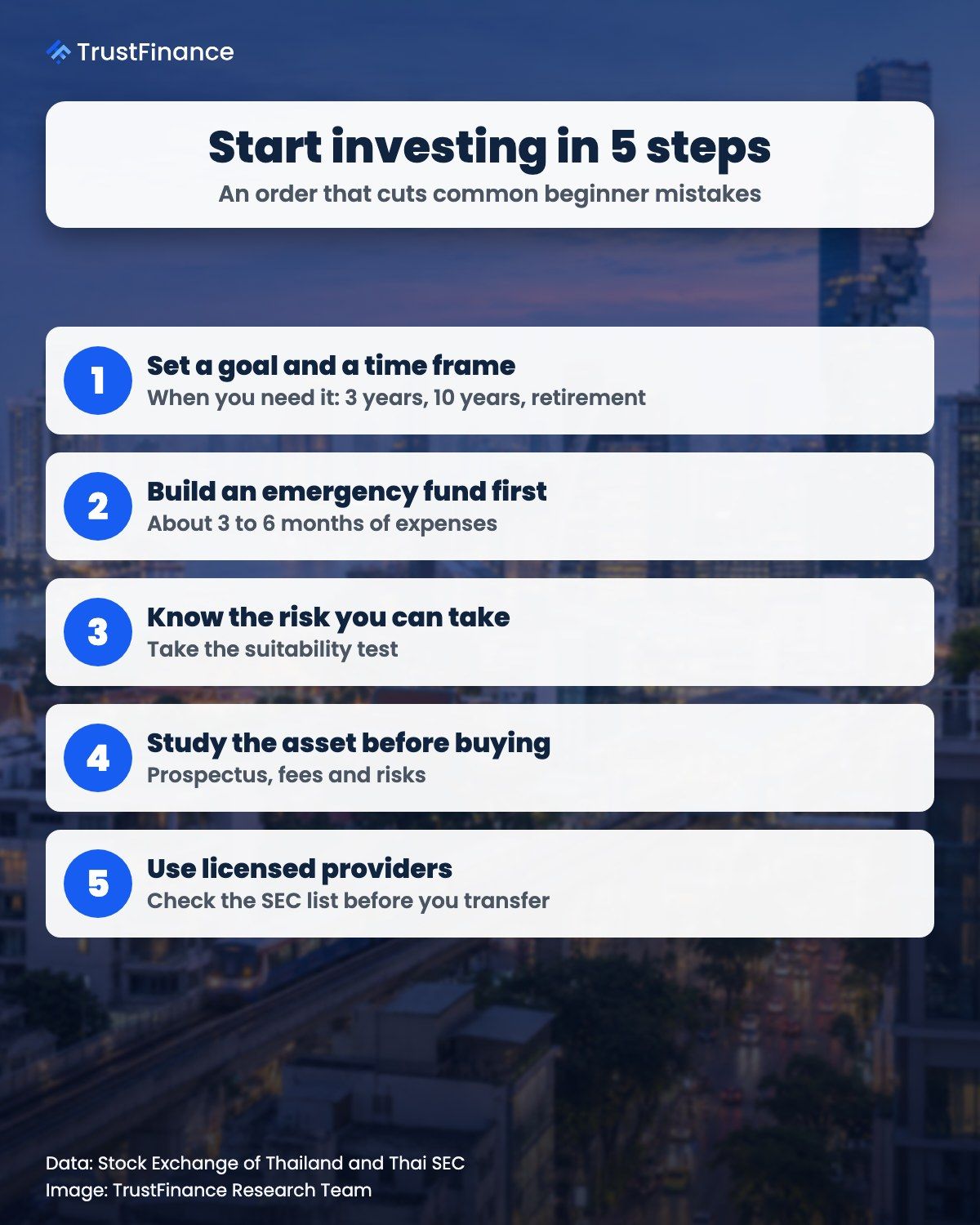
Before investing, keep an emergency fund of about 3 to 6 months of expenses and check the provider's licence with the SEC
Data: Stock Exchange of Thailand and Thai SEC · Image: TrustFinance Research Team
In Thailand, the Securities and Exchange Commission (SEC) supervises securities companies, asset management companies and digital asset businesses. The Bank of Thailand supervises commercial banks, and the Office of Insurance Commission (OIC) supervises insurers.
Investors can check licensed firms in the SEC Check First system before transferring money. If you get an offer through a chat app or social media that claims unusually high returns, check it first.
To learn where Thai stocks trade and how the SET and mai boards differ, read what the Stock Exchange of Thailand is.
Disclaimer: This article is for general education only. It is not investment advice or a solicitation to buy or sell securities, digital assets or derivatives. Readers should study the information and assess the risks themselves before making any decision. |
Investing means using money to buy assets such as stocks, bonds, mutual funds or gold in the hope of a future return, while accepting that their value can fall.
Yes. Many mutual funds accept minimums of a few hundred to a few thousand baht, but set aside an emergency fund first and study the risks of the asset.
No asset guarantees wealth. Results depend on time, discipline, fees and the risk you take. Offers that guarantee high returns are often scams.
Investing focuses on holding for the long term so value can grow. Trading focuses on frequent buying and selling for short-term price moves, with higher risk and higher transaction costs.
It is closer to saving. Deposits are protected up to 1 million baht per depositor per institution, but the return may be lower than inflation.
Investing means using money to buy assets for a return, in exchange for the risk that their value falls. A good start is a clear goal, an emergency fund, an understanding of the asset, and a licensed provider. Investing regularly over the long term lets compounding work, but every method still carries risk.
Other references: SET Investnow article on low- to high-risk assets (setinvestnow.com) · SEC Check First (market.sec.or.th) · future values computed with the monthly compounding formula (assumed figures)
Reviewed by TrustFinance Research Team · Data as of 23 November 2026
Thanakit Sutto
Content & PR Lead at TrustFinance. A finance writer who makes investing easy to understand.


