Loading
Related Articles
Fed Rate Hikes Are Back in 2026: What a Return to Tightening Means for the Dollar, Gold, and Traders
Fed Rate Hikes Are Back in 2026: What a Return to Tightening Means for the Dollar, Gold, and Traders
Related Articles

Thanakit Sutto
Nov 23, 2026
8 min read
0

Inflation and deflation are opposite states of the overall price level. Inflation is a sustained rise in prices, so the same money buys less; deflation is a sustained, broad fall in prices, so the same money buys more.
Both are harmful when severe. The Bank of Thailand therefore targets headline inflation of 1 to 3 percent, and its 2026 target statement says it will prevent deflation.
Key points
|
Inflation is a sustained rise in the general level of prices, not one product getting dearer. With 3% inflation a year, something that cost 100 baht costs about 103 baht a year later.
In Thailand, the main measure is the consumer price index (CPI) published monthly by the Ministry of Commerce, split into headline inflation (all items) and core inflation (excluding volatile fresh food and energy).
Deflation is a sustained and broad fall in the general level of prices. It sounds good for buyers, but when it lasts, households and firms tend to delay spending to wait for lower prices; sales fall, and firms cut output and jobs.
A temporary drop in some prices, such as oil or certain vegetables, is not deflation; the fall has to be broad and lasting. In 2025 and early 2026, Thai headline inflation was negative for several months, but core inflation stayed positive, so the Ministry of Commerce assessed that it was not deflation.
They differ in the direction of overall prices and the effect on buying power. The table sums up the key differences.
| Topic | Inflation | Deflation |
|---|---|---|
| Overall prices | Keep rising | Keep falling, broadly |
| Buying power of money | Falls | Rises |
| Spending behaviour | Buy before prices rise | Delay buying, wait for lower prices |
| Burden of existing debt | Lighter relative to income | Heavier relative to income |
| Effect on business | Higher costs, prices can be raised | Lower sales, cuts to output and jobs |
| Usual central bank tool | Raise the policy rate | Cut the policy rate |
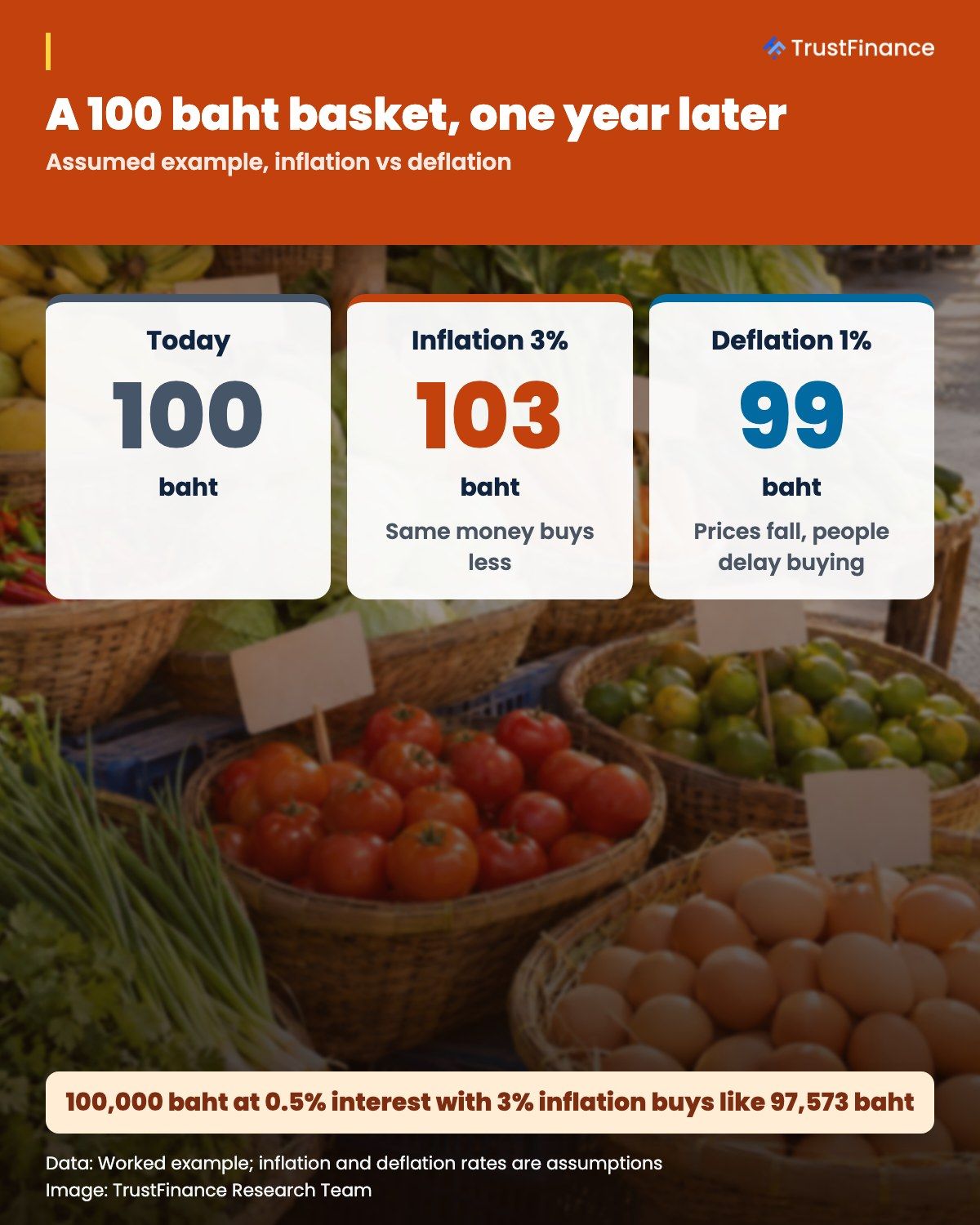
A 100 baht basket costs 103 baht a year later with 3% inflation, or 99 baht with 1% deflation
Data: Worked example; inflation and deflation rates are assumptions · Image: TrustFinance Research Team
Both come from imbalances between demand and the supply of goods, and from production costs. The main causes are:
A country's total spending is part of GDP; see how consumption, investment and exports fit together in what GDP is.
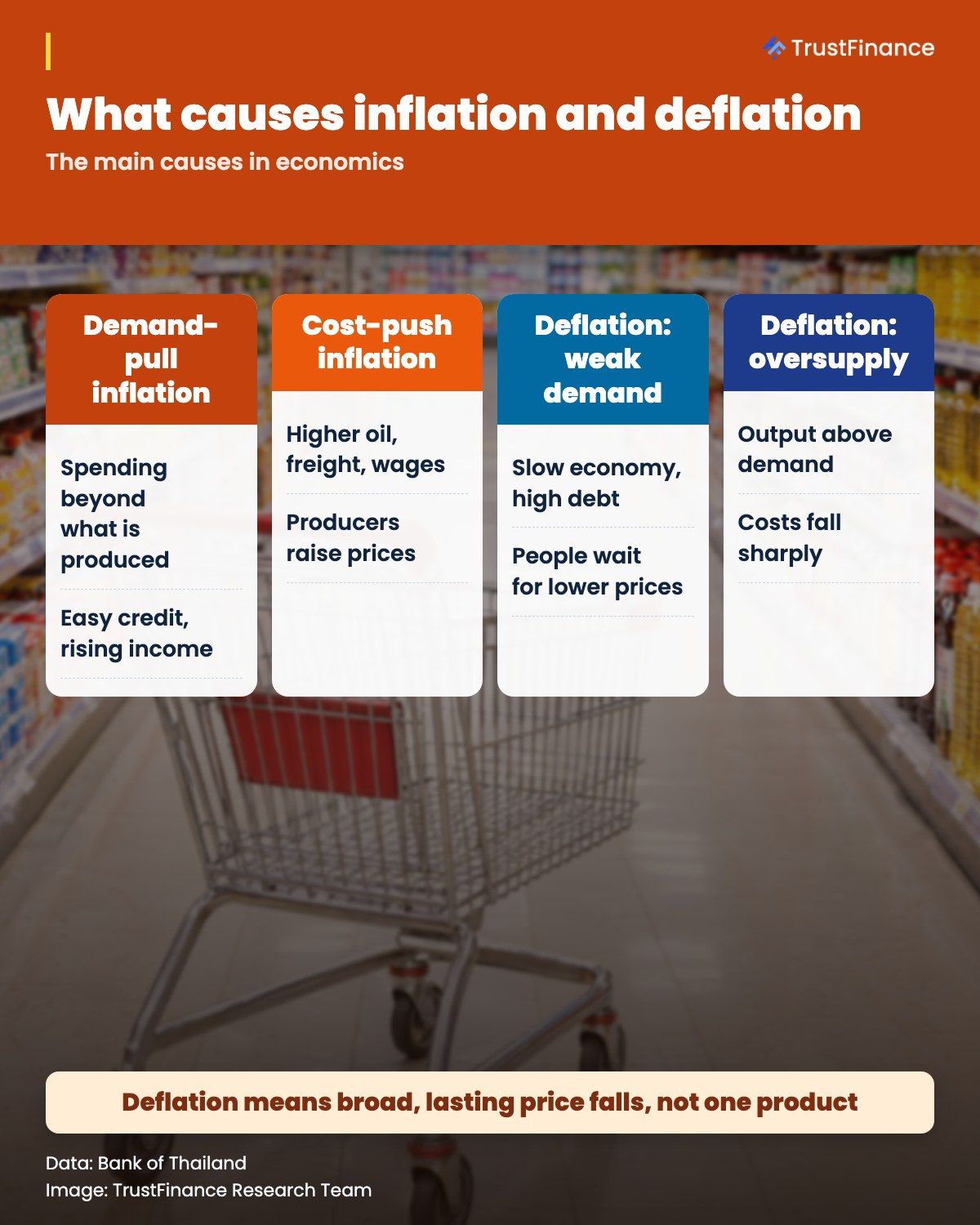
Inflation comes from strong demand or rising costs; deflation usually comes from weak demand or lasting oversupply
Data: Bank of Thailand · Image: TrustFinance Research Team
The effects depend on your role: cash savers, borrowers and employees gain or lose differently.
Example: 100,000 baht savings at 0.5% interest a year (assumed figures) With 3% inflation: buying power after 1 year ≈ 100,000 × 1.005 ÷ 1.03 = 97,573 baht With 1% deflation: buying power after 1 year ≈ 100,000 × 1.005 ÷ 0.99 = 101,515 baht Note: the real interest rate ≈ the interest earned minus inflation |
The BOT uses an inflation-targeting framework: the Finance Minister and the Monetary Policy Committee (MPC) agree on headline inflation of 1 to 3 percent as the medium-term target, and the 2026 target states that the BOT will prevent deflation (Bank of Thailand).
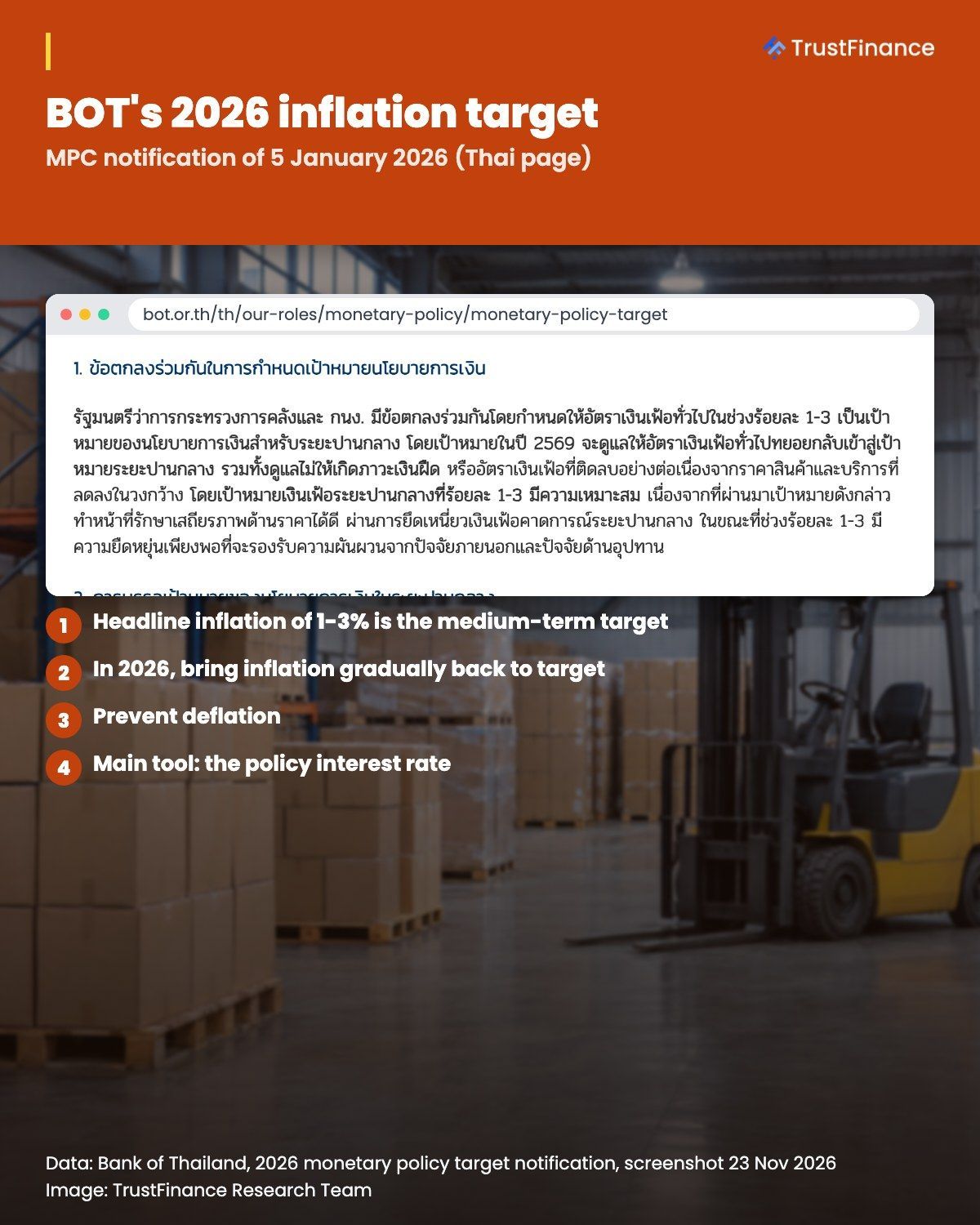
The BOT targets headline inflation of 1 to 3 percent over the medium term and, for 2026, says it will prevent deflation
Data: Bank of Thailand 2026 monetary policy target notification (5 Jan 2026) · Image: TrustFinance Research Team
Disinflation means prices still rise, but more slowly, for example from 4% to 1% a year. Deflation means prices actually fall, broadly and for a sustained period. The two terms are often mixed up in the news.
Long deflation has hit large economies, such as Japan after its asset bubble burst in the early 1990s. Read how economic crises unfold in what an economic crisis is.
Disclaimer: This article is for general education only. It is not investment advice or a solicitation to buy or sell securities, digital assets or derivatives. Figures in the examples are assumptions; readers should study the information and assess the risks themselves before deciding. |
Both are harmful when severe. High inflation erodes buying power, while long deflation cuts spending, output and jobs, which is why central banks aim for low, stable inflation.
The BOT targets headline inflation of 1 to 3 percent over the medium term, under its agreement with the Ministry of Finance.
No. The fall must be broad and lasting; a temporary drop in oil or vegetable prices is not deflation.
Core inflation leaves out volatile fresh food and energy prices, so it shows the trend of most prices more clearly.
Cash gains buying power, but a slowing economy puts income and jobs at risk, and existing debt becomes heavier.
Inflation is a sustained rise in overall prices; deflation is a sustained, broad fall. They affect buying power, debt and jobs in opposite ways. The BOT targets inflation of 1 to 3 percent and uses the policy rate to manage it. Telling disinflation apart from deflation helps you read economic news correctly.
Other references: Ministry of Commerce monthly headline and core CPI (tpso.go.th) · figures in the basket and savings examples are assumptions
Reviewed by TrustFinance Research Team · Data as of 23 November 2026
Thanakit Sutto
Content & PR Lead at TrustFinance. A finance writer who makes investing easy to understand.


