Loading
Related Articles
Fed Rate Hikes Are Back in 2026: What a Return to Tightening Means for the Dollar, Gold, and Traders
Fed Rate Hikes Are Back in 2026: What a Return to Tightening Means for the Dollar, Gold, and Traders
Related Articles

Thanakit Sutto
Nov 23, 2026
9 min read
1

Unit-linked insurance (ประกันควบการลงทุน) is a life insurance policy that combines life cover and investment in mutual funds in one contract. Part of each premium pays for insurance and fees; the rest buys fund units chosen by the policyholder.
The policy's value therefore moves with the fund's net asset value (NAV), with no guaranteed payout like a traditional savings policy. Sellers must be agents or brokers licensed to sell unit-linked policies, which you can check in the system of Thailand's Office of Insurance Commission (OIC).
Key points
|
A unit-linked policy turns the premium left after charges into mutual fund units, then deducts the insurance cost from those units over time. On death, the beneficiary receives the sum assured plus the unit value, or as the policy states.
The investment part of a unit-linked policy is an ordinary mutual fund. To understand fund costs and returns, bonds are a common building block; see what a corporate bond is.
Each premium splits three main ways. Real rates differ by plan and insurer and are listed in the policy's fee table.
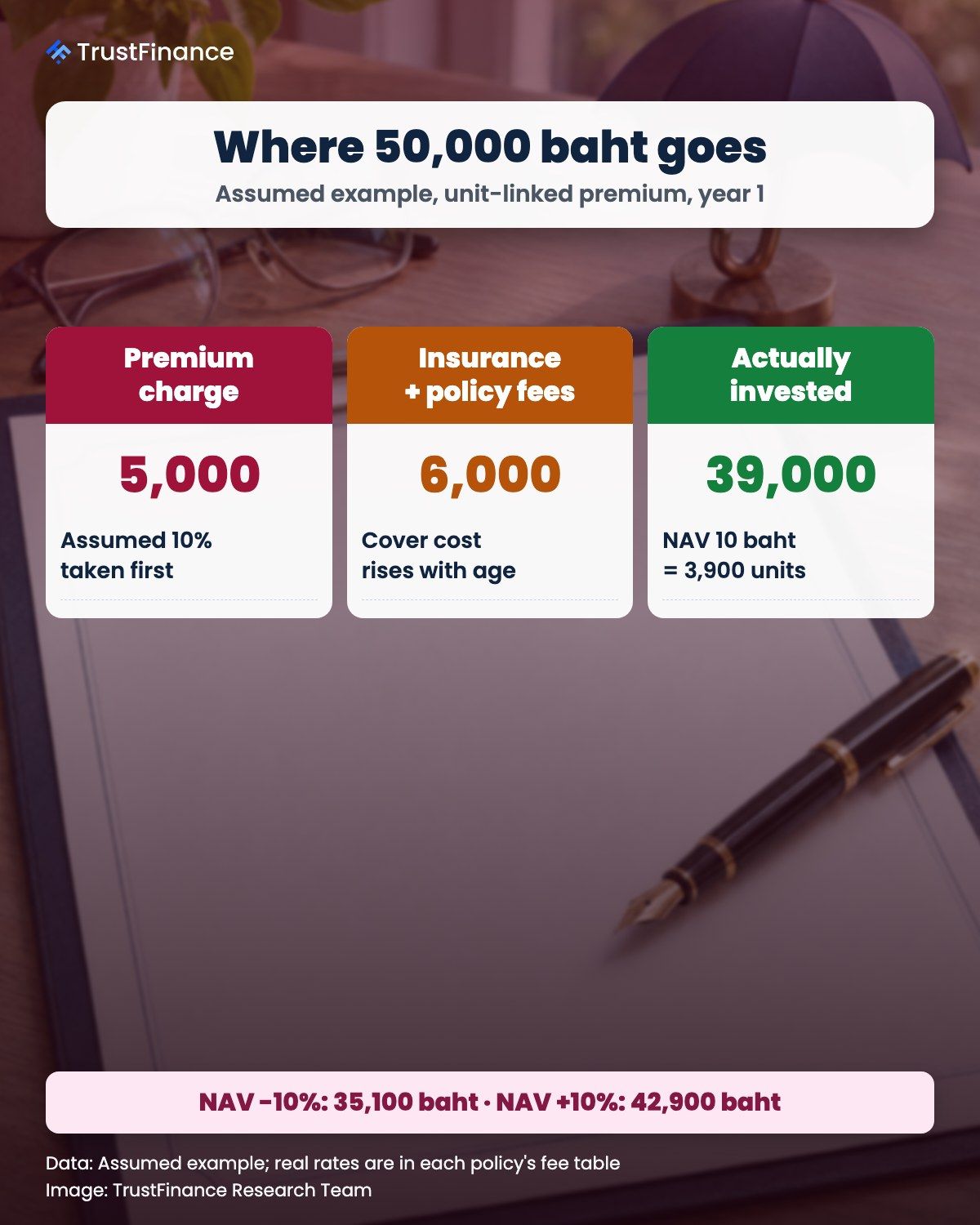
In this assumed example, a 50,000 baht yearly premium loses 11,000 baht to charges, leaving 39,000 baht invested
Data: Assumed example; real rates are in each policy's fee table · Image: TrustFinance Research Team
Assumed example: 50,000 baht yearly premium Assumed premium charge of 10% = 5,000 baht Assumed insurance cost and policy fee = 6,000 baht Invested = 50,000 − 5,000 − 6,000 = 39,000 baht Units bought at a NAV of 10 baht = 3,900 units If NAV falls 10% to 9 baht, value = 3,900 × 9 = 35,100 baht If NAV rises 10% to 11 baht, value = 3,900 × 11 = 42,900 baht |
Unit-linked sits between traditional life insurance and buying mutual funds yourself. The upside is cover and investing in one place; the trade-off is higher and more complex costs.
| Topic | Traditional life insurance | Unit-linked | Buying funds yourself |
|---|---|---|---|
| Life cover | Yes, per contract | Yes, level can be chosen | No |
| Payout or value | Set in the contract | Follows NAV, not guaranteed | Follows NAV, not guaranteed |
| Who bears investment risk | The insurer | The policyholder | The investor |
| Costs | Built into the premium | Insurance cost + several layers of fees | Fund fees |
| Regulator | OIC | OIC and SEC (fund part) | SEC |
Paying the same premium every year works much like dollar-cost averaging, whose mechanics and limits are explained in what DCA is.
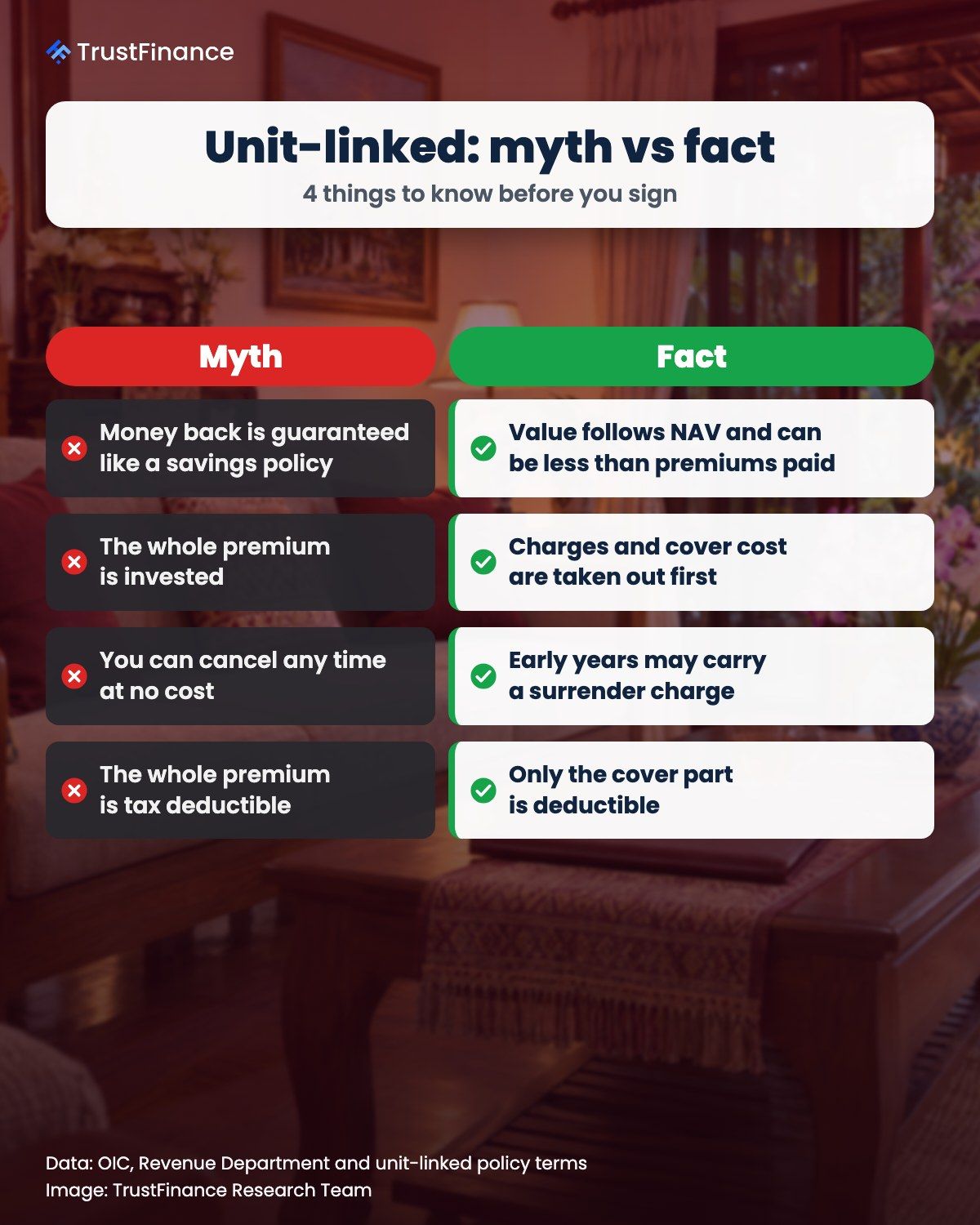
A unit-linked policy's value follows NAV with no guaranteed payout, and cancelling in the early years may carry a surrender charge
Data: OIC, Revenue Department and unit-linked policy terms · Image: TrustFinance Research Team
The main risk is that the policyholder carries the investment risk. If the chosen funds lose money, the policy value falls with them.
Partly. Life insurance premiums are deductible up to 100,000 baht a year for policies of 10 years or more (Revenue Department). For unit-linked, the deductible amount is the protection part of the premium shown on the insurer's certificate; the invested part is not deductible.
The OIC supervises life insurers and agents, while the mutual funds inside the policy fall under the SEC. Unit-linked sellers need a life insurance agent licence plus an extra qualification to sell unit-linked.
The OIC "agent/broker check" has a separate "unit-linked sellers" tab where you search by name or licence number (Office of Insurance Commission). Check before signing the application.
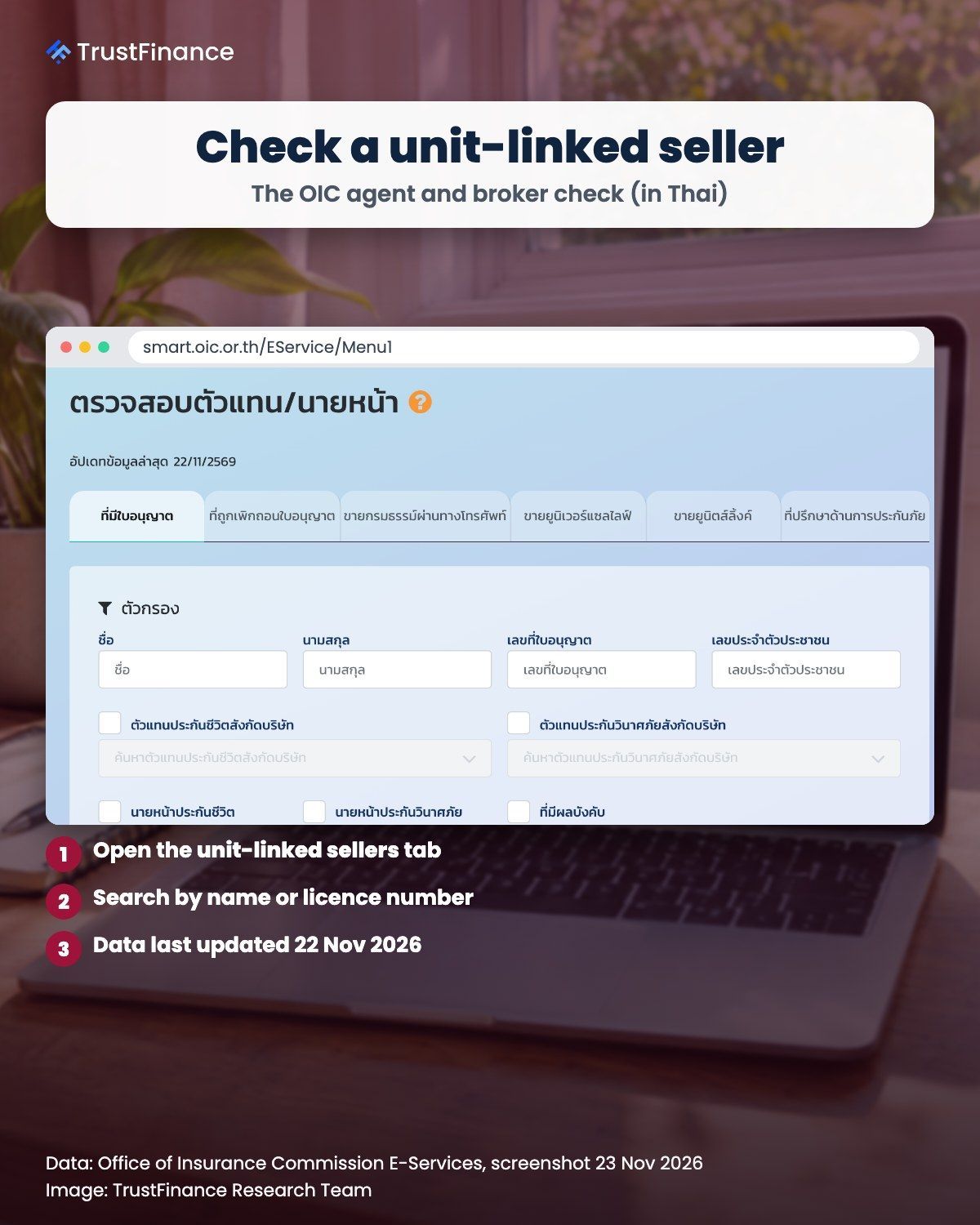
The OIC system lets you check by name or licence number whether an agent may sell unit-linked policies
Data: Office of Insurance Commission E-Services, screenshot 23 Nov 2026 · Image: TrustFinance Research Team
The Life Assurance Fund (กองทุนประกันชีวิต) is not a product you can buy. It is a body set up under the Life Insurance Act to protect policyholders and beneficiaries when a life insurer's licence is revoked. Unit-linked is a policy that insurers sell, so the two are different things despite similar Thai names.
Compulsory motor insurance is another type the OIC supervises; see the cover in what Thai compulsory motor insurance (Por Ror Bor) is.
Before buying, read the product summary and fee table in full, because terms differ a lot between plans.
Disclaimer: This article is for general education only. It is not advice on choosing insurance, not investment advice, and not a solicitation to buy or sell fund units. Readers should study the policy terms and assess the risks themselves before deciding. |
No. The policy value follows the NAV of the chosen funds and can be more or less than the premiums paid.
Only the protection part on the insurer's certificate, within the 100,000 baht yearly life insurance limit, for policies of 10 years or more.
Yes, but early years may carry surrender charges and little has been invested yet, so you may get back far less than you paid.
It is a body under the Life Insurance Act that protects policyholders when a life insurer's licence is revoked. It is not an investment fund.
Search the agent's name or licence number in the OIC agent check, under the "unit-linked sellers" tab.
Unit-linked insurance combines life cover and mutual funds in one policy. Its value moves with NAV and it carries several layers of charges, especially in the early years. It suits long holding periods, and the fee table must be read in full. Before buying, check the seller with the OIC and remember that only the protection part is tax deductible.
Other references: 100,000 baht life premium deduction cap (rd.go.th) · fee figures in the example are assumptions; real rates are in each policy's fee table
Reviewed by TrustFinance Research Team · Data as of 23 November 2026
Thanakit Sutto
Content & PR Lead at TrustFinance. A finance writer who makes investing easy to understand.


