Loading
Related Articles
Fed Rate Hikes Are Back in 2026: What a Return to Tightening Means for the Dollar, Gold, and Traders
Fed Rate Hikes Are Back in 2026: What a Return to Tightening Means for the Dollar, Gold, and Traders
Related Articles

Thanakit Sutto
พ.ย. 23, 2026
9 min read
0

A provident fund (กองทุนสำรองเลี้ยงชีพ, PVD) is a long-term savings fund that an employer and employees set up together on a voluntary basis in Thailand. Employees put part of their salary in, and the employer adds a top-up, to build a lump sum for retirement, resignation or death.
Funds are set up under the Provident Fund Act B.E. 2530 (1987) and managed by asset management companies licensed by the Thai SEC, so the money is kept separate from the employer's own assets.
Key points
|
A provident fund works like automatic savings. Each month the employer deducts part of the employee's salary (savings) and adds its own money (top-up). The asset manager then invests the money in the plan the member chooses.
A PVD is a benefit that a company chooses to offer, so not every employer has one. It differs from the Social Security Fund, which employees in the system must pay into by law; the two are separate retirement pots. See the Social Security side in how much the Social Security retirement pension pays.
| Topic | Provident fund (PVD) | Social Security (old-age benefit) |
|---|---|---|
| Joining | Voluntary, set up by the employer | Required for insured employees |
| Who pays in | Employee and employer, at the fund's rates | Employee, employer and the state |
| Who manages it | An asset manager licensed by the SEC | The Social Security Office |
| Choose your own plan | Yes, from the plans the fund offers | No |
Each member's PVD account has 4 parts, and what you keep when you resign differs by part.
A common rule is that members with under 1 year of service may get none of the top-up, and get 100% after the years the by-laws set. Read the by-laws of the fund your company uses.
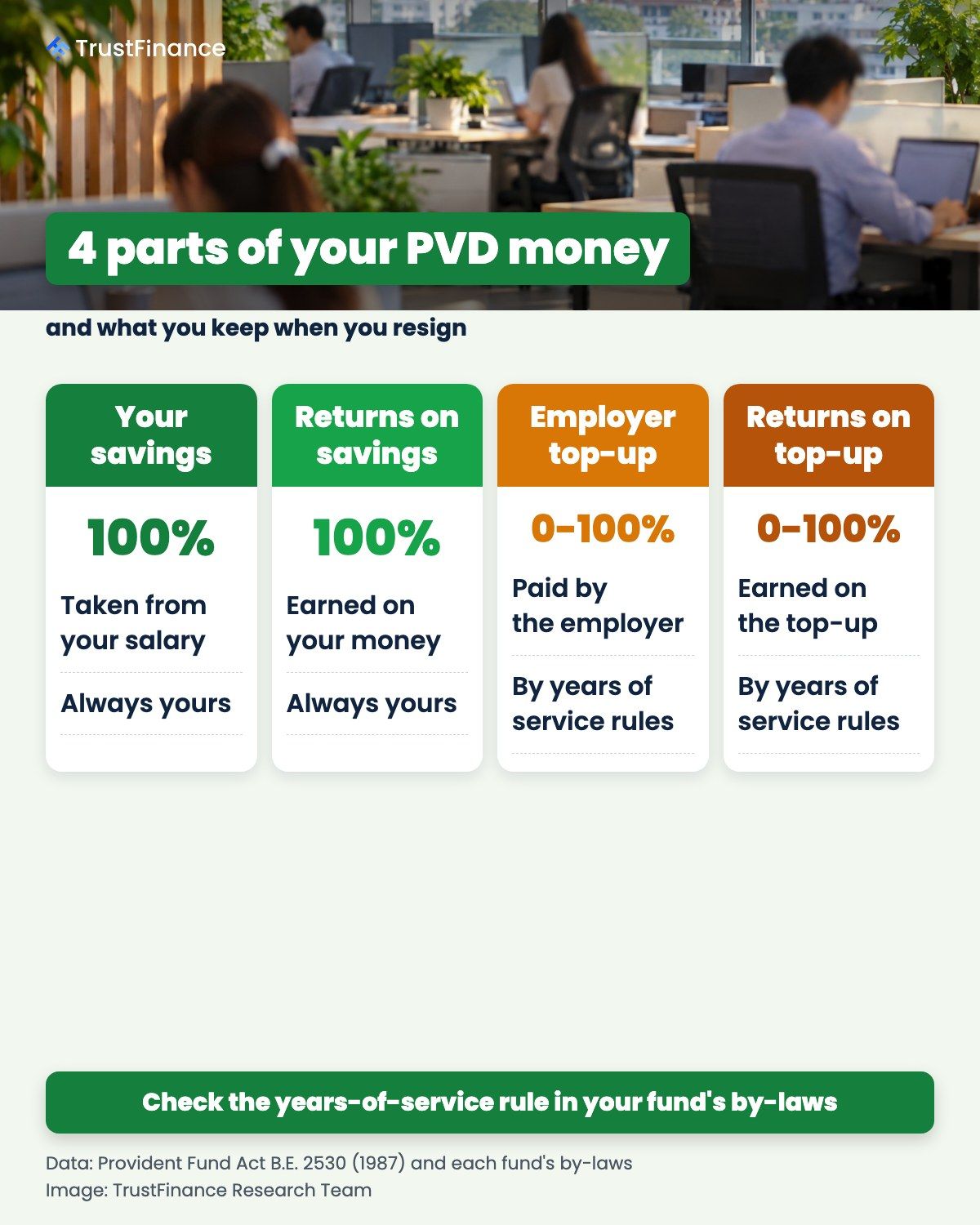
Your own savings and their returns are always yours; the employer's top-up depends on years of service under the fund's by-laws
Data: Provident Fund Act B.E. 2530 (1987) and each fund's by-laws · Image: TrustFinance Research Team
Savings and top-up rates are usually between 2% and 15% of wages; the rate used depends on each fund's by-laws. Many companies let employees choose among several savings rates.
Example: 30,000 baht salary, 5% savings, 5% employer top-up Employee savings = 30,000 × 5% = 1,500 baht a month Employer top-up = 30,000 × 5% = 1,500 baht a month Total into the fund: 3,000 baht a month, or 36,000 baht a year After 20 years, principal is 720,000 baht (salary rises not included) At an assumed 2% a year: about 884,391 baht At an assumed 4% a year: about 1,100,324 baht |
The growth above the principal comes from compounding; the earlier you start, the longer returns have to work. See the idea in compound interest explained. The figures above are assumptions, not the return of any fund.
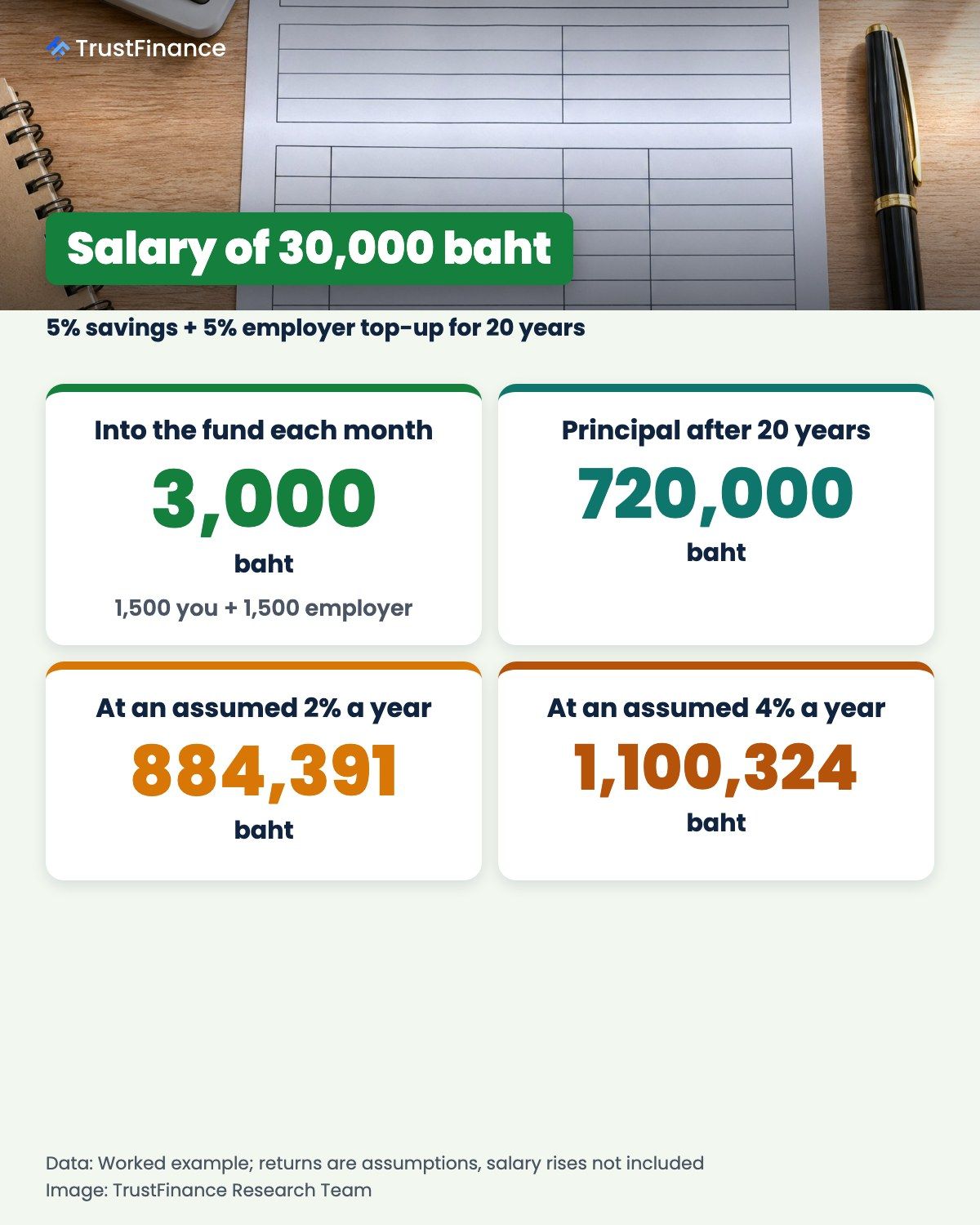
On a 30,000 baht salary with 5% each side, 3,000 baht a month goes into the fund, or 720,000 baht of principal over 20 years
Data: Worked example; returns are assumptions · Image: TrustFinance Research Team
Employee contributions are deductible at the amount actually paid, up to 15% of wages, and together with RMF, pension life insurance and other retirement items they must not exceed 500,000 baht a year (Revenue Department).
You can withdraw when membership ends, for example on resignation, retirement or death. If you are 55 or older and have been a member for at least 5 years, the payout is tax-free under Revenue Department rules.
Most funds let members choose their own plan (Employee's Choice), from low-risk money market plans to more volatile equity plans. The choice should match the years left to retirement and the risk you can take.
The Stock Exchange of Thailand offers a free "provident fund savings planner" where you enter your details and see an estimate of what you may receive at retirement (Stock Exchange of Thailand).
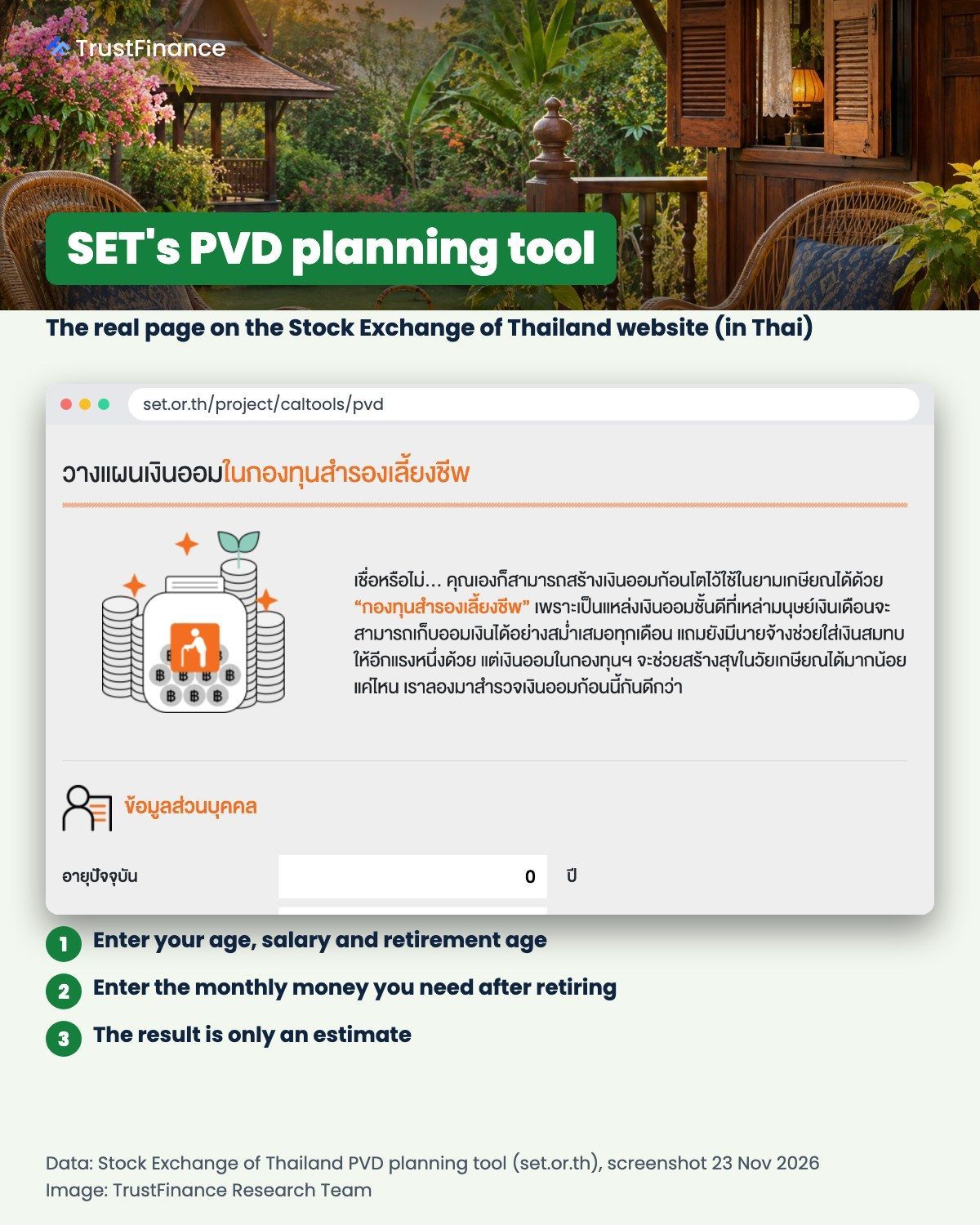
The SET tool asks for your age, salary and retirement goal to estimate your provident fund money; the page is in Thai
Data: Stock Exchange of Thailand PVD planning tool (set.or.th) · Image: TrustFinance Research Team
Disclaimer: This article is for general education only. It is not investment advice or a solicitation to buy or sell securities, fund units or derivatives. Tax rules may change by Revenue Department notice; check your fund's by-laws and assess the risks yourself before deciding. |
PVD money is the balance in your provident fund: your savings, your employer's top-up and the investment returns on both.
Your own contributions are deductible at the amount paid, up to 15% of wages, within a 500,000 baht yearly cap shared with other retirement items.
Yes. Your savings and their returns come back in full; the top-up depends on years of service, and tax may apply if you are under 55.
When you are 55 or older and have been a member for at least 5 years, the payout on leaving the fund is tax-free under Revenue Department conditions.
Yes. Unit values move with the investment plan, and stock-heavy plans can swing a lot in the short term.
A provident fund is retirement savings that employees contribute and employers top up. Contributions are deductible up to 15% of wages, and payouts are tax-free at age 55 with 5 years of membership. The key points to check are your savings rate, the years-of-service rule for the top-up, and an investment plan that fits your time to retirement.
Other references: Provident Fund Act B.E. 2530 (1987) and amendments · Revenue Department notifications on tax-free payouts at age 55 with 5 years of membership (rd.go.th) · future values are assumptions
Reviewed by TrustFinance Research Team · Data as of 23 November 2026
Thanakit Sutto
Content & PR Lead at TrustFinance. A finance writer who makes investing easy to understand.


