Loading
Related Articles
Fed Rate Hikes Are Back in 2026: What a Return to Tightening Means for the Dollar, Gold, and Traders
Fed Rate Hikes Are Back in 2026: What a Return to Tightening Means for the Dollar, Gold, and Traders
Related Articles

Thanakit Sutto
Nov 23, 2026
8 min read
0

A mutual fund (กองทุนรวม) pools money from many investors into one fund, which an asset management company licensed by Thailand's SEC invests according to a stated policy. Investors hold fund units and gain or lose with the net asset value (NAV) per unit.
Mutual funds let people with small amounts spread their money across stocks, bonds or gold without picking each asset themselves. Data from the Association of Investment Management Companies (AIMC) as of 18 Sep 2025 show about 3,400 mutual funds in Thailand, with net assets of 6.248 trillion baht.
Key points
|
A mutual fund divides its money into units. Investors buy units at that day's NAV, the asset manager invests the whole pool, and the NAV is recalculated every business day from the value of what the fund holds.
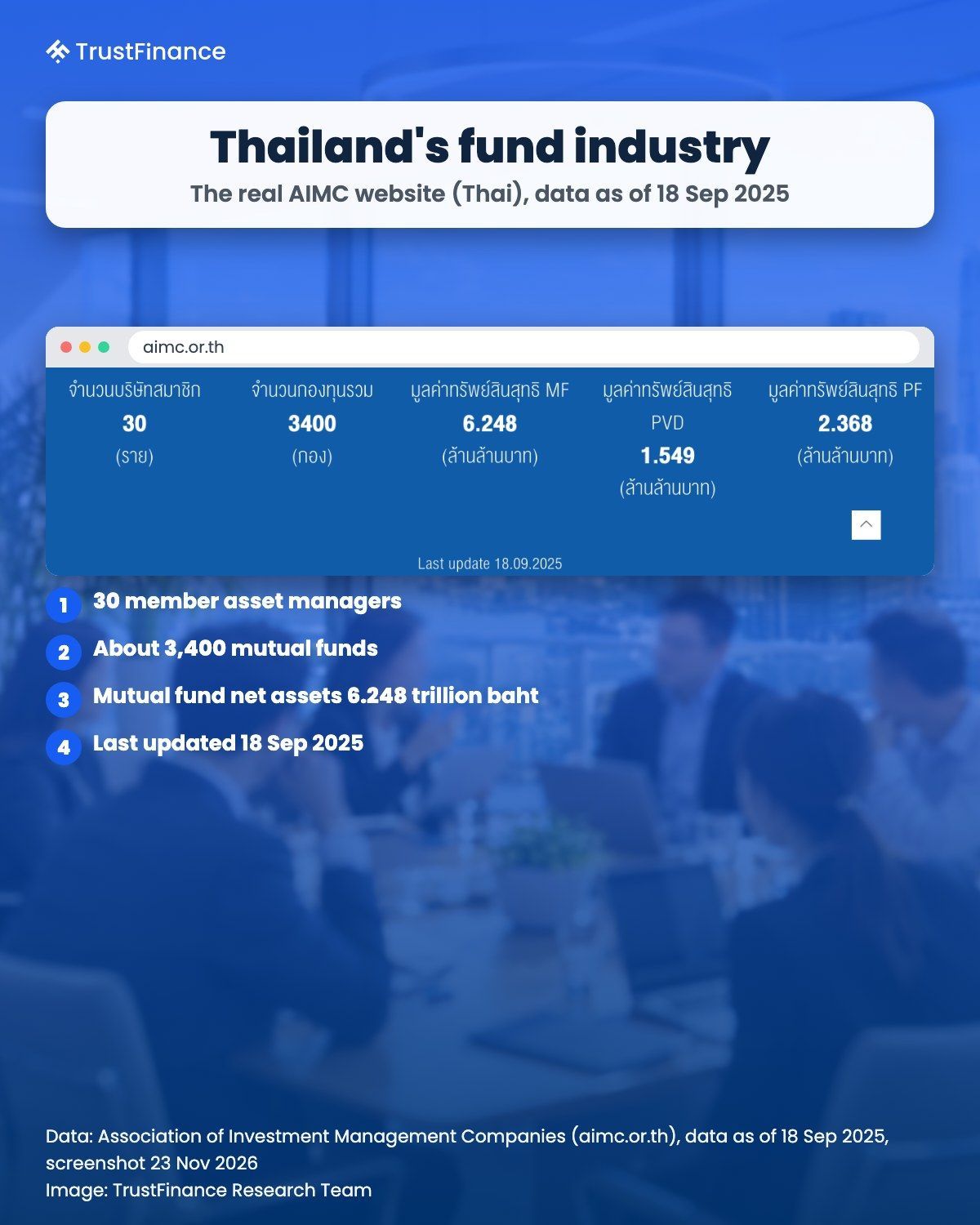
AIMC data as of 18 Sep 2025 show about 3,400 mutual funds in Thailand with 6.248 trillion baht in net assets
Data: Association of Investment Management Companies (aimc.or.th), data as of 18 Sep 2025, screenshot 23 Nov 2026 · Image: TrustFinance Research Team
Mutual fund returns come from the change in NAV between the day you buy and the day you sell, and from dividends in funds with a dividend policy.
Assumed example: investing 10,000 baht Buying at a NAV of 12.50 baht = 10,000 ÷ 12.50 = 800 units If NAV rises to 13.00 baht, value = 800 × 13.00 = 10,400 baht (a 400 baht gain) With a 1% front-end fee, money actually invested = 9,900 baht = 792 units Value at a NAV of 13.00 baht = 792 × 13.00 = 10,296 baht If NAV falls to 11.50 baht, value = 792 × 11.50 = 9,108 baht |
Mutual funds fall into 5 main groups by what they invest in, and the Thai SEC rates fund risk on 8 levels, from 1 (lowest) to 8 (highest). The Stock Exchange of Thailand's investor education pages explain the same asset groups (Stock Exchange of Thailand).
| Type | Invests in | Typical risk level |
|---|---|---|
| Money market funds | Deposits, short-term bills | 1 to 2 |
| Fixed income funds | Government bonds, corporate bonds | 3 to 4 |
| Mixed funds | Stocks and bonds | 5 |
| Equity funds | Thai or foreign stocks | 6 to 7 |
| Alternative funds | Gold, oil, property | 8 or per asset |
Fixed income funds invest in corporate and government bonds, which carry the issuer's credit risk; read more in what a corporate bond is.
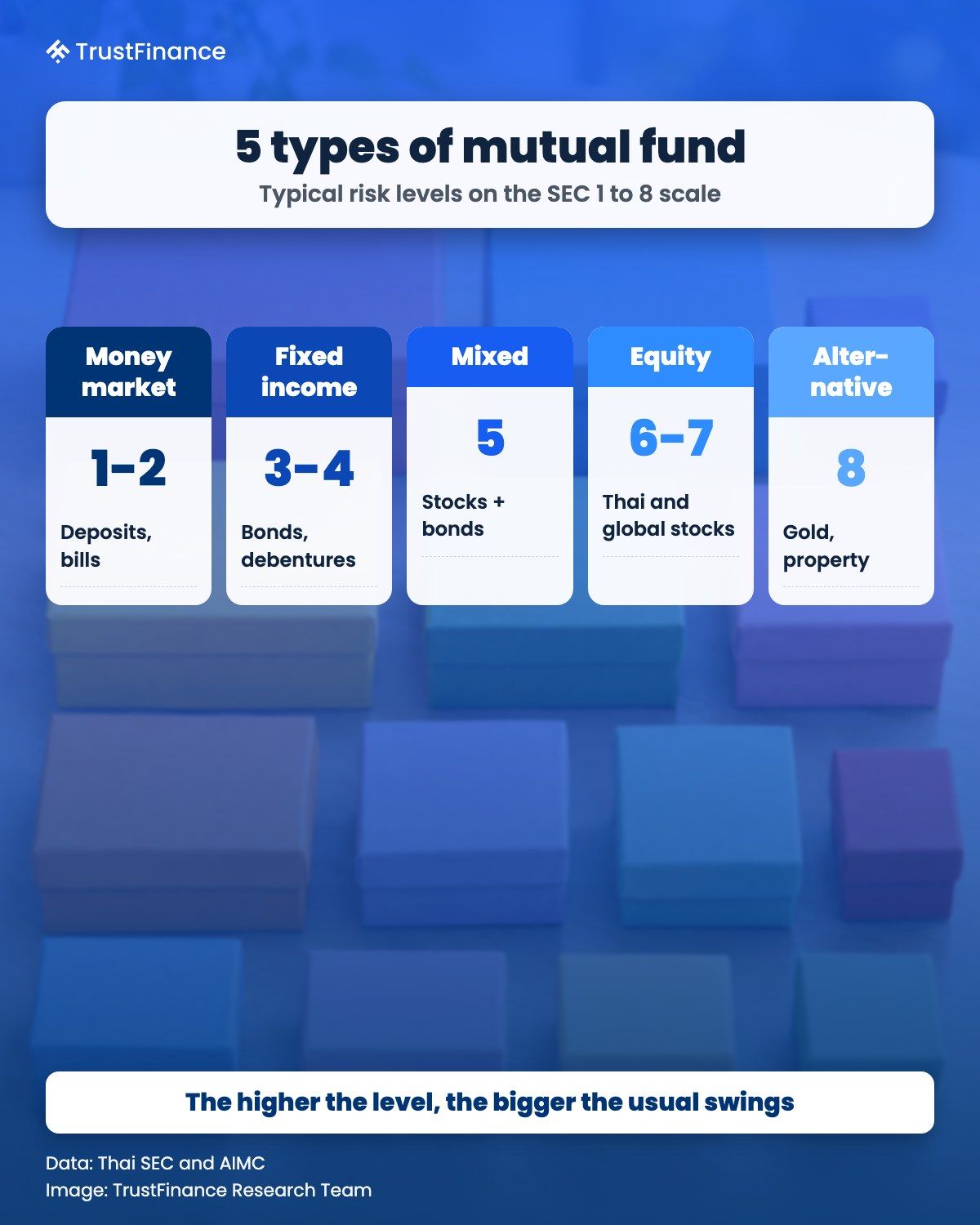
Mutual funds fall into 5 main groups by asset, with 8 risk levels under the Thai SEC scale
Data: Thai SEC and AIMC · Image: TrustFinance Research Team
Mutual fund fees split into those paid when you buy or sell, and those taken from the fund every day and already reflected in NAV. All are listed in the fund fact sheet.
The fund fact sheet is a summary prospectus that asset managers must produce. It helps you compare funds quickly. Read it in this order:
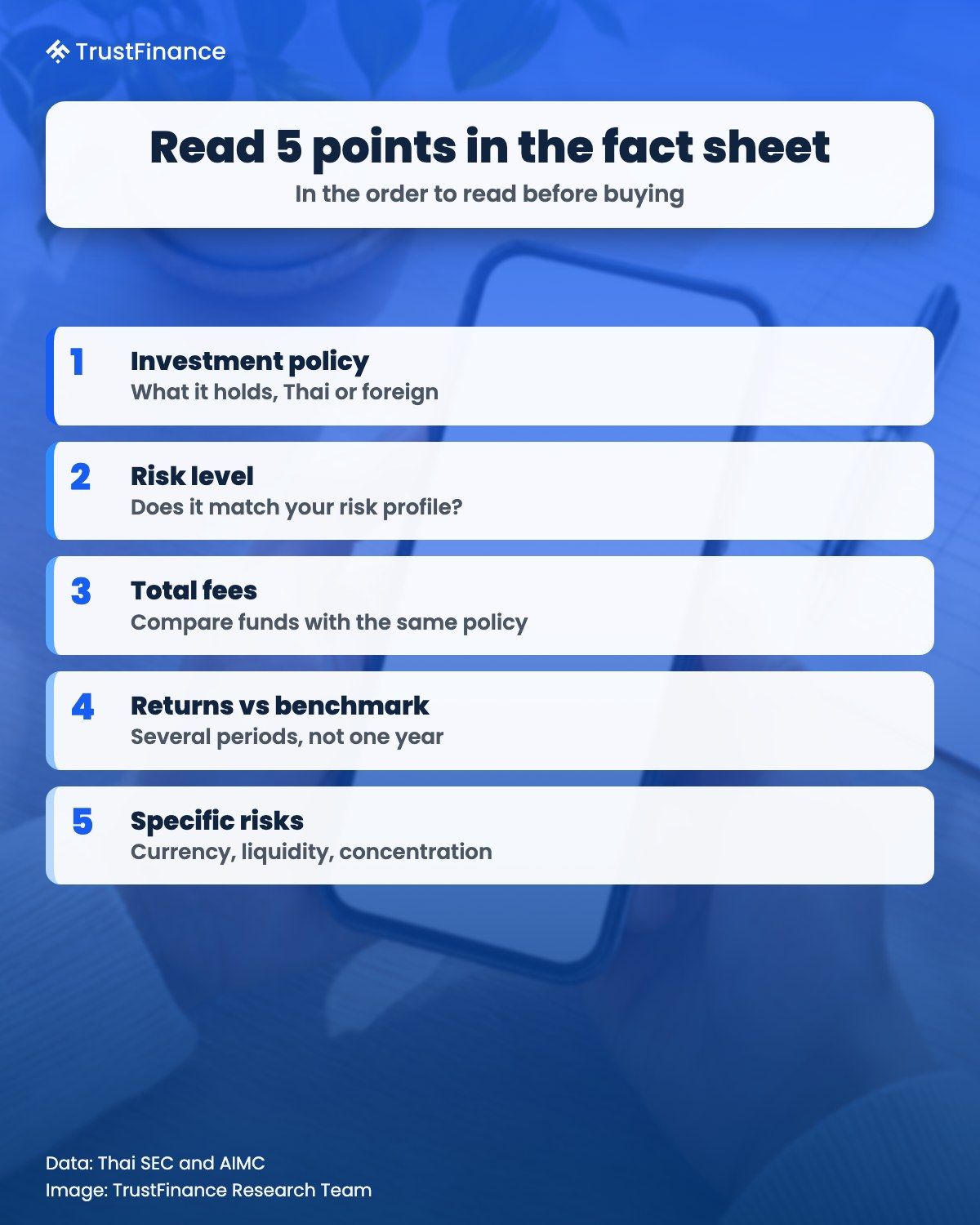
Before buying a mutual fund, read the fact sheet for policy, risk level, fees, returns against the benchmark and specific risks
Data: Thai SEC and AIMC · Image: TrustFinance Research Team
Mutual funds suit people without time to pick assets themselves, but you accept fees and the risks of the assets the fund holds.
Disclaimer: This article is for general education only. It is not investment advice or a solicitation to buy or sell fund units, securities or derivatives. Past performance does not guarantee future results; readers should study the information and assess the risks themselves before deciding. |
Regular mutual funds trade with the asset manager at the end-of-day NAV, while ETFs trade on the stock exchange during the day at market prices.
Yes. NAV moves with the prices of the fund's assets, and mutual funds are not protected like bank deposits.
It depends on the fund type and your goal. Money market funds can park cash short term, while equity funds are usually designed for holding several years through volatility.
Eight under the Thai SEC scale, from level 1 for domestic money market funds to level 8 for funds investing in alternative assets.
Many funds set minimums of a few hundred to a few thousand baht; check each fund's prospectus.
A mutual fund pools money from many investors for an asset manager to invest, and investors earn returns through NAV. Thailand has about 3,400 mutual funds worth 6.248 trillion baht (AIMC, data as of 18 Sep 2025). Before buying, read the fact sheet for the policy, risk level and fees, and remember that mutual funds do not protect your principal.
Other references: Thai SEC 8-level fund risk scale and summary prospectus rules (sec.or.th) · NAV and fee figures in the example are assumptions
Reviewed by TrustFinance Research Team · Data as of 23 November 2026
Thanakit Sutto
Content & PR Lead at TrustFinance. A finance writer who makes investing easy to understand.


