Loading
Related Articles
Fed Rate Hikes Are Back in 2026: What a Return to Tightening Means for the Dollar, Gold, and Traders
Fed Rate Hikes Are Back in 2026: What a Return to Tightening Means for the Dollar, Gold, and Traders
Related Articles

Thanakit Sutto
11월 23, 2026
8 min read
0

The US dollar to Thai baht rate (USD/THB) tells you how many baht one US dollar buys. On 23 November 2026, the Bank of Thailand's weighted-average interbank rate was 33.993 baht per 1 US dollar.
This number changes every day and is a reference rate, not the rate you get at a counter. Banks and money changers set their own buying and selling rates, which differ slightly from the reference.
Key points
|
As of 23 November 2026, the Bank of Thailand (BOT) published a weighted-average interbank rate of 33.993 baht per 1 US dollar. The average rates of commercial banks in Bangkok, split into buying and selling rates, are in the table below.
| Rate type (baht per 1 US dollar) | 23 Nov 2026 | 20 Nov 2026 |
|---|---|---|
| Reference rate (interbank average) | 33.9930 | 33.9530 |
| Bank buys notes / drafts (Buying Sight) | 33.7253 | 33.7376 |
| Bank buys transfers (Buying Transfer) | 33.8165 | 33.8065 |
| Bank sells (Selling) | 34.1573 | 34.1252 |
| Mid rate | 33.9869 | 33.9659 |
All figures come from the BOT statistics table "Rates of Exchange of Commercial Banks in Bangkok Metropolis" (Bank of Thailand), last updated on 23 Nov 2026 at 18:00.
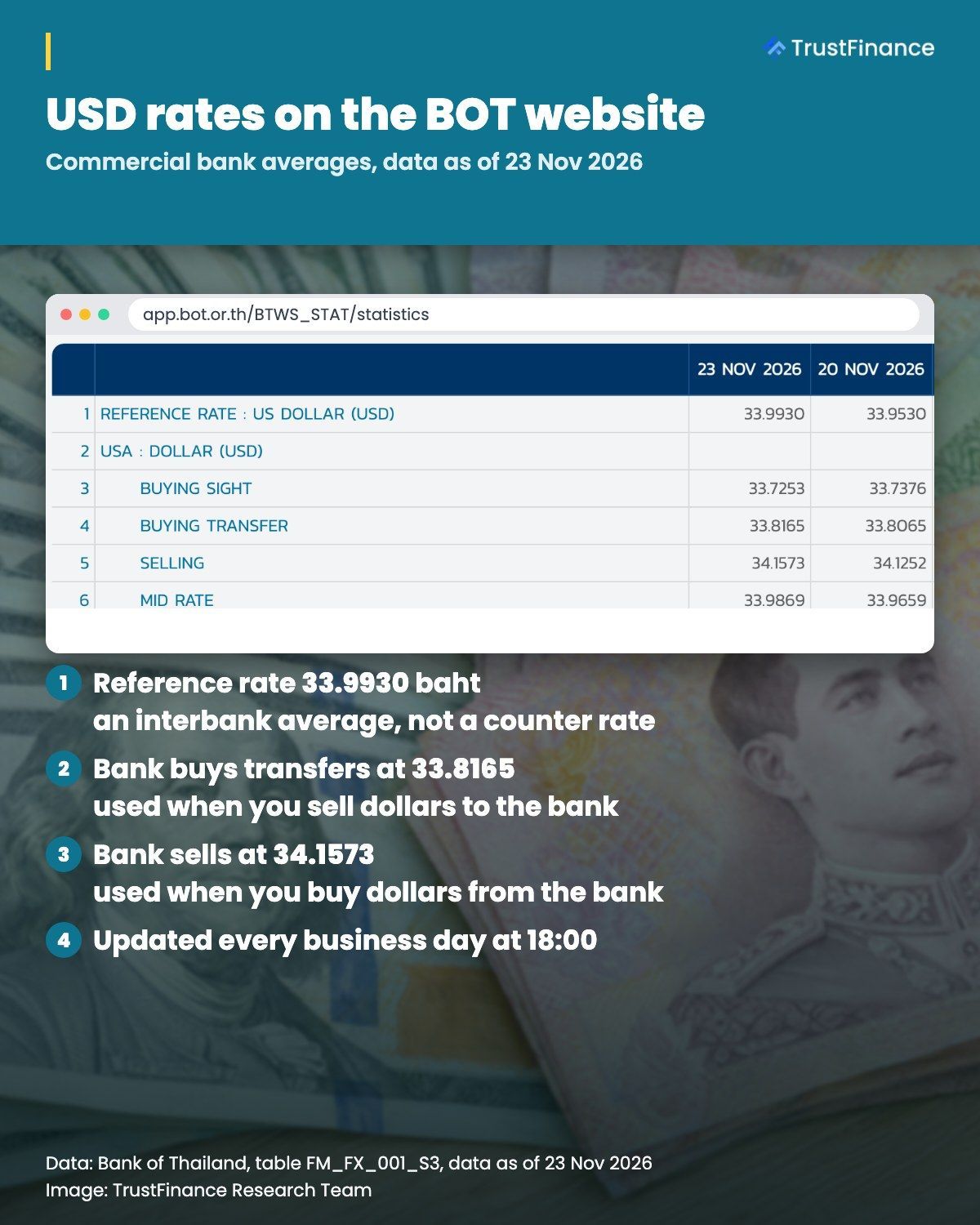
On 23 Nov 2026, Bangkok commercial banks bought dollar transfers at an average 33.8165 baht and sold at 34.1573 baht
Data: Bank of Thailand, table FM_FX_001_S3, data as of 23 Nov 2026 · Image: TrustFinance Research Team
Buying and selling rates differ because the exchange provider carries costs and the risk that the currency moves. The gap is called the spread, and the rates are named from the bank's side, not the customer's.
On 23 Nov 2026, the average selling rate was about 0.43 baht per dollar above the cash buying rate. If you exchange often or in large amounts, that gap adds up to a visible sum.
Conversion is a simple multiplication or division by the exchange rate. Pick the rate for your side of the deal: use the selling rate when you buy dollars, and the buying rate when you sell dollars.
Worked example (BOT average rates, data as of 23 Nov 2026) Dollars to baht = dollars × rate Buying 1,000 dollars for a trip: 1,000 × 34.1573 = 34,157.30 baht Selling 1,000 dollars back as cash: 1,000 × 33.7253 = 33,725.30 baht Gap from buying and selling back at once = 432 baht Baht to dollars = baht ÷ selling rate, e.g. 10,000 ÷ 34.1573 ≈ 292.77 dollars |
If you receive a 100 dollar transfer from abroad, you get about 3,381.65 baht at the transfer buying rate. International bank transfers also carry separate fees and usually travel over the SWIFT network, explained in what a SWIFT code is.
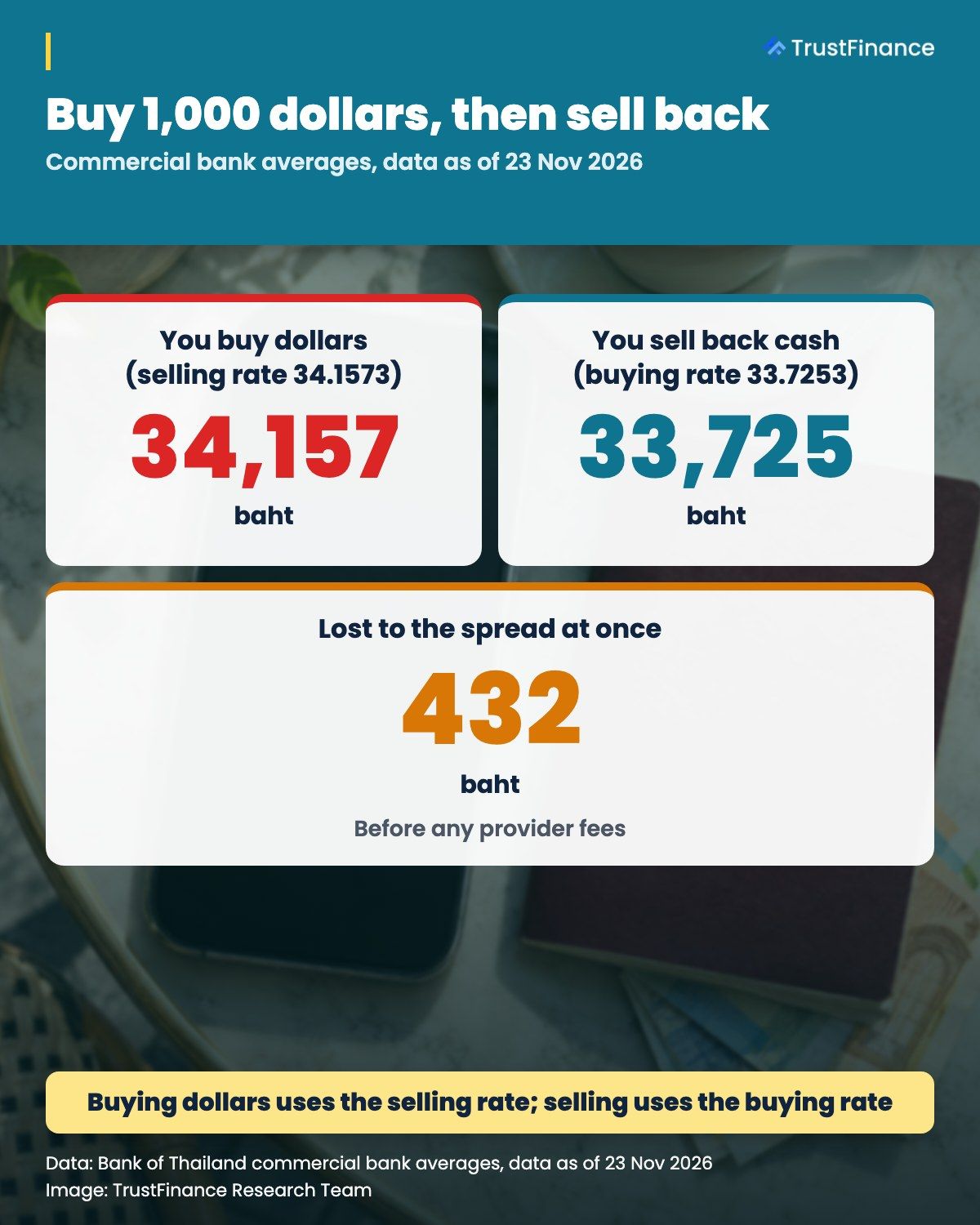
Buying 1,000 dollars and selling them back at once at the 23 Nov 2026 average rates loses about 432 baht to the spread
Data: Bank of Thailand commercial bank averages, data as of 23 Nov 2026 · Image: TrustFinance Research Team
A stronger baht means you need fewer baht to buy 1 dollar; a weaker baht means you need more. A falling USD/THB number therefore means the baht has strengthened.
| Scenario | 1 US dollar equals | Cost of 1,000 dollars | Who benefits |
|---|---|---|---|
| Stronger baht | 33 baht | 33,000 baht | Travellers abroad, importers |
| Weaker baht | 35 baht | 35,000 baht | Exporters, tourism in Thailand |
The 33 and 35 baht figures are examples for comparison, not a forecast of the currency.
The baht moves with supply and demand for baht and dollars in the foreign exchange market. Thailand has used a managed float since 2 July 1997, the start of the Tom Yum Kung crisis, covered in what an economic crisis is.
Before exchanging money, compare the total cost, not just the headline rate, because fees and note sizes change what you actually receive.
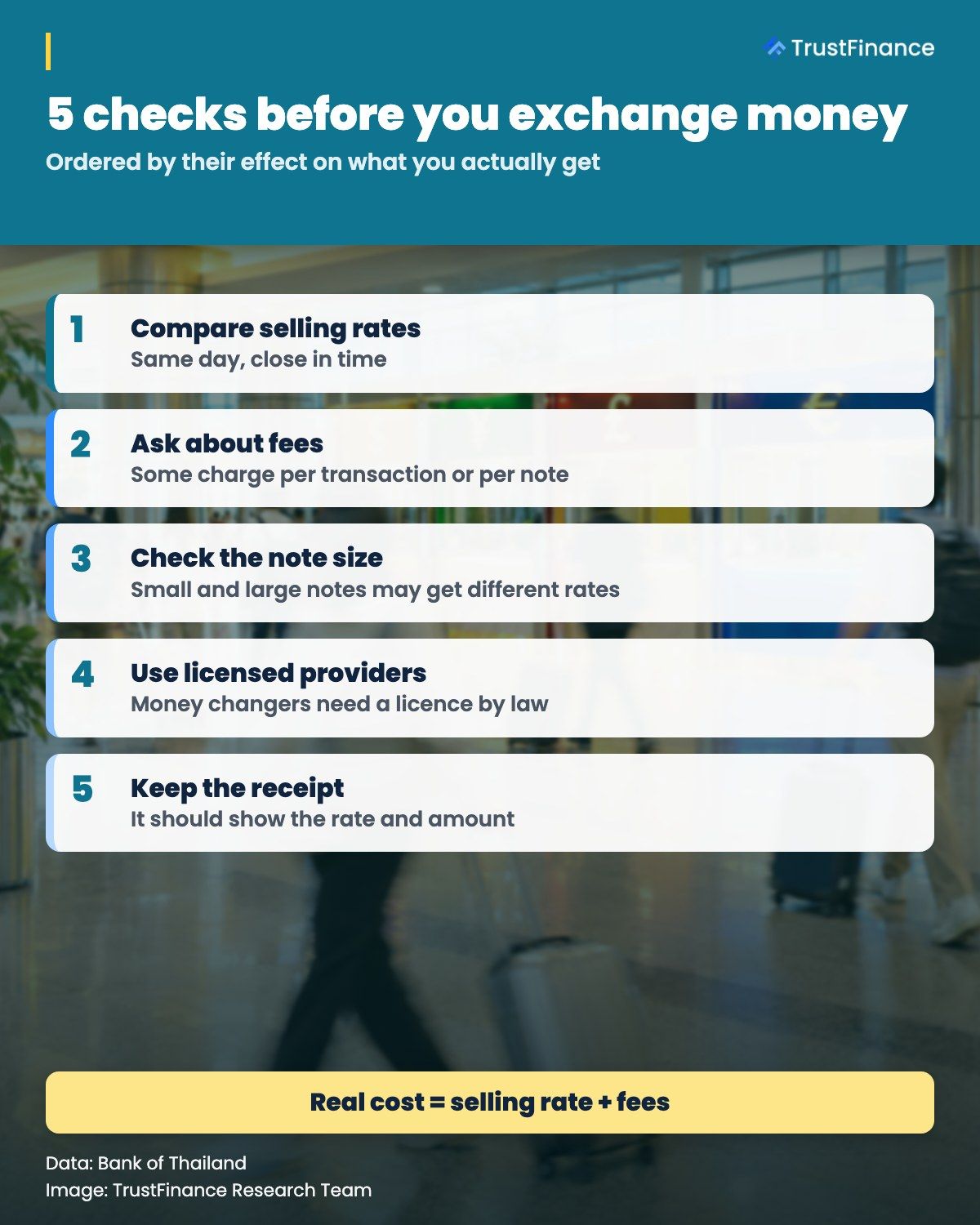
The real cost of exchanging money is the selling rate plus fees, not the reference rate the Bank of Thailand publishes
Data: Bank of Thailand · Image: TrustFinance Research Team
Disclaimer: This article is for general education only. It is not investment advice or a solicitation to trade foreign currency, securities or derivatives. Exchange rates change all the time; check the latest rate with your provider before any transaction. |
As of 23 Nov 2026, the BOT reference rate was 33.993 baht. Commercial banks sold at an average 34.1573 baht and bought transfers at 33.8165 baht.
Each bank sets its own rate from its costs and market conditions. The BOT figure is an average across banks.
No. The BOT rate is a reference and an average; real exchanges use the buying and selling rates each provider posts.
The BOT updates its exchange rate tables every business day at about 18:00. Bank rates can change several times during the day.
Before 2 July 1997, Thailand pegged the baht to a basket led by the dollar at about 25 baht per dollar. After the float, the baht weakened sharply.
1 US dollar equals about 33.99 baht at the BOT reference rate on 23 Nov 2026, but real exchanges use a provider's buying or selling rate, with a gap of about 0.3 to 0.4 baht per dollar. Before exchanging, check same-day rates and fees, and use a licensed provider.
Other references: managed float since 2 July 1997 (BOT) · the 33 and 35 baht figures in the stronger/weaker table are assumptions
Reviewed by TrustFinance Research Team · Data as of 23 November 2026
Thanakit Sutto
Content & PR Lead at TrustFinance. A finance writer who makes investing easy to understand.


