Loading
Related Articles
Fed Rate Hikes Are Back in 2026: What a Return to Tightening Means for the Dollar, Gold, and Traders
Fed Rate Hikes Are Back in 2026: What a Return to Tightening Means for the Dollar, Gold, and Traders
Related Articles

Thanakit Sutto
พ.ย. 23, 2026
9 min read
0

Win rate is the share of trades closed in profit out of all trades, as a percentage. For example, 55 profitable trades out of 100 give a 55% win rate.
Win rate tells you how often you win, not how much each win is worth, so it must always be read with the risk reward ratio, the size of wins compared with losses. This guide explains the formula, the breakeven win rate and an example where a high win rate still loses.
Key takeaways
|
Win rate is the percentage of trades that ended in profit. It uses closed trades only; open positions do not count.
Formula: Win rate (%) = profitable trades ÷ total trades × 100 Example: 40 trades, 22 profitable and 18 losing. Win rate = 22 ÷ 40 × 100 = 55%, and loss rate = 18 ÷ 40 × 100 = 45% |
Decide in advance whether breakeven trades, or trades whose profit is smaller than the fees, count as wins, because different definitions can move the win rate by several percent.
Because the total depends on both how often you win and how big wins and losses are. A strategy that wins often but lets each loss grow large can do worse than one that wins less often with bigger wins.
| Hypothetical example (100 trades, 1,000 baht risked each) | Strategy A | Strategy B |
|---|---|---|
| Win rate | 70% | 40% |
| Profit per winning trade | 500 baht (RR 1:0.5) | 2,000 baht (RR 1:2) |
| Total from wins | 70 × 500 = 35,000 baht | 40 × 2,000 = 80,000 baht |
| Total from losses | 30 × 1,000 = 30,000 baht | 60 × 1,000 = 60,000 baht |
| Net result (before fees) | +5,000 baht | +20,000 baht |
Strategy A wins almost twice as often but nets four times less. If A lost 1,500 baht per losing trade instead of 1,000, its net would be 35,000 − 45,000 = −10,000 baht, with the win rate still at 70%.
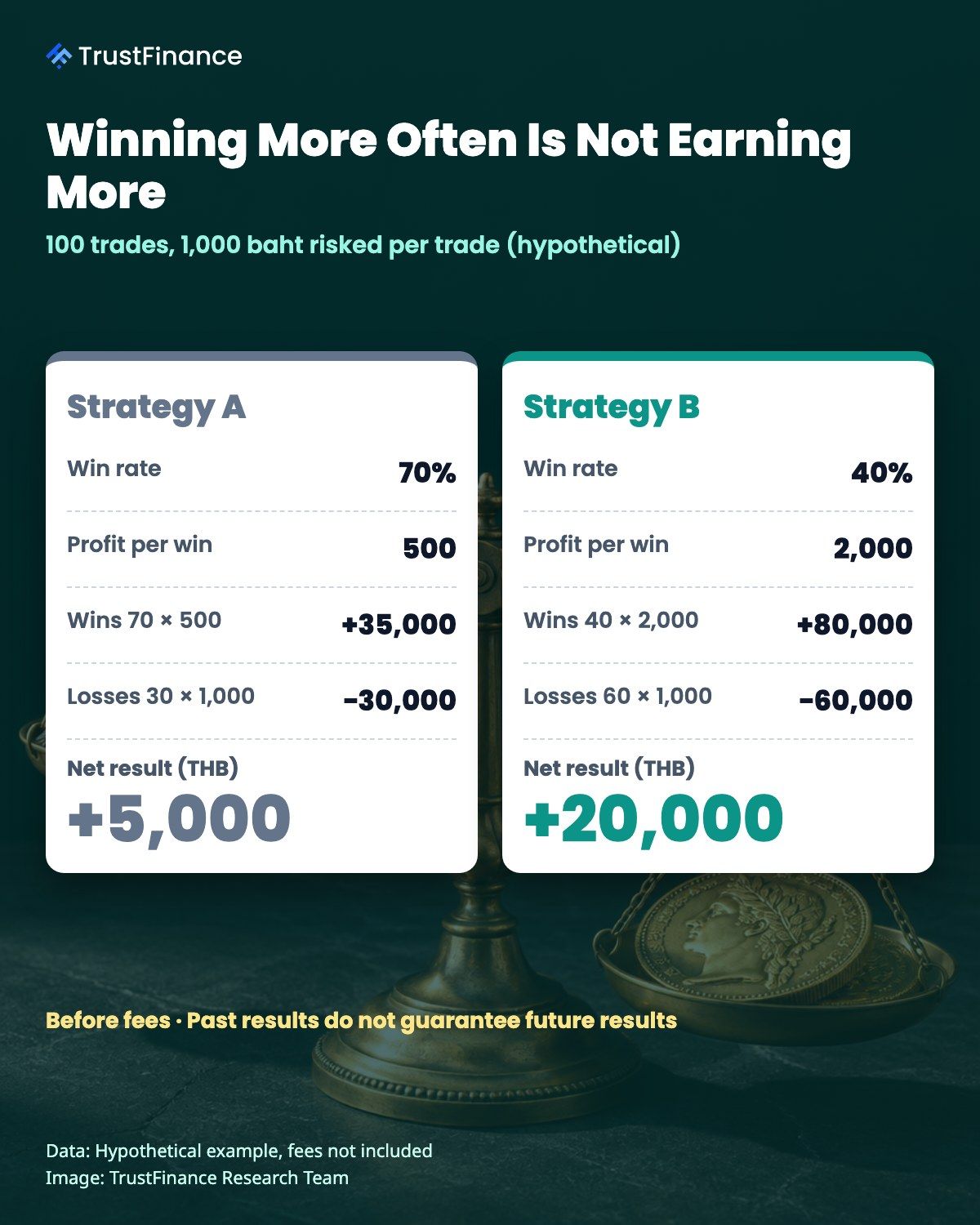
Over 100 trades risking 1,000 baht each, a 70% win rate strategy earning 500 baht per win nets 5,000 baht, while a 40% win rate strategy earning 2,000 baht per win nets 20,000 baht.
Data: Hypothetical example, fees not included · Image: TrustFinance Research Team
The risk reward ratio (RR) compares the loss you accept per trade with the profit you aim for, for example risking 1,000 baht to make 2,000 baht is RR 1:2. The two numbers work together: a higher RR lets a lower win rate break even, but a more distant profit target usually makes winning harder.
Stop loss and take profit levels set the RR of each trade; see stop loss and take profit explained.
The minimum win rate that breaks even (before fees) can be calculated from the strategy's RR.
Breakeven win rate: 1 ÷ (1 + RR) × 100, where RR = profit per win ÷ loss per loss Example: at RR 1:2, 1 ÷ (1 + 2) × 100 = 33.3%, so winning one trade in three breaks even. |
| RR (risk : reward) | Breakeven win rate | What it means |
|---|---|---|
| 1:0.5 | 66.7% | You must win 2 trades in 3 to break even |
| 1:1 | 50% | Winning exactly half breaks even |
| 1:1.5 | 40% | Winning 4 in 10 breaks even |
| 1:2 | 33.3% | Winning 1 in 3 breaks even |
| 1:3 | 25% | Winning 1 in 4 breaks even |
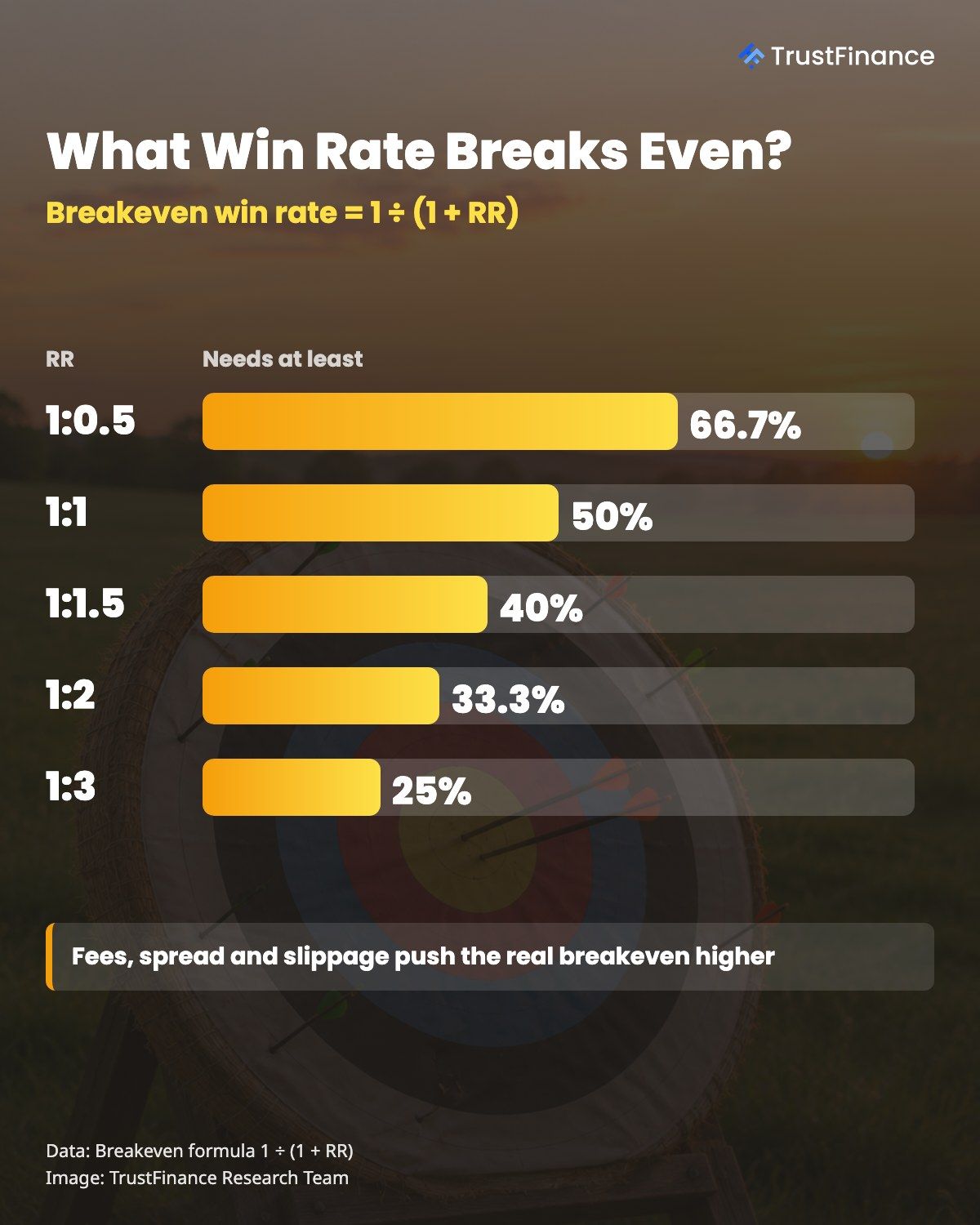
The breakeven win rate equals 1 ÷ (1 + RR): RR 1:1 needs 50%, RR 1:2 needs 33.3% and RR 1:3 needs 25% before fees.
Data: Breakeven formula 1 ÷ (1 + RR) · Image: TrustFinance Research Team
Fees, the spread and slippage, the gap between the price you set and the price you get, always push the real breakeven win rate above the table.
Expectancy is the average profit or loss per trade. It combines the win rate and the size of wins and losses into one number.
Formula: Expectancy = (win rate × average win) − (loss rate × average loss) Strategy A: (0.70 × 500) − (0.30 × 1,000) = 350 − 300 = +50 baht per trade Strategy B: (0.40 × 2,000) − (0.60 × 1,000) = 800 − 600 = +200 baht per trade |
A positive expectancy does not mean profit in every period. Real results swing around the average, especially when the number of trades is small.
| Myth | Fact |
|---|---|
| A high win rate means a good strategy | Check the size of wins and losses; a 70% win rate can still lose money |
| A 40% win rate is always bad | At RR 1:2 or better, 40% is above the 33.3% breakeven |
| 20 trades give reliable statistics | With few trades the win rate swings a lot; use a large enough sample |
| A past win rate will repeat | Market conditions change; past results do not guarantee future results |
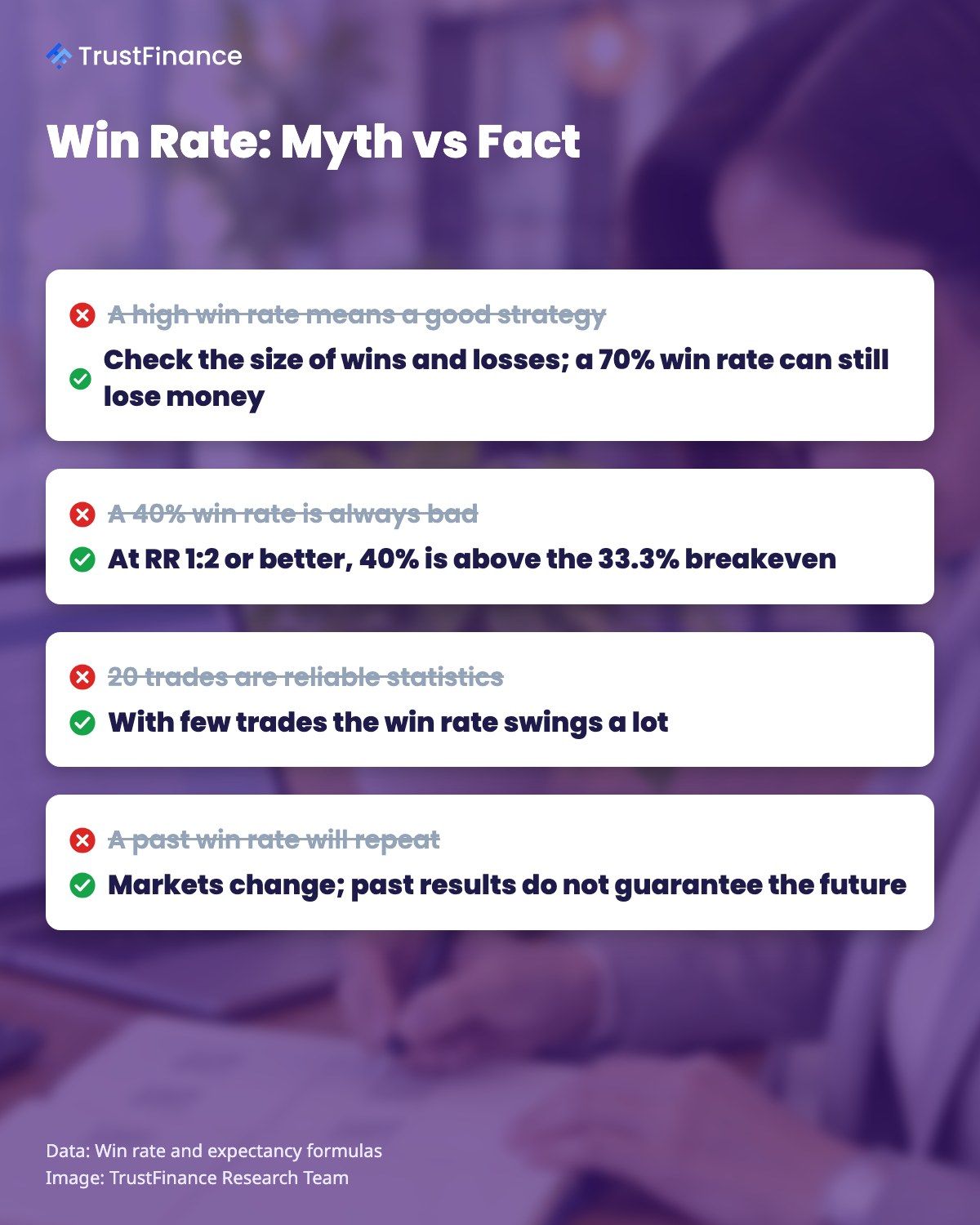
A high win rate does not always mean profit, and a 40% win rate can be above breakeven when the risk reward is 1:2 or better.
Data: Win rate and expectancy formulas · Image: TrustFinance Research Team
A reliable win rate comes from a complete trading record, kept trade by trade with entries, exits, fees and results.
| Note: Forex and CFD trading with overseas providers is not licensed or supervised by any authority in Thailand. The Bank of Thailand says it has no policy to license Forex business for investment or speculation (BOT news, 25 Jun 2026). Legal options in Thailand include foreign currency deposit accounts and futures on TFEX (BOT Forex page, in Thai). |
This article is for education only. It is not investment advice or an offer to buy or sell securities, digital assets or derivatives, and no return is promised. Readers should study the information and assess the risks themselves before deciding.
There is no single number. It must be compared with the strategy's RR: the win rate has to be above 1 ÷ (1 + RR), plus a margin for fees, to be above breakeven.
It depends on RR. At RR 1:1 it breaks even before fees; if wins are larger than losses, the total is positive.
Look at both together, or at expectancy, which combines them into one number.
The more the better. With only 10 to 20 trades the win rate can be high or low by chance, so many traders collect at least a few hundred before drawing conclusions.
Win rate is the percentage of profitable trades. It is easy to calculate but only shows how often you win, not how much.
Read it with the risk reward ratio: the breakeven win rate is 1 ÷ (1 + RR), and expectancy sums up the average result per trade.
This article uses basic arithmetic and no outside data; every set of numbers is a hypothetical example to explain the formulas.
Other references: Bank of Thailand (Forex status in Thailand)
Fact-checked by TrustFinance Research Team · Information as of 23 November 2026
Thanakit Sutto
Content & PR Lead at TrustFinance. A finance writer who makes investing easy to understand.


