Loading
What Is Trading? Trading vs Investing Explained for Beginners

TrustFinance
Nov 13, 2026
17 min read
18

One study from Brazil followed everyone who started day trading stock index futures between 2013 and 2015, then looked only at those who kept trading for at least 300 days. 97 percent of that group lost money, and only 0.4 percent earned more than a bank teller's wage (Chague, De-Losso and Giovannetti, Day Trading for a Living?)
This number does not mean trading is wrong or off-limits. It does show that the picture you see in ads, "trade for a living and make thousands a day," is far from reality. Before asking whether you should trade, you first need to answer the basic questions: what is trading, how does it work, and how is it different from buying and holding for the long term?
This article is an overview for people who are just getting interested. It covers the definition, the markets people trade, trading styles, how a single trade works with hypothetical numbers, and the risks you should know. It is general education only. It does not encourage you to trade and does not recommend any broker.
What Is Trading? A One-Minute Definition
Trading is buying and selling financial assets, such as stocks, currencies, gold or crypto, to profit from the "price difference" over a fairly short period. You buy when the price is low and sell when it rises, or, in some markets, you open a sell position first and buy it back after the price falls.
The word "trade" simply means buying and selling goods. The idea is the same as any shopkeeper: buy, sell and keep the difference. "Trading" refers to the activity as a whole, and a person who does it regularly is called a trader.
What sets trading apart from buying goods to resell is that a trader does not care about the product itself, only about which way the price will move. Guess right and you make a profit. Guess wrong and you lose. And every trade comes with a cost attached.
So why do so many people trade? Mainly because it has become very easy to start. You can open an account in an app within minutes, prices move in front of you every second, and some markets let you profit whether prices rise or fall. These advantages are real, but the same ease leads many people to start trading before they understand what kind of risk they are taking on.
Trading in Brief: Key Points Before You Read On
|
Trading vs Long-Term Investing: What Is the Difference?
Many people use the words trading and investing interchangeably, but in the industry they describe two different ways of thinking. Once you understand this, it becomes clearer what trading is and which goals it suits.
Different Profit Goals
Long-term investors buy a stock because they believe the business will grow. Their return comes from dividends and the value that builds up over time. Traders look for moments when the price is likely to move in the short term. Sometimes they do not care at all what the company does, as long as the chart offers a chance to get in and out.
Different Holding Periods
An investor may hold for a year or ten years. A trader holds for anywhere from a few seconds to a few weeks. As a result, traders have to make decisions more often, spend more time watching the screen and pay fees many more times.
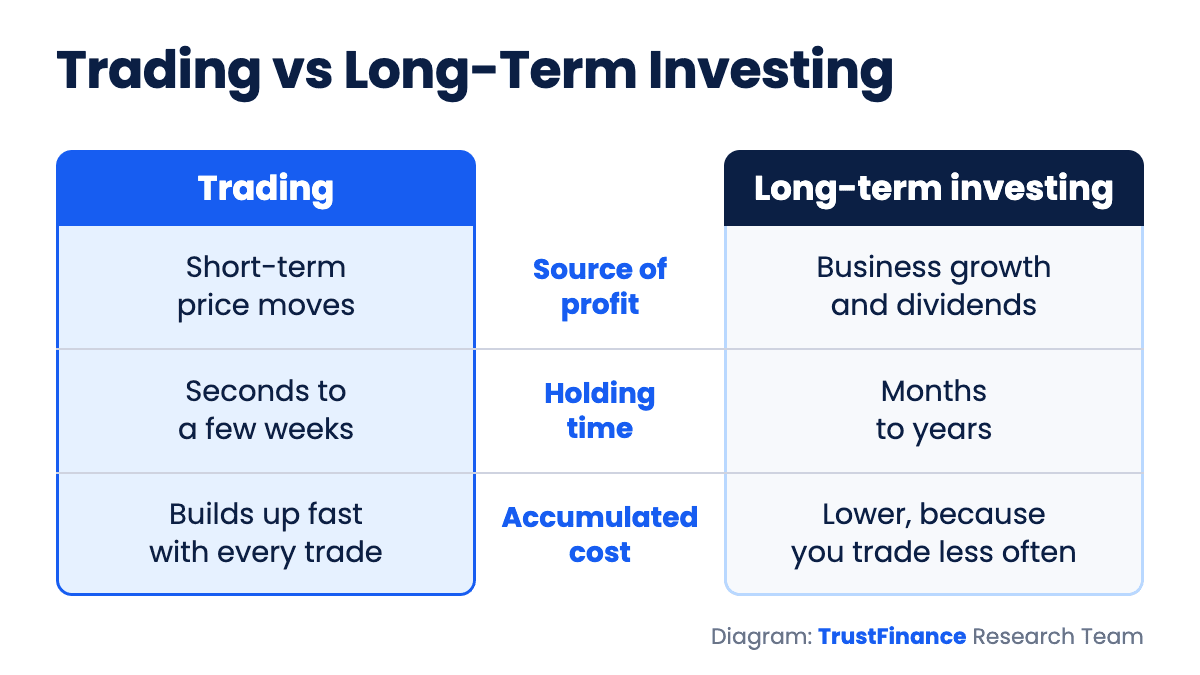
Image: Trading vs long-term investing in 3 areas · Source: TrustFinance Research Team, summarized from the comparison table in this article
| Aspect | Trading | Long-term investing |
|---|---|---|
| Main source of profit | Short-term price moves | Business growth and dividends |
| Holding time | Seconds to a few weeks | Months to years |
| Trading frequency | High | Low |
| Accumulated cost | Builds up fast with every trade | Lower, because you trade less often |
| Information used most | Price charts, news, trading volume | Financial statements, the business, the long-term economy |
| Time required | Close monitoring of the market | Periodic portfolio reviews |
Which Markets Are Popular for Trading?
In practice, what trading means depends on which market you trade. Each market has its own opening hours, regulators and level of volatility. This section is a short overview, like looking at the map before the journey. The examples cover the markets most popular with retail traders in Thailand.
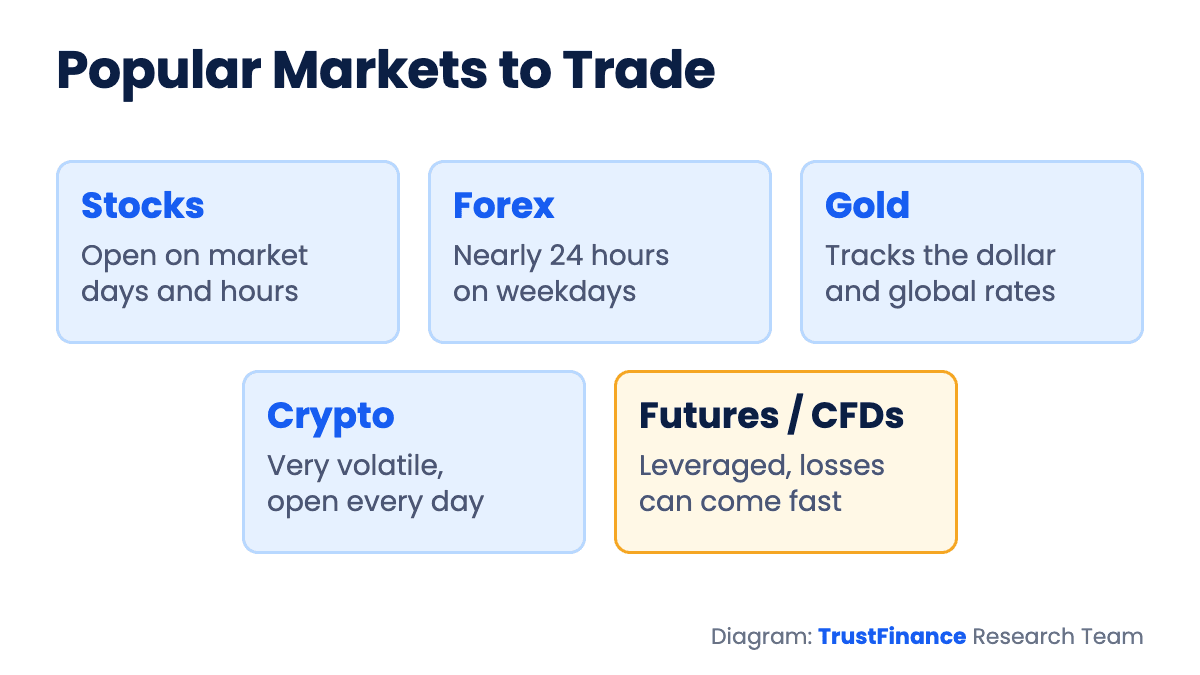
Image: 5 popular markets to trade · Source: TrustFinance Research Team, summarized from this section
Stock Trading
You buy and sell shares of listed companies through a securities broker. In Thailand, this means the Stock Exchange of Thailand (SET) and the mai market, which are supervised by Thailand's Securities and Exchange Commission (SEC). Share prices move with company results, news and buying and selling pressure in the market.
Forex and Currency Pair Trading
Forex is trading currencies in pairs, such as EUR/USD. Profit or loss comes from one currency strengthening or weakening against another. The basics of currency pairs and how to read a quote are explained in detail in What Is Forex? How the Foreign Exchange Market Works
Gold Trading
There are several ways to trade gold: buying and selling gold bars at a gold shop, trading gold futures contracts, or trading the global gold price (XAU/USD). The price moves with the US dollar, interest rates and market fear.
Crypto Trading
You buy and sell digital coins such as Bitcoin through an exchange. The market is open 24 hours a day, every day, and prices swing harder than most other assets. In Thailand, you should first check whether the exchange you use is licensed by the Thai SEC.
Futures and CFDs
Both are derivatives, meaning contracts based on the price of another asset, so you do not own the asset itself. In Thailand, futures are traded on the Thailand Futures Exchange (TFEX). A CFD is a contract for difference made directly with a provider. Both allow leverage, which magnifies both profits and losses.
| Market | What is traded | What beginners should know |
|---|---|---|
| Stocks | Shares of listed companies | Open only on market days and during trading hours |
| Forex | Currency pairs, such as EUR/USD | Trades nearly 24 hours a day on weekdays |
| Gold | Gold bars, futures or the XAU/USD price | Price tracks the US dollar and global interest rates |
| Crypto | Digital coins | Very volatile, open every day with no breaks |
| Futures/CFDs | Contracts based on an asset's price | Use leverage, so losses can come fast |
Trading Styles by Holding Time
Traders usually group styles by how long they hold each position. No style is better than another on its own. The right one depends on your free time, your temperament and the risk you can accept.
| Style | Typical holding time | Key features |
|---|---|---|
| Scalping | Seconds to a few minutes | Very frequent trades, so the cost per trade matters a lot |
| Day Trade | Closed within the same day | No overnight positions, you need to watch the screen during the day |
| Swing Trade | Several days to a few weeks | Aims to catch medium-term price swings |
| Position Trade | Several weeks to several months | Close to investing, focuses on the bigger trend |
Styles with short holding times require quick decisions and mean paying fees often, so it helps to plan each day trade carefully before you start.
How One Trade Works, From Placing the Order to Closing It
Now that the definition is clear, let us look at what trading means once you actually do it. Every trade follows the same basic steps, whatever the market.
- Choose an asset and check its current price
- Decide on a direction: buy or sell
- Set the position size, meaning the number of shares or contracts
- Place the order, and the system matches it with the other side
- Hold the position, then close it when it reaches your target or when it goes the wrong way
- Work out the result from the price difference, minus all costs
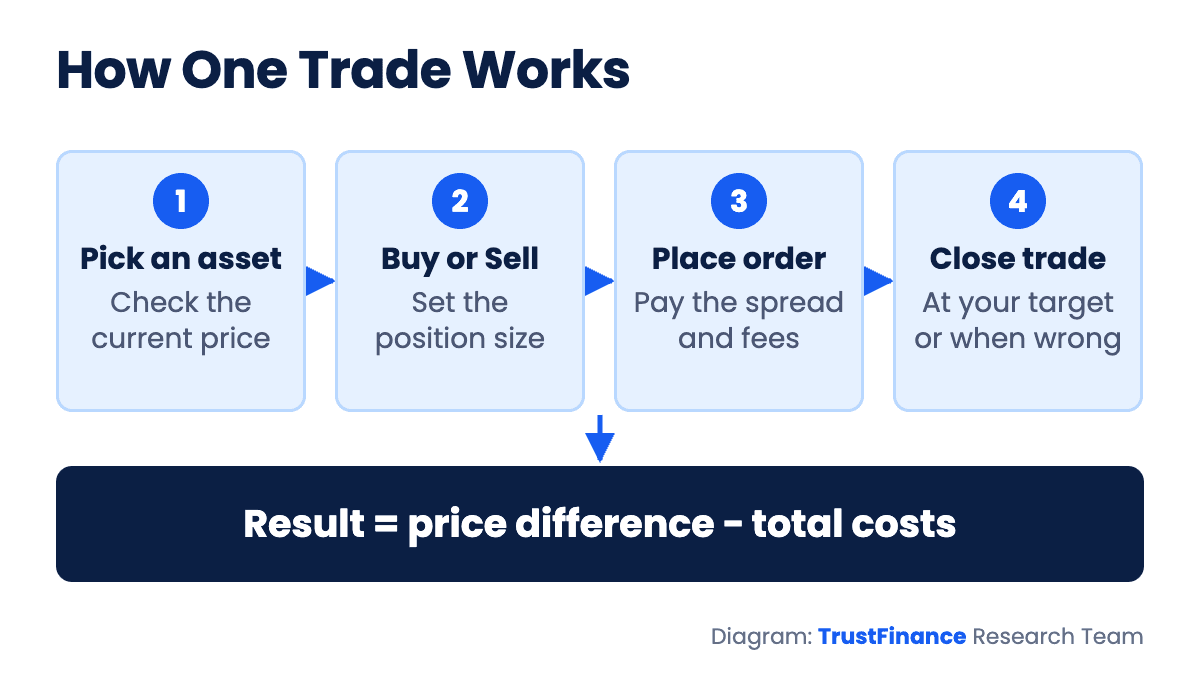
Image: The steps of one trade and the costs deducted · Source: TrustFinance Research Team, summarized from the steps in this section
Buy and Sell Orders
Buy means purchasing because you expect the price to rise. Sell means selling, and in markets that allow you to sell first, such as futures or CFDs, traders profit when the price falls. Common order types are the Market Order, which trades immediately at the market price, and the Limit Order, which waits for the price you set.
Costs Deducted on Every Trade
The screen shows two prices: the price you can buy at and the price you can sell at. The gap between them is called the spread. On top of that there are commissions, exchange fees and, in some markets, an overnight holding fee (swap). The cost of each trade may look small, but over hundreds of trades it eats up a large share of your profit.
Hypothetical Profit and Loss Example
Formula: Net profit or loss = (Sell price − Buy price) × Number of shares − Total fees Example (hypothetical numbers): Suppose you buy 1,000 shares of a stock at THB 10 each, which costs THB 10,000, and assume the round-trip fees total THB 30.
Notice that the price moved by the same amount in both directions, but the loss is bigger because the costs never go away. |
Be careful with leverage: Now switch to an asset that uses leverage. Suppose you put up the same THB 10,000 as margin but control a position worth THB 100,000 (leverage of 1:10). If the price moves 5 percent in your favor, you gain about THB 5,000. But if it moves 5 percent against you, you lose about THB 5,000, or half of the money you put up, even though the price moved only a little. This is why leverage is described as one of the top risks for beginners. All numbers in this section are hypothetical examples to show the method only. |
What Research Says About Retail Traders' Results
The most widely cited study is "Trading Is Hazardous to Your Wealth" by Barber and Odean, published in the Journal of Finance in 2000. The researchers examined the accounts of 66,465 US households from 1991 to 1996 and found that the group that traded most often earned an average of 11.4 percent a year, while the market returned 17.9 percent. The authors explain that overconfidence leads people to trade too much, and costs eat into their returns (Barber and Odean, Journal of Finance)
As for the Brazilian study mentioned at the start, the researchers concluded that it is virtually impossible for individuals to day trade for a living, and they found no evidence that people who trade longer get better over time.
| Study | Group studied | Findings |
|---|---|---|
| Barber and Odean (Journal of Finance, 2000) | 66,465 US households, 1991 to 1996 | The group that traded most often earned an average of 11.4 percent a year, while the market returned 17.9 percent |
| Chague, De-Losso and Giovannetti (FGV/EESP) | People in Brazil who day traded stock index futures for at least 300 days, 2013 to 2015 | 97 percent lost money, and only 0.4 percent earned more than a bank teller's wage |
Both studies have limits: each looks at one market over one period, so neither can predict everyone's results. But both point the same way: trading more often does not mean earning more.
The practical lesson is this: before asking whether trading can make you money, ask what edge you have over everyone else in the market. On the other side of your trades are financial institutions, funds and automated trading systems that are far faster. If you cannot answer that yet, trading less often and keeping costs low is the approach the evidence supports better.
Trading Risks Every Beginner Should Know
|
A basic way to reduce risk is to decide in advance how much you are willing to lose on each trade, then set your position size in proportion to your capital.
Start Learning to Trade, One Step at a Time
|
These steps may sound slow, but they help you find out early whether trading suits you, before you lose a large sum through trial and error.
Frequently Asked Questions About Trading
Please note: Forex trading is not licensed or regulated by any authority in Thailand. The Bank of Thailand has no policy of granting Forex business licenses to retail traders (source: Thai PBS), and Thailand's Securities and Exchange Commission has also confirmed that Forex businesses are not under its supervision but fall under the exchange control law instead (source: The Standard) |
This article is for general education only. It is not personalized investment advice and does not guarantee any return. Traders should research further and assess the risks themselves before making any decision.
Is trading the same as gambling?
Not necessarily. With a plan, clear reasons for entering and exiting, and risk control, it is not gambling. But if you enter trades on emotion, set no stop-loss and hope to get rich from a few trades, that behavior comes very close to gambling. The difference lies in how you trade, not in the market itself.
How much money do you need to start trading?
Each market has a different minimum, and some let you start with a few hundred baht. The more important question is whether you can afford to lose that money. Money you need for daily living or borrowed money should never be used for trading.
Is trading different from "playing the stock market"?
"Playing stocks" is an everyday Thai expression for buying and selling stocks, whether short term or long term. Trading means buying and selling to profit from short-term price differences, which you can do in stocks and in other assets. If you buy a stock and hold it for several years, that is closer to investing.
Can trading really be a full-time job?
Some people manage it, but they are a very small minority. The Brazilian study found that among people who day traded for more than 300 days, only 0.4 percent earned more than a bank teller's wage. Expecting a regular income from trading deserves careful thought.
Which market should a beginner start with?
No market suits everyone. Start with a market where you understand what drives prices, that has a clear regulator and that does not force you to use high leverage. Then practice on a demo account before using real money, to see how well you handle prices moving against you.
Does trading mean watching the screen all day?
It depends on your style. Scalping and day trading require close monitoring during the day, while swing trading and position trading need less screen time and suit people with a full-time job better. Many people start with short holding times, find it stressful and time-consuming, and move to longer holding periods, which also reduces the number of trades and the costs.
Trading: The Big Picture
In short, what is trading? It is buying and selling assets to profit from short-term price moves. It differs from long-term investing in its goal, holding time and costs. Popular markets in Thailand include stocks, Forex, gold, crypto and derivatives, and each market has its own rules and risks.
The things to remember are that every trade has a cost, prices can always move against you, and research shows that trading more often does not lead to earning more. If you want to start, begin with understanding, practice first, control your position size and check the provider with the regulator every time before you transfer money.
Sources on Trading
- Chague, De-Losso and Giovannetti, Day Trading for a Living? (FGV/EESP, RePEc)
- Barber and Odean, Trading Is Hazardous to Your Wealth, Journal of Finance (2000)
- Thai PBS: The Bank of Thailand has no policy of licensing retail Forex (in Thai)
- The Standard: Forex businesses are not supervised by Thailand's SEC (news article, in Thai)
Written by
TrustFinance
TrustFinance helps financial companies build credibility and traders make safer choices through verified profiles, authentic reviews, and research-driven insights.