Decoding the Secret! How to Build an Asian Stock Portfolio to Get Rich in 2025

TrustFinance
ก.ย. 26, 2025
10 min read
368

Why is Asia the shining star for global investors?
2025 is seen as another golden year for investors seeking opportunities in Asia. But the real question is: how can you build a portfolio that grows sustainably? Earlier, we introduced 10 Asian stocks to watch in 2025, the “hidden gems” amid market volatility. In this article, we will go further by exploring how to construct a portfolio that not only picks individual stocks but also balances different types of equities with the right strategy.
Imagine standing on top of a skyscraper in downtown Shanghai, looking down at a city that never sleeps. On one side, you see an electric vehicle factory running 24/7, with thousands of lit windows reflecting the hard work of employees assembling the cars of the future. On the other side, you see the offices of a tech company developing the next generation of AI, where young programmers are glued to their screens, writing code that could change the way humans work forever.
This is the real picture of Asia today – a land of opportunity that global investors are closely watching. From giant funds to retail investors like us, everyone is searching for opportunities in a region of over 4.6 billion people, with a combined GDP accounting for nearly 40% of the world – and most importantly, with vast room for further growth.
But did you know? Investing in Asia is not just about picking the “hottest” country, as many people mistakenly think. People often believe that simply investing in China, India, or Vietnam will make them rich. The truth is far more complex. It’s like preparing a gourmet dish – you can’t make something delicious with just one ingredient. You need a balanced blend of flavors – sour, sweet, salty, umami – to create the perfect taste.
An investment portfolio is the same. You need to combine different types of stocks because each has its own strengths and weaknesses. Some grow fast but carry high risk, while others are slow but stable. Some move in sync with the economy. The right combination will help your portfolio grow in a balanced and sustainable way.
The Golden Triangle of Investing: Growth – Cyclical – Value
If investing were like building a football team, each stock type would be a player in a specific position. You need strikers to score goals, midfielders to connect plays, and defenders to protect the team. Without balance, the team won’t succeed. Let’s look at how each type of stock plays its role in your portfolio:

1. Growth Stocks – The Dark Horse of the Future, the Striker of the Team
Think of companies developing AI technology or producing electric cars. They may not yet generate massive profits today; some may even still be losing money. But investors believe that in 5–10 years, these companies will become industry giants – like planting a seed that will grow into a massive tree.
Look back 20 years: who would have thought that Alibaba, which started in Jack Ma’s small rented apartment, would become an e-commerce empire worth trillions? Or that Tencent, which began with the QQ messaging service, would evolve into a gaming and social media giant? That’s the power of growth stocks.
Today, examples include Chinese companies building autonomous driving systems competing fiercely with Tesla and Western rivals. Japanese firms producing LiDAR sensors for self-driving cars – a technology set to revolutionize transportation. Korean firms developing next-gen batteries that charge 10 times faster and last 5 times longer. Or Indian startups creating financial apps for 200+ million people without bank accounts.
Yes, growth stock prices often look expensive. P/E ratios may be sky-high – or nonexistent if the company isn’t profitable yet. But if their technology succeeds, if they dominate the market, the returns could make you smile for months.
Pros: Huge profit potential – 100–1000% returns within a few years if the company succeeds.
Cons: Extremely risky – if plans fail, technology becomes obsolete, or rivals overtake them, you could lose 50–80% of your money, or the company could go bankrupt.

2. Cyclical Stocks – The Wave Riders, the Midfielders of the Team
Picture the economy as an ocean wave – it rises and falls with the tides. Cyclical stocks are like surfers waiting for the right wave. They know which wave to ride and which to let pass. When the economy is booming, people spend more, factories run at full capacity, and cyclical stocks soar. But when the economy weakens, people tighten their belts, factories slow down, and these stocks sink.
Fanuc, the Japanese industrial robot maker, is a perfect example. When factories worldwide want to boost efficiency, cut labor costs, and increase speed, they buy robots – and Fanuc is one of the global leaders. When the economy is strong, robot orders surge, and Fanuc’s stock rises. But in downturns, when factories hold back investments, its stock falls.
Or Yangzijiang Shipbuilding from Singapore: when global trade booms and shipping demand rises, new ship orders skyrocket, pushing its stock higher. But when trade slows and old ships suffice, orders dry up, and the stock slumps.
Another example: Sumitomo Mitsui Financial Group, one of Japan’s biggest banks. When the economy thrives, more people borrow, businesses expand, and higher interest rates boost bank profits. But in downturns, bad debts rise, lending slows, and banks struggle.
Key tip: Timing is everything. Like a boxer, you must know when to strike and when to retreat. Enter when the economy is recovering, exit before it slows. Watch economic signals like GDP, employment, consumer confidence, and central bank policy.

3. Value Stocks – The Overlooked Treasures, the Defenders of the Team
Value stocks are like your local food stall – not fancy, no luxurious décor, no staff in suits, but always serving loyal customers every day. They deliver steady profits, consistent cash flow, and most importantly, they’re cheap. Many offer high dividends, making them ideal for those seeking stability rather than thrills – for those who want peaceful sleep rather than daily price stress.
Examples:
- Food Moments (Thailand): Agriculture and food business – not flashy, but people eat every day. Stable business, low P/E, high dividend. Solid portfolio foundation.
- JBM Healthcare (Hong Kong): Healthcare and medical products. With aging populations, demand is rising. Slow but steady growth, offering dividends around 7% annually.
- Yum China: Franchise owner of KFC and Pizza Hut in China. A business relying on domestic demand more than exports. With 1.4 billion Chinese consumers, demand is strong even if global conditions wobble.
Special strength: Value stocks don’t grow dramatically, nor make headlines, but they act as the backbone of your portfolio – comforting you when growth stocks tumble, while providing regular dividend income like a side salary every quarter.
The Secret Formula to a Winning Portfolio – A Blend of Art and Science
Building a portfolio is like making a Caesar salad. Too much lettuce, and it’s bland. Too much dressing, and it’s greasy. Too many croutons, and it’s dry. Balance is key – mix everything in the right proportions for a satisfying result.
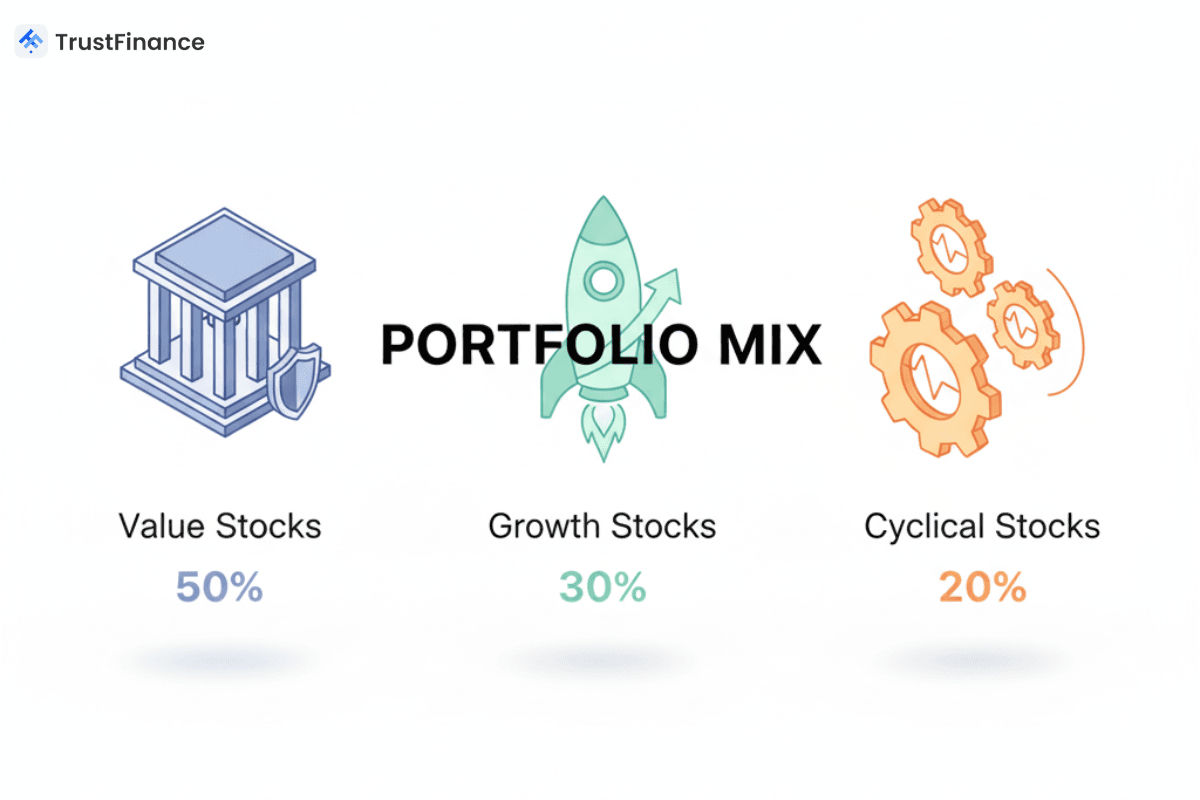
For New Investors
- 50% Value stocks – strong foundation
- 30% Growth stocks – profit opportunities
- 20% Cyclical stocks – market excitement
Example: With $3,000 – $1,500 in dividend-paying value stocks like Food Moments, JBM Healthcare; $900 in tech growth stocks; $600 in banks or cyclical industries.
For Challenge Seekers
- 50% Growth – chasing high returns
- 25% Value – safety cushion
- 25% Cyclical – opportunities in recovery cycles
Ideal for ages 30–45 with a long runway before retirement, able to take risks but still seeking some stability.
For Pre-Retirees
- 60% Value – steady dividends
- 20% Growth – fight inflation
- 20% Cyclical – add excitement without too much risk
This group prioritizes stability and reliable income, while still needing some growth to outpace inflation.
Special Tips – The Details That Make the Difference
- Watch exchange rates: If the Thai Baht strengthens 10% but your stock only rises 5%, you actually lost 5% in Baht terms. Always calculate returns in your home currency.
- Follow government policies: China subsidizing EVs, India prioritizing digital, Japan promoting robotics, Korea pushing semiconductors. Investing in line with government policy often leads to success.
- Study demographics: India – youthful population (average age 28), strong purchasing power, attractive for tech, entertainment, fashion. Japan – aging society (average age 48), opportunities in healthcare, medical services, elderly care robotics.
- Beware geopolitical risks: Asia has high geopolitical risk – China–Taiwan tensions, North–South Korea, India–Pakistan conflict – all can instantly hit markets.
- Use ETFs as a shortcut: If you don’t want to pick stocks yourself, use Asia-focused ETFs like iShares MSCI Asia ETF to diversify effectively.

The Final Truth You Must Accept
Investing in Asia in 2025 is not gambling or luck. It is both a science and an art that requires discipline, patience, and continuous learning...
And if you are someone who wants a portfolio that is “more stable, less volatile, and generates consistent income,” one long-term approach many investors rely on is dividend investing.
If you want to explore this path, take a look at our curated list of real examples here: 6 High-Dividend Thai Stocks That Have Paid Consistent Dividends for Over 10 Years.
In the end, the best portfolio is the one that lets you sleep peacefully every night…
Written by
TrustFinance
TrustFinance helps financial companies build credibility and traders make safer choices through verified profiles, authentic reviews, and research-driven insights.
Tags:
Best pick of the Week
Related Articles