Loading
Related Articles
Related Articles
Fed Rate Hikes Are Back in 2026: What a Return to Tightening Means for the Dollar, Gold, and Traders
Fed Rate Hikes Are Back in 2026: What a Return to Tightening Means for the Dollar, Gold, and Traders

TrustFinance Research Team
Nov 06, 2026
7 min read
2
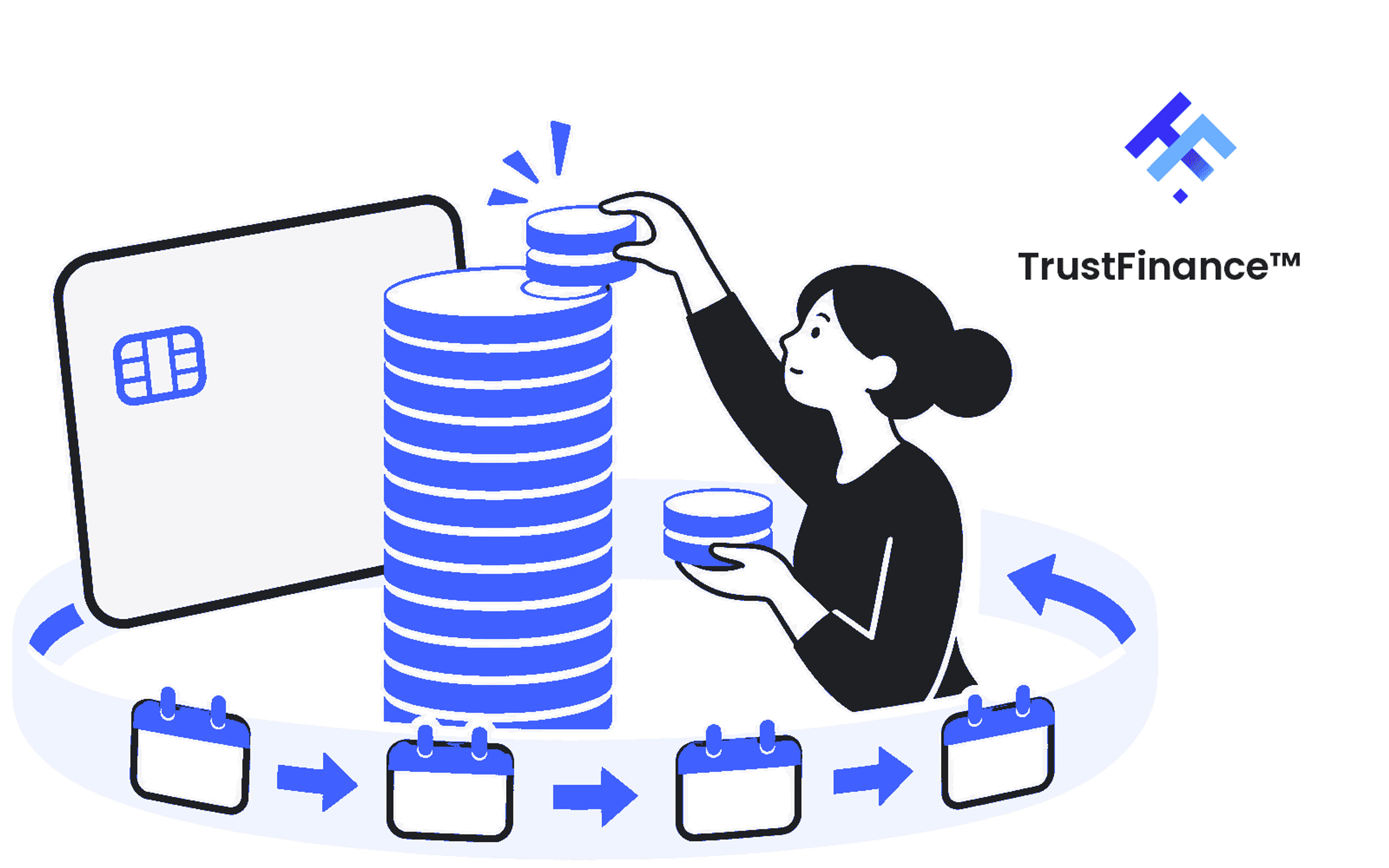
The minimum payment on a credit card statement tells you what is required for that billing cycle. It does not tell you how quickly the carried balance will disappear. To see your progress, connect three amounts: the balance you started with, the interest and other charges added, and the payment actually credited. This guide uses an invented example to show that connection without recommending a card or quoting any country's minimum-payment rate.
The statement balance is a snapshot at the end of a billing period. The current balance can reflect later posted purchases, payments or credits. The minimum due, payment due date and available credit serve different purposes. Read the actual amount required and the provider's payment-receipt cutoff, rather than treating available credit or a scheduled transfer as proof that a bill has been paid.
A required minimum can be calculated using a percentage, a fixed floor or other components under the agreement. This article supplies no real issuer formula. Recheck each statement: an amount accepted last month may be insufficient this month.
The CFPB explains, in its US guidance, that many issuers calculate interest using daily balances and may apply different rates to purchases and other transactions. A purchase grace period is conditional on the card's terms and repayment history. Making only the minimum does not by itself meet those conditions. Check your own agreement instead of assuming purchases, cash advances and promotional balances share the same treatment.
Assume one fictional balance of 1000 units, no fees, new spending or cash advances, and a toy rate of 2% per equal monthly cycle. This is not APR, a legal limit or an actual bank rate. Interest is charged on the opening balance, rounded to two decimal places using half-up rounding, then the payment is made at cycle end. The rounded closing balance carries into the next cycle.
Compare fixed teaching payments of 30 and 100. Neither path is an issuer's minimum-payment formula. Even if 30 were the first statement's minimum in an illustration, later actual minimums would still need checking. The model stops after six cycles with money still owed; it gives no payoff date.
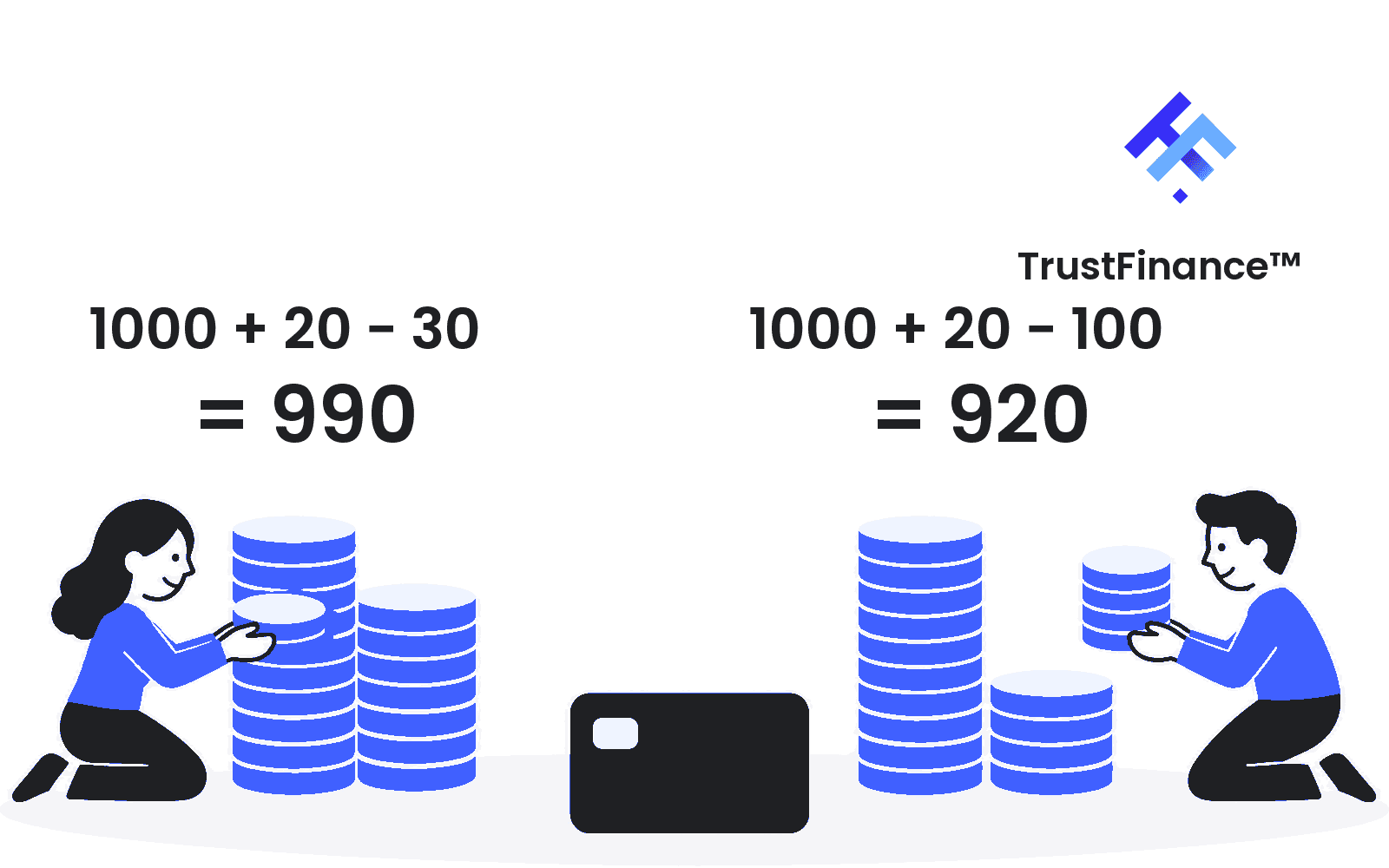
First-cycle interest is 1000 × 2% = 20. Paying 30 leaves 1000 + 20 - 30 = 990, so the balance falls by 10. Paying 100 leaves 1000 + 20 - 100 = 920, reducing the balance by 80. The 20 interest is a borrowing cost, not principal repayment. Payment size and balance reduction are therefore different numbers.
In cycle two, the 30-payment path starts at 990, adds 19.80 interest and closes at 979.80. The 100-payment path starts at 920, adds 18.40 and closes at 838.40. Different remaining balances change the following cycle's interest under these assumptions.
After six cycles, paying 30 each time means 180 paid, 116.93 interest added and 936.93 still owed. Paying 100 each time means 600 paid, 95.35 interest and 495.35 still owed. Check the identities: 1000 + 116.93 - 180 = 936.93 and 1000 + 95.35 - 600 = 495.35.
The remaining-balance difference is 441.58, but it is not 441.58 of interest saved. It contains 420 of additional cash paid and 21.58 less toy interest. The example compares cash commitments as well as costs. It does not establish that either payment is affordable for a particular household.
Fictional units. Each line reads opening balance + rounded interest - fixed payment = closing balance. The same previously stated model assumptions apply.
Fixed payment 30: 1000.00 + 20.00 - 30.00 = 990.00
Fixed payment 100: 1000.00 + 20.00 - 100.00 = 920.00
Fixed payment 30: 990.00 + 19.80 - 30.00 = 979.80
Fixed payment 100: 920.00 + 18.40 - 100.00 = 838.40
Fixed payment 30: 979.80 + 19.60 - 30.00 = 969.40
Fixed payment 100: 838.40 + 16.77 - 100.00 = 755.17
Fixed payment 30: 969.40 + 19.39 - 30.00 = 958.79
Fixed payment 100: 755.17 + 15.10 - 100.00 = 670.27
Fixed payment 30: 958.79 + 19.18 - 30.00 = 947.97
Fixed payment 100: 670.27 + 13.41 - 100.00 = 583.68
Fixed payment 30: 947.97 + 18.96 - 30.00 = 936.93
Fixed payment 100: 583.68 + 11.67 - 100.00 = 495.35
Real statements can use daily accrual, multiple interest rates, fees, refunds, new purchases or changed promotional terms. Payment allocation and grace eligibility also matter. New spending can replace the balance you have just paid down. The monthly illustration cannot reproduce every issuer's bill, and a calculator result is an estimate tied to its inputs. If extending a teaching projection, cap the last payment at what is owed and stop at zero rather than showing a negative debt balance.
Before the due date, record the actual minimum, the amount you can afford, and when payment must be received. A higher fixed budget can help reveal repayment progress, but keep checking the contractual minimum and essential living costs. With automatic payment, verify the selected amount and enough funds in the paying account. Confirm that payment was credited, then reconcile the next statement. If you cannot meet the required amount, contact the issuer early about available support and obtain its terms; assistance is not guaranteed.
Copy these fields from your own statement and payment confirmation. Keep the worksheet for yourself; it is not information to submit to TrustFinance. The toy ledger above does not supply any of these actual amounts.
Compare the next balance with the previous statement plus newly posted amounts and charges, minus credited payments and credits. Use each component once and check how your issuer presents it. Ask the issuer to explain an unexplained difference; do not replace the actual minimum with the model's 30.
No. It addresses the stated payment requirement; an unpaid balance and interest may remain. Check the balance and charges separately.
No. The figures require the invented rate, timing and zero additional charges. Your required minimum and actual interest calculation can differ.
No. It is a balance-reading exercise, not an issuer ranking, approval test or credit-score prediction.
Sources checked 6 November 2026. CFPB material concerns US credit cards; Moneysmart material is Australian consumer education. Their legal disclosures and default calculator settings do not establish terms elsewhere. The example is fictional. Actual rights, charges and required payments depend on your agreement and applicable local rules.
TrustFinance Research Team
Official TrustFinance research and editorial team, sharing insights, analysis, and best practices to help financial companies and traders build transparency, credibility, and growth.