Loading
Related Articles

24 11月 2026
TrustFinance Reviews: How They Are Checked



Fed Rate Hikes Are Back in 2026: What a Return to Tightening Means for the Dollar, Gold, and Traders
Fed Rate Hikes Are Back in 2026: What a Return to Tightening Means for the Dollar, Gold, and Traders
Related Articles
24 11月 2026
TrustFinance Reviews: How They Are Checked

TrustFinance Research Team
11月 24, 2026
8 min read
0
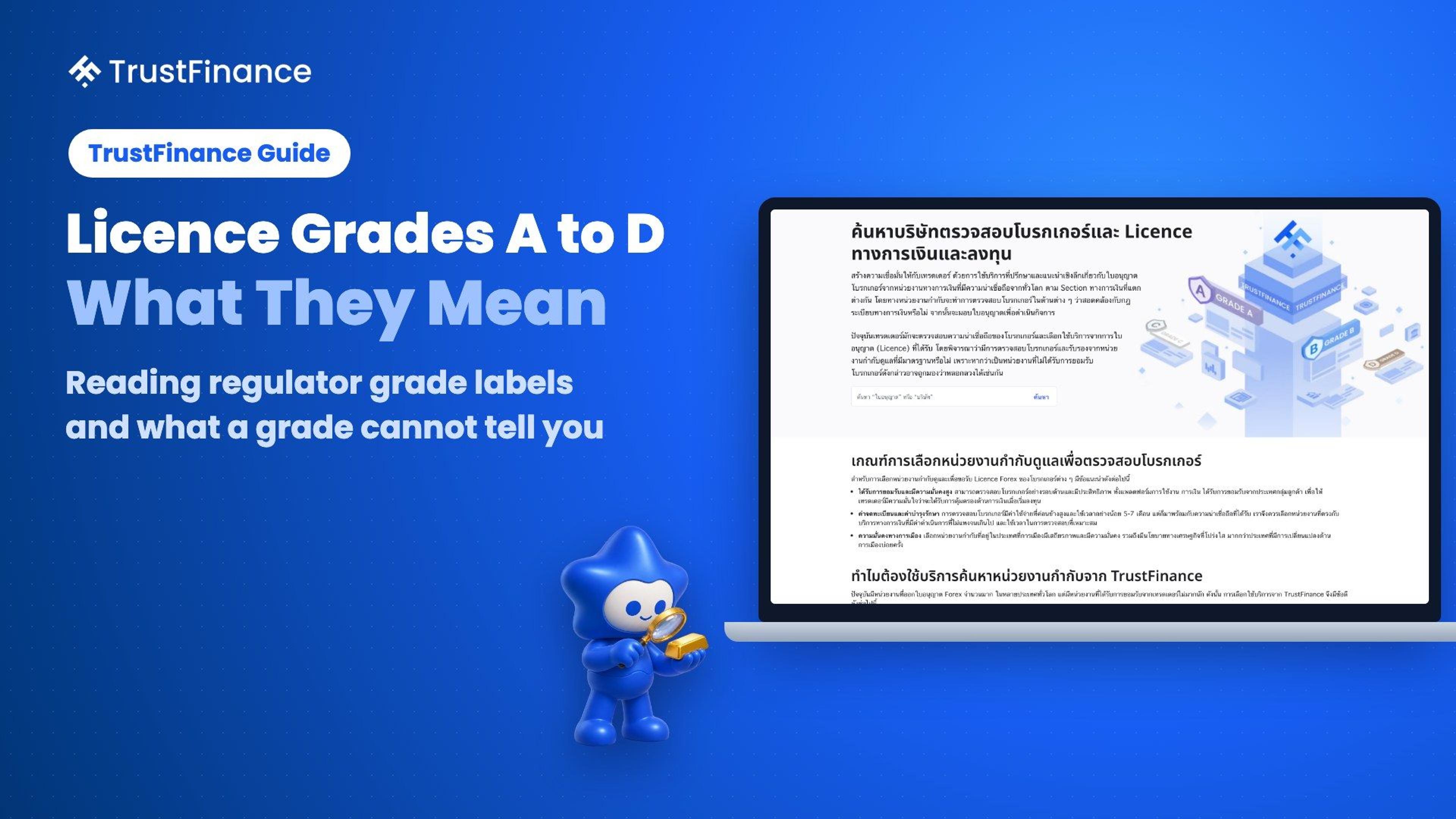
A licence grade on TrustFinance is the A to D label TrustFinance uses to group financial regulators by how strictly they protect users. Grade A is a world-leading regulator with the strictest rules; grade D is the least regulated jurisdiction.
The licence grade label appears on regulator cards on the regulation page and in the safety box of a company profile. This guide explains what each licence grade means and what a grade cannot tell you. Data as of 24 November 2026.
Key points
|
A licence grade is a ranking of the regulator that issued a financial company's licence. TrustFinance explains on company profiles that the grades differ in protection measures, such as segregated client funds, insurance, regular audits and dispute resolution.
| Grade | Regulator level | Measures TrustFinance lists |
|---|---|---|
| A | World-leading regulator | Strict compliance, segregated funds, insurance, regular audits, dispute resolution and AML/CTF standards |
| B | Recognised regional regulator | Segregated funds, financial reporting and compensation plans; slightly less strict than grade A |
| C | Regulator in an emerging market | Basic protection such as minimum capital and AML policy; users should take more care |
| D | Least regulated jurisdiction | Often no segregated funds or insurance; higher risk |
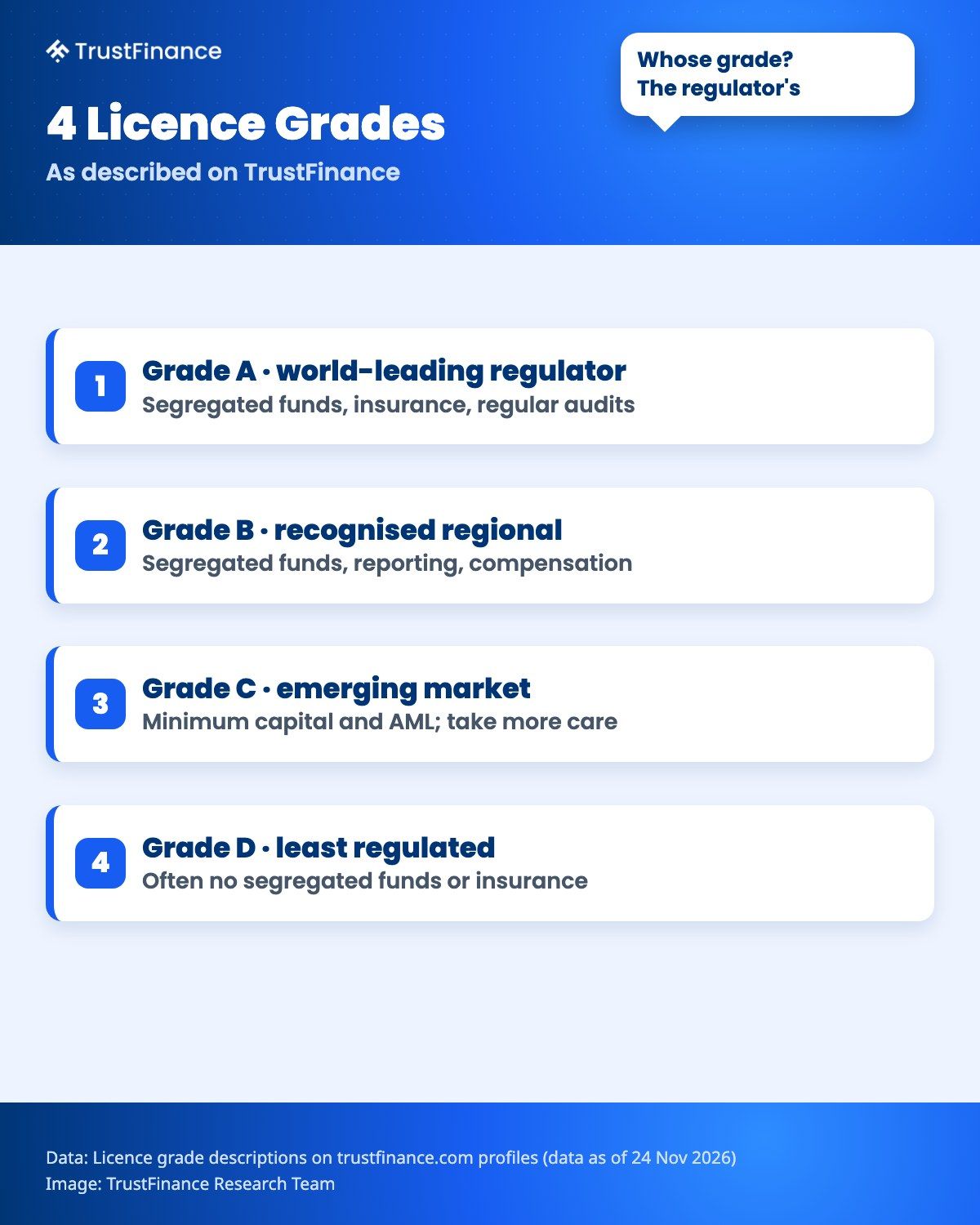
TrustFinance sorts licences into 4 grades, from grade A world-leading regulators to grade D least regulated jurisdictions
Data: Licence grade descriptions on trustfinance.com profiles (data as of 24 Nov 2026) · Image: TrustFinance Research Team
There are two main places: the regulation page that lists regulators worldwide, and the safety box on each company profile.
The TrustScore on a profile is split into a review part and an "others" part; what each covers is answered in the TrustScore 2.0 FAQ.
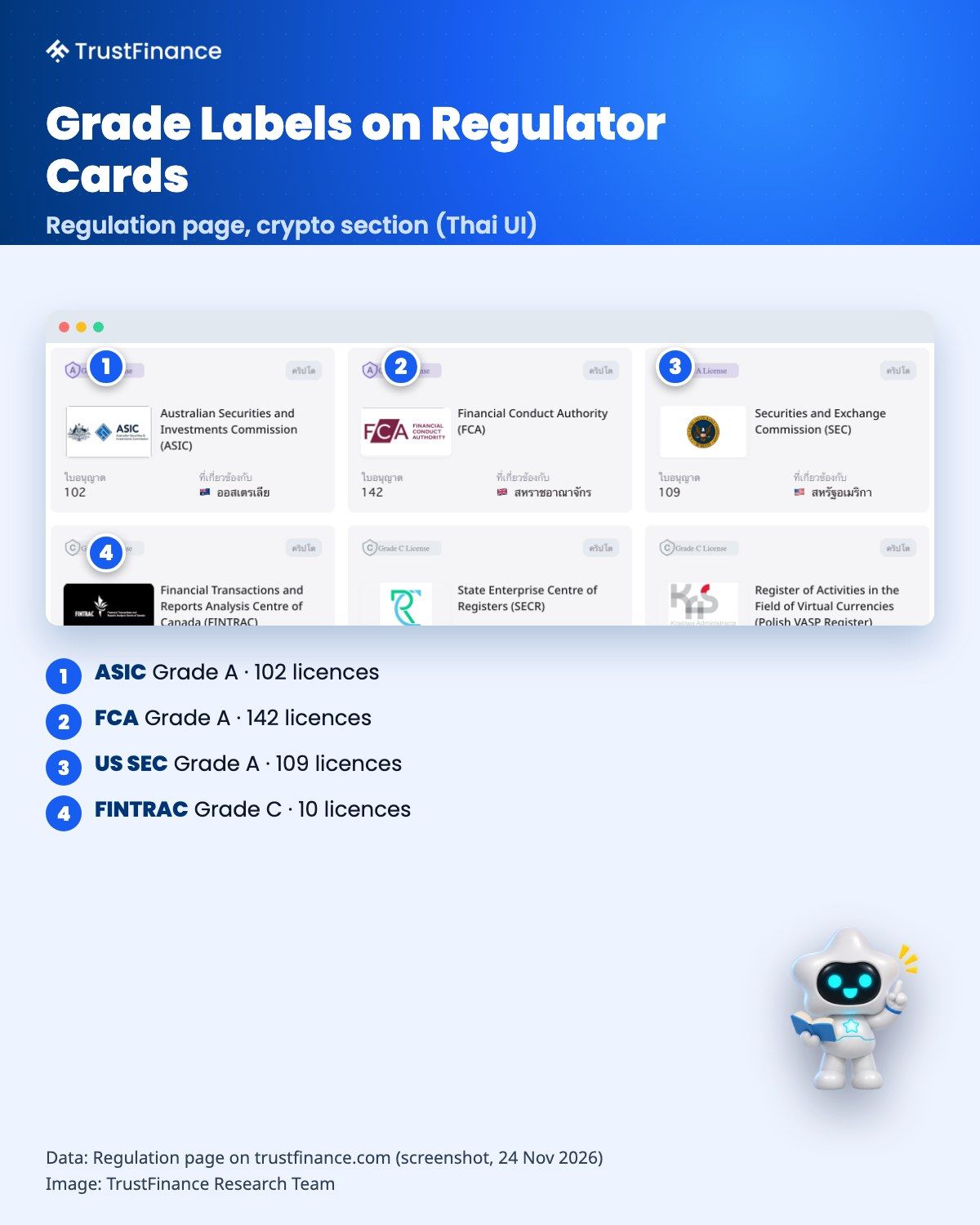
The regulation page shows ASIC 102, FCA 142 and US SEC 109 licences as grade A, and FINTRAC with 10 licences as grade C
Data: Regulation page on trustfinance.com (screenshot, 24 Nov 2026) · Image: TrustFinance Research Team
The crypto section of the regulation page on 24 Nov 2026 shows regulators in both grade A and grade C, with the number of licences TrustFinance has recorded.
| Regulator | Country | Grade on card | Licences in database |
|---|---|---|---|
| Australian Securities and Investments Commission (ASIC) | Australia | A | 102 |
| Financial Conduct Authority (FCA) | United Kingdom | A | 142 |
| Securities and Exchange Commission (SEC) | United States | A | 109 |
| FINTRAC | Canada | C | 10 |
| State Enterprise Centre of Registers (SECR) | Lithuania | C | 1 |
The licence count is the number in the TrustFinance database, not the total the regulator has issued. The stocks section also lists SEC Thailand with 190 licences.
A licence grade tells you the regulator's level, not that a company is safe in every way. Read other data as well.
How TrustFinance tracks licence status changes is explained in what the License Monitoring Program (LMP) is.
The regulator detail page shows who the regulator is, which country it covers and which licence types it issues. The FCA page on TrustFinance lists the United Kingdom, Crypto, Financial and Forex licence types, and 142 License Holders.
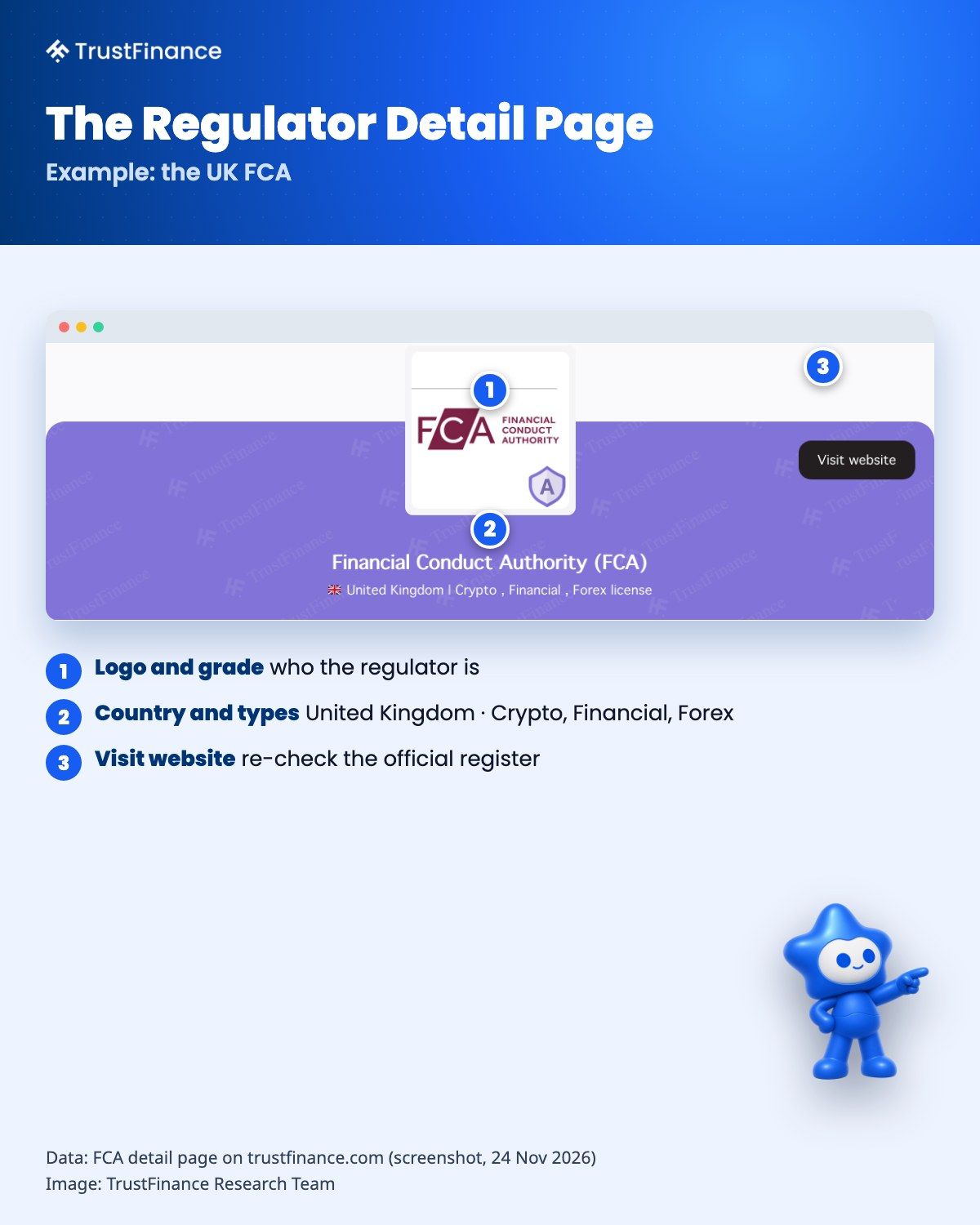
The FCA page on TrustFinance lists the United Kingdom, Crypto, Financial and Forex licences and 142 License Holders
Data: FCA detail page on trustfinance.com (screenshot, 24 Nov 2026) · Image: TrustFinance Research Team
How the score on a company profile is built is in how TrustScore 2.0 is calculated.
Note: Forex trading has no licence or supervision from any authority in Thailand; the Bank of Thailand has no policy to license retail Forex businesses. Disclaimer: This article is for general education only. It is not investment advice or a solicitation to trade securities, digital assets or derivatives. Readers should study the information and assess the risks themselves before deciding. |
4: A, B, C and D, from world-leading regulators to the least regulated jurisdictions.
No. The grade rates the regulator; you still need to check that the licence covers clients in your country and that its status is Regulated.
On regulator cards on the regulation page, and in the safety box on company profiles.
Pending means in progress; Expired means the licence has lapsed. Check with the regulator directly.
No. The Bank of Thailand has no policy to license retail Forex businesses, and a foreign licence does not make it legal in Thailand.
Licence grades A to D on TrustFinance rank regulators by how strictly they protect users. They are a good first screen, but a grade belongs to the regulator, not the company: check which licence covers Thai clients, its latest status, and always re-check the licence number on the regulator's own register.
Other references: grade A to D descriptions from company profiles on trustfinance.com · the Bank of Thailand's position on retail Forex (bot.or.th)
Reviewed by TrustFinance Research Team · Data as of 24 November 2026
TrustFinance Research Team
Official TrustFinance research and editorial team, sharing insights, analysis, and best practices to help financial companies and traders build transparency, credibility, and growth.

