Loading
Related Articles


31 Aug 2026
When Trust Becomes an Asset You Can Audit


18 Feb 2026
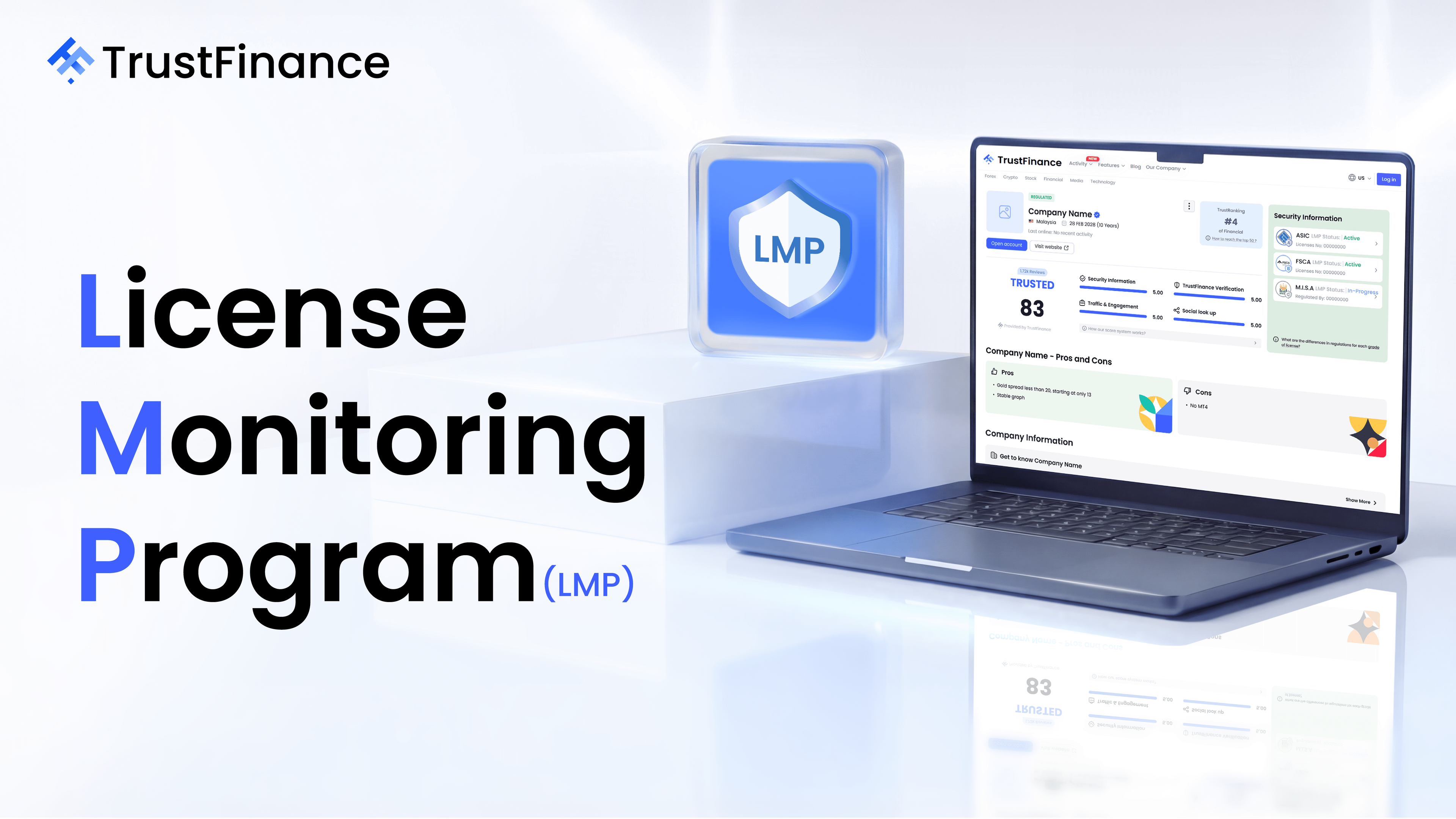
What Is License Monitoring Program (LMP)?
Fed Rate Hikes Are Back in 2026: What a Return to Tightening Means for the Dollar, Gold, and Traders
Fed Rate Hikes Are Back in 2026: What a Return to Tightening Means for the Dollar, Gold, and Traders
Related Articles
31 Aug 2026
When Trust Becomes an Asset You Can Audit
18 Feb 2026
What Is License Monitoring Program (LMP)?

TrustFinance Research Team
Sep 28, 2026
9 min read
50
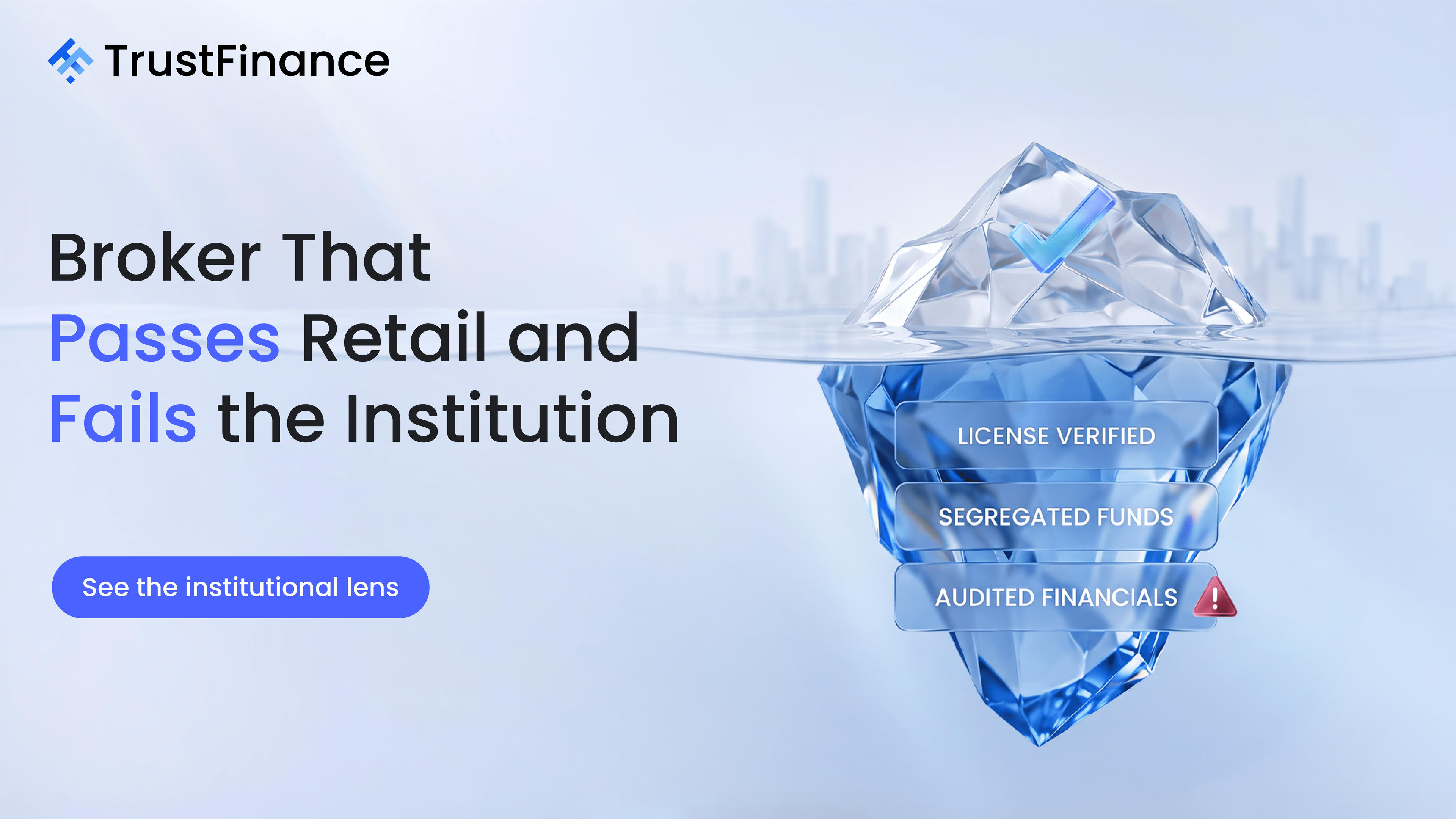
A retail trader and a pension fund can look at the same broker and reach opposite conclusions, because they are not looking at the same things. The retail trader weighs the app interface, the spread, a bonus offer, a recommendation from an online forum. The institution, a fund manager, a corporate treasury desk, a regional bank, runs the same skepticism a credit committee applies to a bank counterparty: structured due diligence, documented risk assessment, and monitoring that continues long after the first trade. A broker can be perfectly credible on a landing page and still fail the moment someone asks for audited financials, license history, and evidence of how client funds are segregated.
That gap is worth understanding, and not only for institutions. The standards institutional buyers apply are quietly becoming the standards informed retail clients and financial media expect too. Evidence-based evaluation is turning into the norm rather than the exception, which is why "choose on evidence, not advertising" is less a slogan than a description of how serious capital already gets allocated.
Retail clients typically evaluate a broker through a narrow set of visible signals: platform design, spreads, support responsiveness, social proof. Institutional buyers treat the same relationship as a counterparty exposure, not a service subscription, and work from a formal checklist.
Due-diligence guidance published by asset managers, including J.P. Morgan Asset Management's Global Liquidity Investment Academy, describes institutions examining five broad categories when assessing a counterparty: the strength and experience of the management team, credit analysis and investment process, liquidity and investor concentration, governance and risk oversight, and technology infrastructure. Each category generates its own documentation trail, and each is revisited periodically rather than assessed once at onboarding. The difference is not thoroughness for its own sake; it reflects that an institution treats a broker failure as a loss event to be underwritten, not an inconvenience to be complained about.
Frameworks vary by asset class and jurisdiction, but most converge on a common set of pillars:
Regulatory license verification. Confirming the entity holds an active license from a recognized regulator, covering the specific activities offered, checked against the regulator's own register rather than the broker's claims.
Counterparty and credit risk. Assessing the broker's own financial strength: capital adequacy, leverage, exposure concentration, and the quality of its banking and liquidity relationships.
Segregation of client funds. Verifying client money is held separately from operating capital, with clear rules on reconciliation and on what happens in insolvency.
Audited financial statements. Requiring independently audited accounts, not internally prepared summaries.
Operational track record. Reviewing how long the entity has operated, how it behaved through market stress, and whether it carries regulatory actions or unresolved disputes.
Governance and compliance. Examining whether there is an independent compliance function with clear escalation lines and capable senior oversight.
Technology and continuity. Evaluating execution infrastructure, cybersecurity, and disaster recovery, since operational failure can be as damaging as financial failure.
The International Organization of Securities Commissions (IOSCO) has formalized several of these expectations in its recommendations on the protection of client assets, which call for intermediaries to maintain accurate, auditable records of client asset location and ownership, and in many jurisdictions to have those controls independently verified.
License verification is the first and most binary filter. A missing, lapsed, or misrepresented license is typically disqualifying, regardless of how strong the rest of the profile looks.
The Securities and Exchange Commission of Thailand maintains a public "List of Licensee" register, and the Stock Exchange of Thailand publishes its own member list, both allowing any party, an institution, a partner, or a client, to check licensing status directly rather than rely on marketing claims. The observable reality is straightforward: institutional partners check the register before signing anything, and an entity that cannot be found on it, or whose license type does not match the activity it advertises, does not clear an institutional gate.
Once licensing is confirmed, reviewers turn to counterparty risk, often borrowing a framework similar to the CAMELS approach used in banking supervision: Capitalization, Asset quality, Management, Earnings, Liquidity. Applied to a broker, that becomes questions such as: How well capitalized is the entity relative to its client exposure? How diversified are the banks and liquidity providers it relies on? Is management experienced and stable, or has there been high turnover in compliance and risk leadership? Are earnings sustainable, or dependent on aggressive client-acquisition incentives that could signal balance-sheet stress? And critically, this is treated as ongoing monitoring, not a one-time snapshot, because regulatory status and ownership change over the life of a relationship.
Segregation is one of the most heavily scrutinized elements, because it directly determines what happens to client assets if a broker fails. Under frameworks such as the UK Financial Conduct Authority's Client Assets Sourcebook (CASS), firms must place client money in segregated accounts separate from their own funds, and exercise ongoing care in selecting and reviewing the banks holding those accounts, including considering how much client money sits with a single banking counterparty and what deposit protection applies. The principle is that segregation is not a box to tick but a risk-management practice needing continuous oversight.
Institutional reviewers ask for documented evidence: which banks hold client funds, how and how often reconciliations occur, and what happens to client assets in insolvency. A broker that cannot produce this, or that commingles client and operating funds even temporarily, represents a structural red flag no amount of platform polish offsets.
| Evaluation Dimension | Typical Retail Signal | Institutional Criteria |
|---|---|---|
| Regulatory status | Logo or badge on the website | Direct verification against the regulator's register (e.g. Thailand SEC List of Licensee) |
| Financial strength | Marketing claims of "well capitalized" | Independently audited statements, capital adequacy ratios |
| Client fund protection | General assurance of "safety" | Documented segregation, custodian due diligence, reconciliation frequency |
| Track record | Years in business as stated in copy | Verified operational history, disciplinary and complaint record |
| Governance | Team photos and bios | Verified compliance function, board oversight, escalation procedures |
| Technology | UI and app-store reviews | Execution-quality data, cybersecurity posture, continuity testing |
| Ongoing relationship | One-time onboarding decision | Periodic re-review, monitoring of regulatory and ownership changes |
Reading Thailand through this lens is instructive, because it shows how the same evidence-based standards surface in a market where cross-border activity is closely watched. A few observations follow from how institutions evaluate providers:
Thai licensing status functions as a verifiable public fact, not a claim, since institutional partners check the SEC register themselves before any agreement.
Segregation and custody arrangements carry weight only when documented in a way that can be independently reviewed, rather than asserted in marketing material.
Audited financials, prepared under recognized standards, are treated as a baseline expectation for any serious institutional conversation.
A demonstrable operational record, including conduct through periods of stress or regulatory change, weighs more heavily with institutional counterparts than promotional visibility.
Because Thailand's posture toward cross-border financial and digital-asset services has tightened, with enforcement against unlicensed operators reported in 2026, entities whose Thai licensing status is ambiguous or recently changed tend to attract heightened scrutiny.
None of these are instructions for entering the market; they are simply what the institutional evaluation process makes visible about how credibility is judged there.
The useful thing about the institutional lens is that it is reproducible. The pillars institutional buyers rely on, verified licensing, evidence of segregated client funds, audited financial disclosure, and a documented operational track record, are the same categories TrustFinance treats as the foundation of broker trust intelligence, made accessible to a broader audience than a fund's due-diligence desk. The underlying principle is consistent across audiences: trust should rest on evidence that can be checked against a public record or an independent source, not on claims that cannot be verified. As Thailand's environment for cross-border financial services keeps evolving, the gap between companies that can produce that evidence and those that cannot is likely to become a more visible differentiator, for institutional partners and individual clients alike.
Institutional buyers evaluate a broker through a structured, evidence-based process that looks past marketing and platform design to the regulatory, financial, and operational reality of the business: license verification first, then counterparty and credit risk, segregation of client funds, audited financials, and operational track record and governance. In Thailand, where a public SEC register allows direct verification and cross-border scrutiny has tightened, these standards increasingly matter well beyond the institutional audience. The companies that can produce clear, verifiable evidence across these categories are the ones positioned to earn the trust of institutional partners, regulators, and the growing share of retail clients now learning to ask the same questions institutions have always asked.
Regulation and Due Diligence, Global Liquidity Investment Academy, J.P. Morgan Asset Management
Counterparty Exposure Risk, The Hedge Fund Journal
Recommendations Regarding the Protection of Client Assets, Final Report, IOSCO
FCA Handbook, CASS 7 Client Money Rules
How Do Licensing Requirements Apply to Cross-Border Business in Thailand, Baker McKenzie
List of Licensee, Securities and Exchange Commission Thailand
TrustFinance Research Team
Official TrustFinance research and editorial team, sharing insights, analysis, and best practices to help financial companies and traders build transparency, credibility, and growth.
