Loading
Related Articles
Fed Rate Hikes Are Back in 2026: What a Return to Tightening Means for the Dollar, Gold, and Traders
Fed Rate Hikes Are Back in 2026: What a Return to Tightening Means for the Dollar, Gold, and Traders
Related Articles

Thanakit Sutto
Nov 23, 2026
8 min read
0
Filing tax on a provident fund in Thailand has two stages. While you work, the contributions you pay into the fund can be deducted and exempted from tax. When you leave the job or the fund, the money you receive may be tax-exempt, taxable, or eligible for separate filing, depending on Revenue Department conditions.
This guide explains how to fill in each stage with worked numbers, and the option of keeping money in the fund so no tax is due yet.
Key takeaways
|
The Revenue Department's PND.91 filing guide for tax year 2025 splits employee contributions into two parts, filled in different places.
Hypothetical example: salary 50,000 baht a month, 600,000 baht a year, contributing 5% = 30,000 baht. Deduction 10,000 baht and exempt income 20,000 baht (within 15% of wages = 90,000 baht). Total tax benefit used: 30,000 baht, within the 500,000 baht combined cap. |
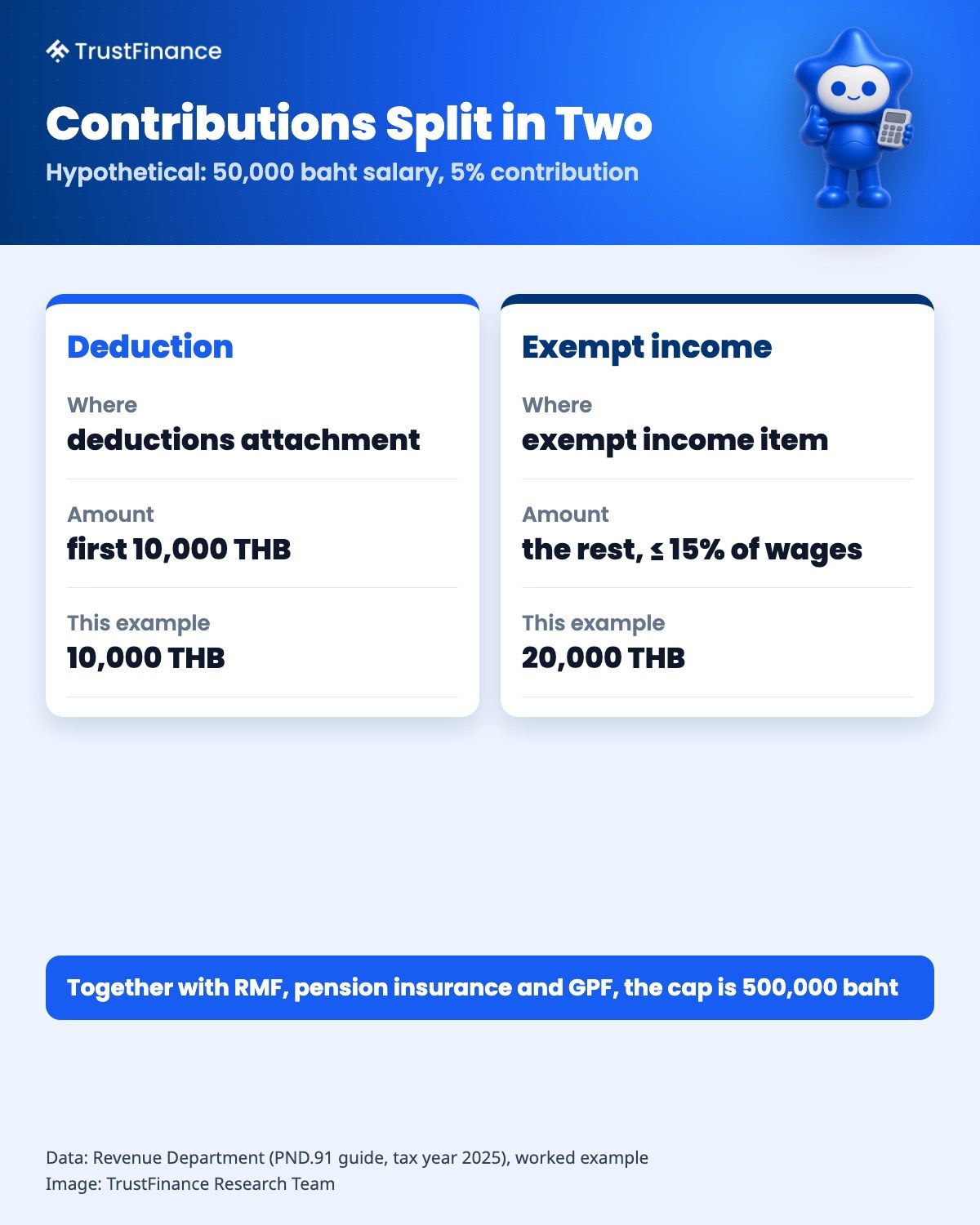
30,000 baht of provident fund contributions splits into a 10,000 baht deduction and 20,000 baht of exempt income, which must stay within 15% of wages.
Data: Revenue Department (PND.91 filing guide, tax year 2025), worked example · Image: TrustFinance Research Team
It depends on why you leave, your age and your years of membership. Revenue Department Notice No. 52 sets the exempt cases.
| Case | Tax |
|---|---|
| Leaving work at 55 or older with at least 5 years of membership | Fully exempt |
| Disability certified by a doctor, or death | Exempt |
| Leaving before meeting the conditions | Your own contributions are not taxed; employer contributions and the returns on both are taxable |
| Less than 5 years of work | The taxable part is added to your other income for the year |
| 5+ years of work but not exempt | You may choose separate filing for extra deductions |
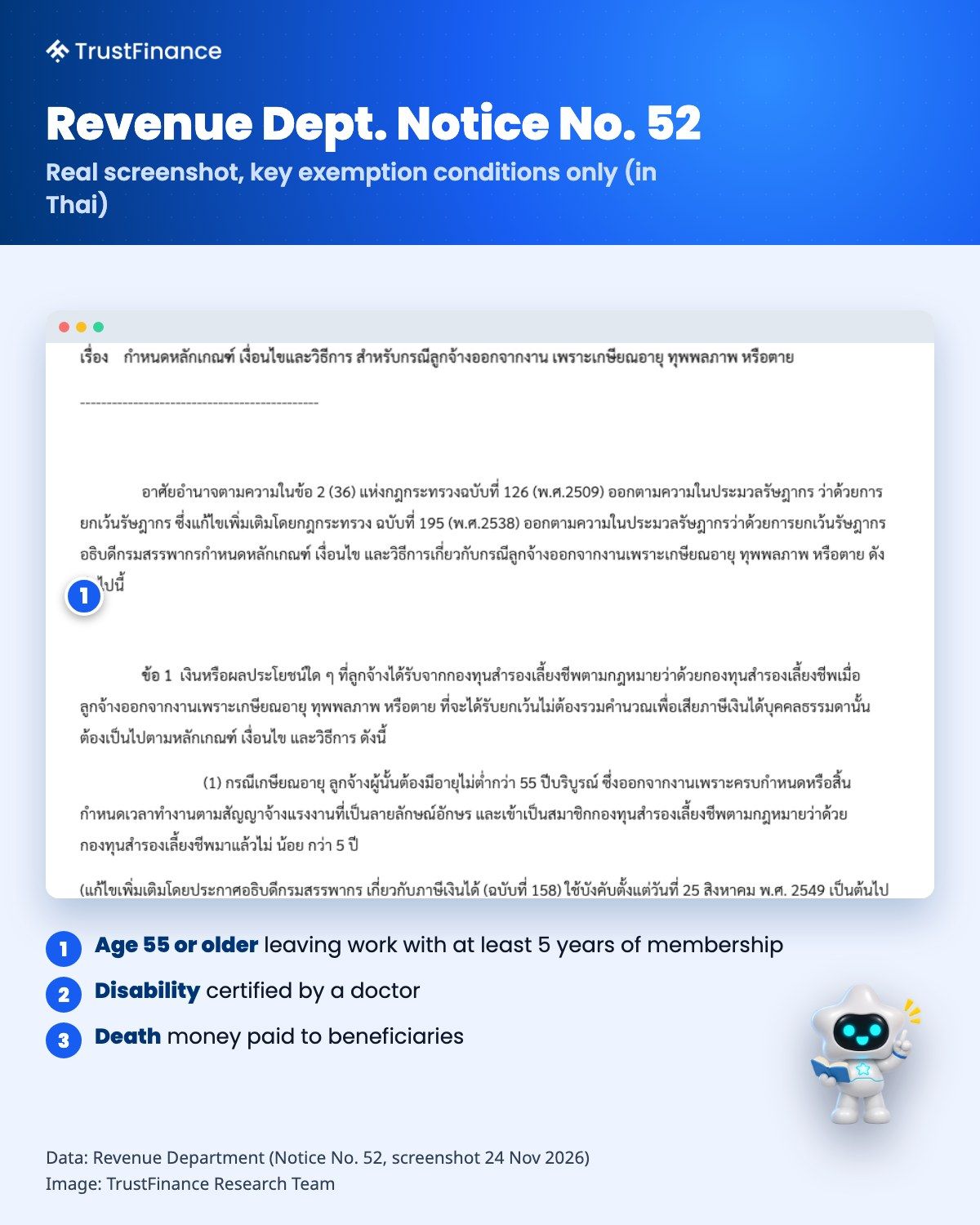
Revenue Department Notice No. 52 exempts money from a provident fund when you leave work at 55 or older with at least 5 years of membership.
Data: Revenue Department (Notice No. 52, screenshot 24 Nov 2026) · Image: TrustFinance Research Team
If you worked for at least 5 years, you can tax the one-off money received for leaving work separately from other income, under section 48(5) of the Revenue Code.
Step 1: deduct 7,000 baht × years worked, but no more than the amount received Step 2: deduct a further 50% of what remains Step 3: calculate tax on the rest at the income tax rates, separately from other income Hypothetical example: 6 years of work and a taxable part of 300,000 baht: less 7,000 × 6 = 42,000 baht leaves 258,000 baht; less another 50% leaves 129,000 baht to be taxed separately. |
Separate filing uses an attachment filed with PND.91 if you only have salary income, or PND.90 if you also have other types of income.
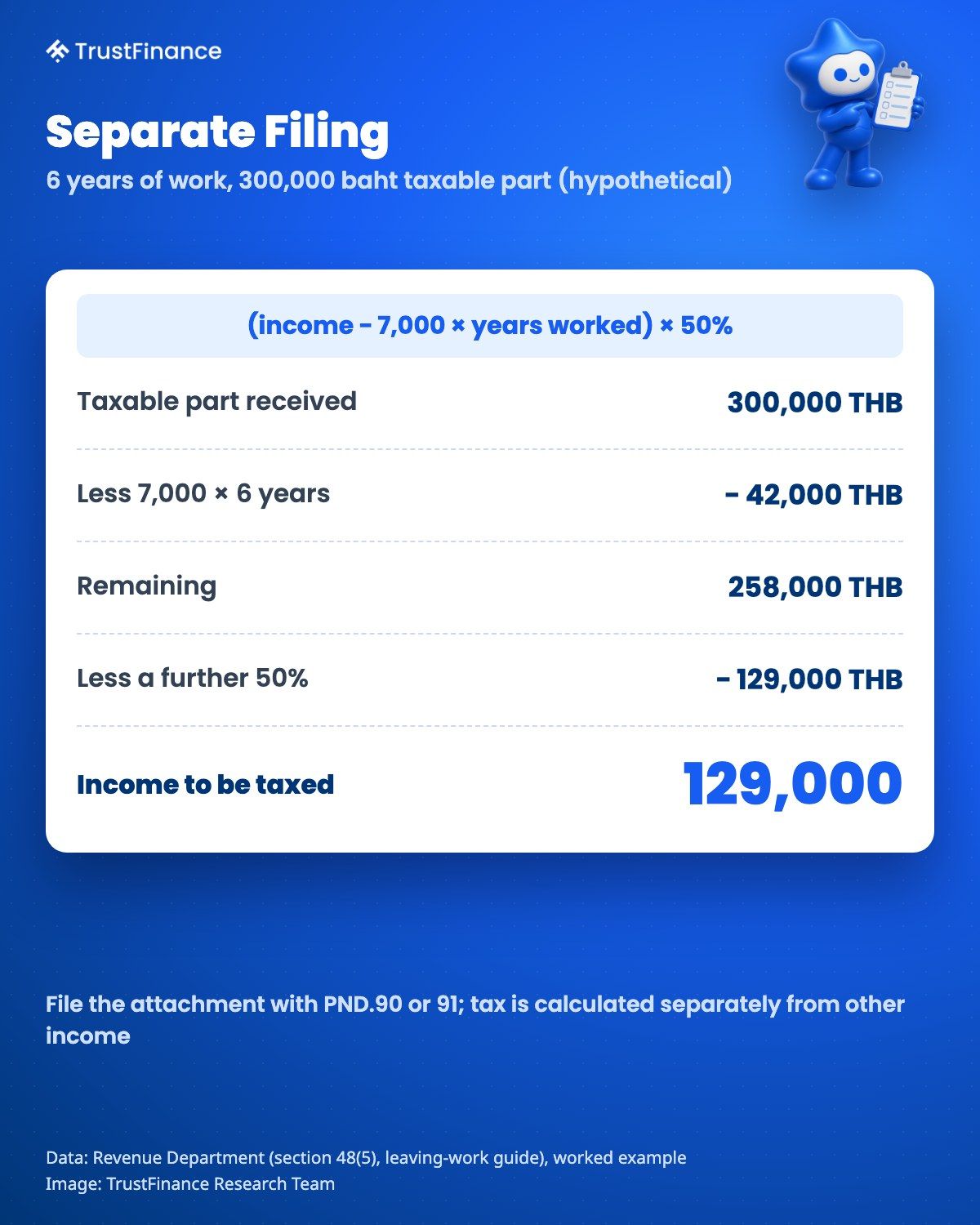
With separate filing, a 300,000 baht taxable fund payout after 6 years of work, less 7,000 × 6 and then 50%, leaves 129,000 baht to be taxed.
Data: Revenue Department (section 48(5), leaving-work guide), worked example · Image: TrustFinance Research Team
If you do not need the money yet, some options do not count as receiving income, so no tax is due at that point.
Before choosing a fund investment plan or an RMF, read the fund fact sheet carefully; see how to read a fund fact sheet. The effect of leaving money invested for many years follows the logic of compound interest.
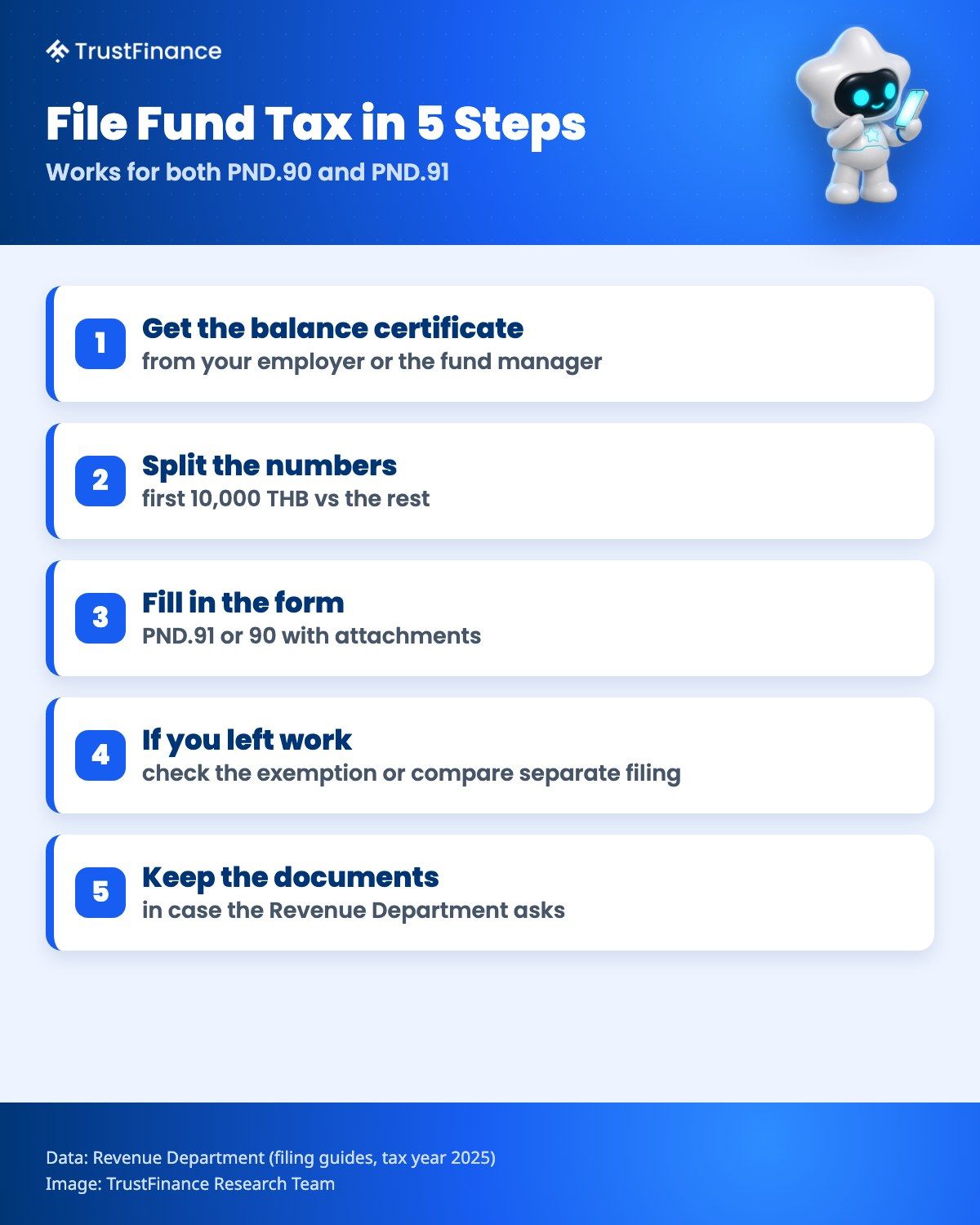
Filing provident fund tax takes five steps: get the certificate, split deduction and exempt income, fill in the form, check the leaving-work conditions and keep the documents.
Data: Revenue Department (PND.90 and PND.91 filing guides, tax year 2025) · Image: TrustFinance Research Team
This article is for education only. It is not personal tax or investment advice. Readers should check the latest conditions with the Revenue Department and their own fund before deciding.
The first 10,000 baht is a deduction, and the rest is exempt up to 490,000 baht and 15% of wages, within the 500,000 baht cap for the retirement group.
No. Only the contributions the employee pays can be deducted.
Your own contributions are not taxed, but employer contributions and returns are, unless you keep the money in the fund or move it to a new fund or an RMF.
When you have worked for at least 5 years and the money is a one-off payment received because you left work.
Tell the fund through its channels; you must keep the full amount, and how long you can keep it depends on each fund's rules.
While working, the first 10,000 baht of provident fund contributions is a deduction and the rest exempt income, within 15% of wages and a 500,000 baht retirement-group cap.
When leaving, money is exempt at 55 or older with 5 years of membership; otherwise, with 5+ years of work you can file separately to deduct 7,000 baht a year and 50% more, or keep the money in a fund to defer tax.
Fund fees and NAV affect what you receive; see the worked example on fund NAV and fees.
Other references: Association of Investment Management Companies / thaipvd.com (keeping money in the fund and RMF for provident fund), Revenue Department (deductions summary 28 Jan 2025)
Fact-checked by TrustFinance Research Team · Information as of 24 November 2026
Thanakit Sutto
Content & PR Lead at TrustFinance. A finance writer who makes investing easy to understand.


