Loading
Related Articles
Fed Rate Hikes Are Back in 2026: What a Return to Tightening Means for the Dollar, Gold, and Traders
Fed Rate Hikes Are Back in 2026: What a Return to Tightening Means for the Dollar, Gold, and Traders
Related Articles

Thanakit Sutto
Nov 23, 2026
7 min read
0

The home loan interest tax deduction lets you deduct interest actually paid in the tax year on a loan to buy, hire-purchase or build a home from Thai personal income tax, up to 100,000 baht a year, according to the Revenue Department's filing guide.
The deduction comes with conditions on the lender, the mortgage and living in the home, plus specific rules for co-borrowers and refinancing. This guide sums up the conditions, a worked example and the steps to claim it.
Key takeaways
|
You can deduct the interest actually paid in the tax year, up to 100,000 baht. Principal repayments do not count, only the interest part.
If you paid 180,000 baht in instalments for the year and the interest certificate shows 85,000 baht of interest, you can deduct 85,000 baht. If interest was 130,000 baht, the maximum is 100,000 baht.
A repayment schedule splits principal and interest for each instalment; see how to check it in reconciling a loan amortization schedule.
The Revenue Department's PND.91 filing guide for tax year 2025 sets four main conditions.
If several qualifying homes are lived in, each can be claimed, but the total is still capped at 100,000 baht.

The home loan interest deduction of up to 100,000 baht a year requires a lender operating in Thailand, a loan for a home, a mortgage for the term and living there that year.
Data: Revenue Department (PND.91 filing guide, tax year 2025) · Image: TrustFinance Research Team
The rule is to split by the number of borrowers with income, with a combined limit of 100,000 baht for that loan.
| Case | How to claim |
|---|---|
| Two co-borrowers | Each claims half, together up to 100,000 baht |
| Spouses borrowing jointly, both with income | Each claims half, together up to 100,000 baht |
| Spouses borrowing jointly, one with income | The earning spouse claims the full amount, up to 100,000 baht |
| Each spouse with a separate loan | Each claims up to 100,000 baht |
| Wife borrows alone, husband not a co-borrower | The husband cannot deduct that interest |
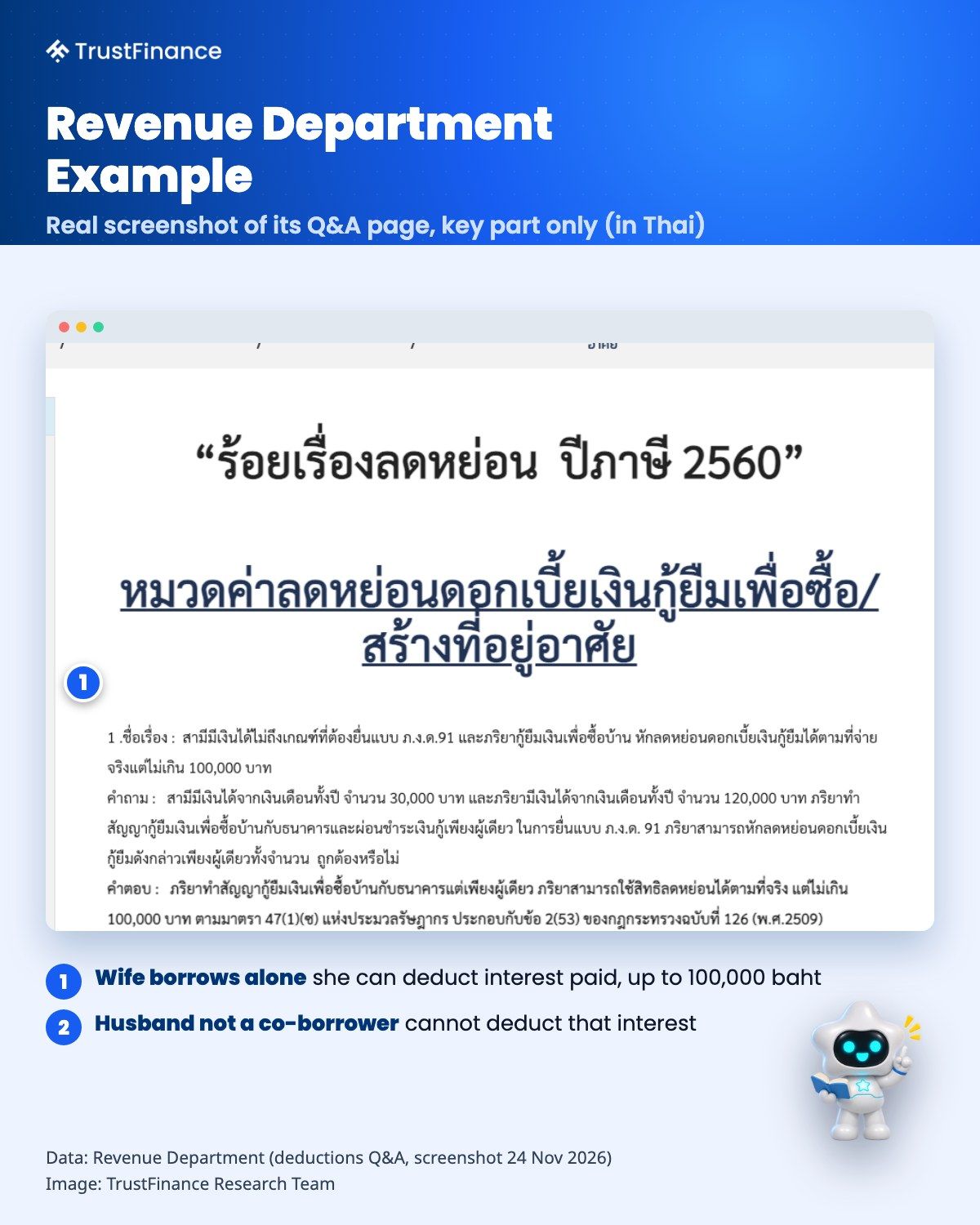
The Revenue Department's Q&A confirms that a wife who borrows alone to buy a home can deduct interest paid up to 100,000 baht, while a husband who is not a co-borrower cannot.
Data: Revenue Department (deductions Q&A, screenshot 24 Nov 2026) · Image: TrustFinance Research Team
Yes. The Revenue Department says that if the loan moves from one qualifying lender to another, the deduction continues within the 100,000 baht limit, but only for the part of the new loan that paid off the old home loan, up to the outstanding balance. Extra money borrowed for other purposes does not count.
Before refinancing, compare interest and costs across loan types; see how to choose a loan.
The saving depends on the top tax bracket your net income falls in; it is not equal to the amount deducted.
Hypothetical example: net income before the home loan deduction is 700,000 baht, in the 15% bracket (500,001 to 750,000 baht). Deducting 100,000 baht of home loan interest leaves 600,000 baht of net income, still in the 15% bracket. Tax saved ≈ 100,000 × 15% = 15,000 baht |
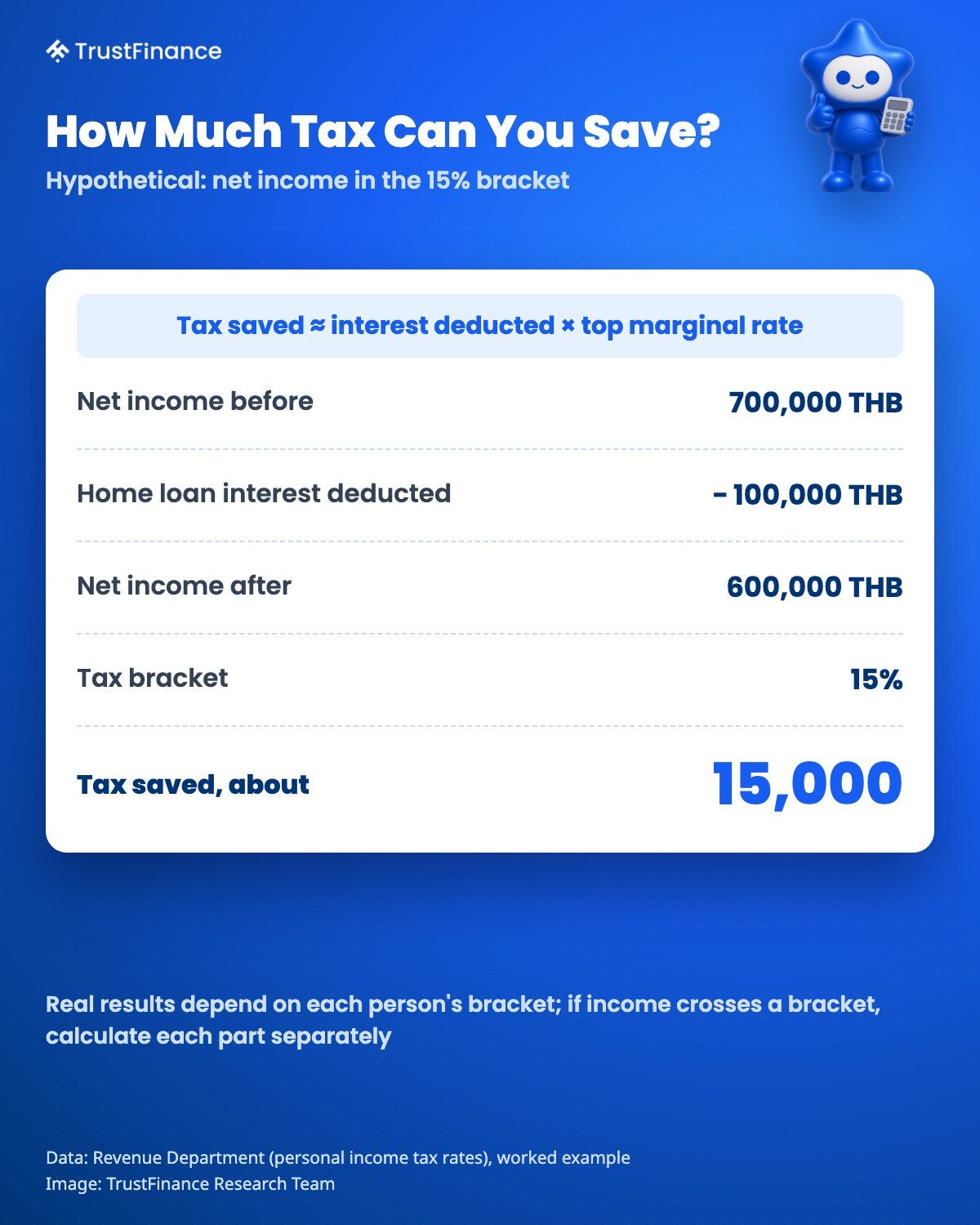
If net income is in the 15% bracket, deducting 100,000 baht of home loan interest cuts tax by about 15,000 baht.
Data: Revenue Department (personal income tax rates), worked example · Image: TrustFinance Research Team
This article is for education only. It is not personal tax or financial advice. Readers should check the latest conditions with the Revenue Department before filing.
100,000 baht per tax year, based on interest actually paid, and the total for all homes claimed must stay within this limit.
Yes. Condo units qualify if the loan is from a qualifying lender, the unit is mortgaged as security and you live in it that year.
Half of the interest actually paid each, together up to 100,000 baht; for example, 120,000 baht of interest gives each 50,000 baht.
No. The lender must be one of the businesses the Revenue Department lists, such as a bank, life insurer, cooperative or employer.
The lender's interest certificate in the official form, used when filing and kept as evidence.
Home loan interest is deductible up to 100,000 baht a year when the loan is from a lender operating in Thailand, for a home, mortgaged for the term and lived in.
Co-borrowers split it, refinancing keeps the deduction only for the part that repaid the old loan, and you need the interest certificate. How loan interest is charged is compared in flat rate vs effective rate.
Other references: Revenue Department (PND.90 filing guide for tax year 2025, personal income tax rates)
Fact-checked by TrustFinance Research Team · Information as of 24 November 2026
Thanakit Sutto
Content & PR Lead at TrustFinance. A finance writer who makes investing easy to understand.