Building Trust in Financial Services: 2025 Strategies for Growth & Compliance

TrustFinance Research Team
Sep 05, 2025
7 min read
142

Introduction: Trust as the Defining Currency of Finance
For decades, reputation was enough to carry financial institutions. A strong brand name, a polished lobby, or a long history of service created an almost automatic level of confidence. That era is over.
Between 2023 and 2025, the financial services industry entered a new reality: the age of active trust. Customers no longer take institutions at their word. They expect ongoing proof — in the form of transparency, security, and credibility — before they are willing to commit.
For Forex brokers, crypto exchanges, payment providers, and investment platforms, this shift has raised the stakes. Companies that can consistently demonstrate trustworthiness are winning new business and retaining clients. Those that can’t are finding themselves exposed, vulnerable, and in many cases, left behind.
This guide brings together recent market research, regulatory insights, consumer behavior trends, and case studies to show how trust is being built (and lost) in 2025 — and what financial companies can do about it.
The Financial Trust Landscape (2023–2025)
Traditional Institutions Still Lead — For Now
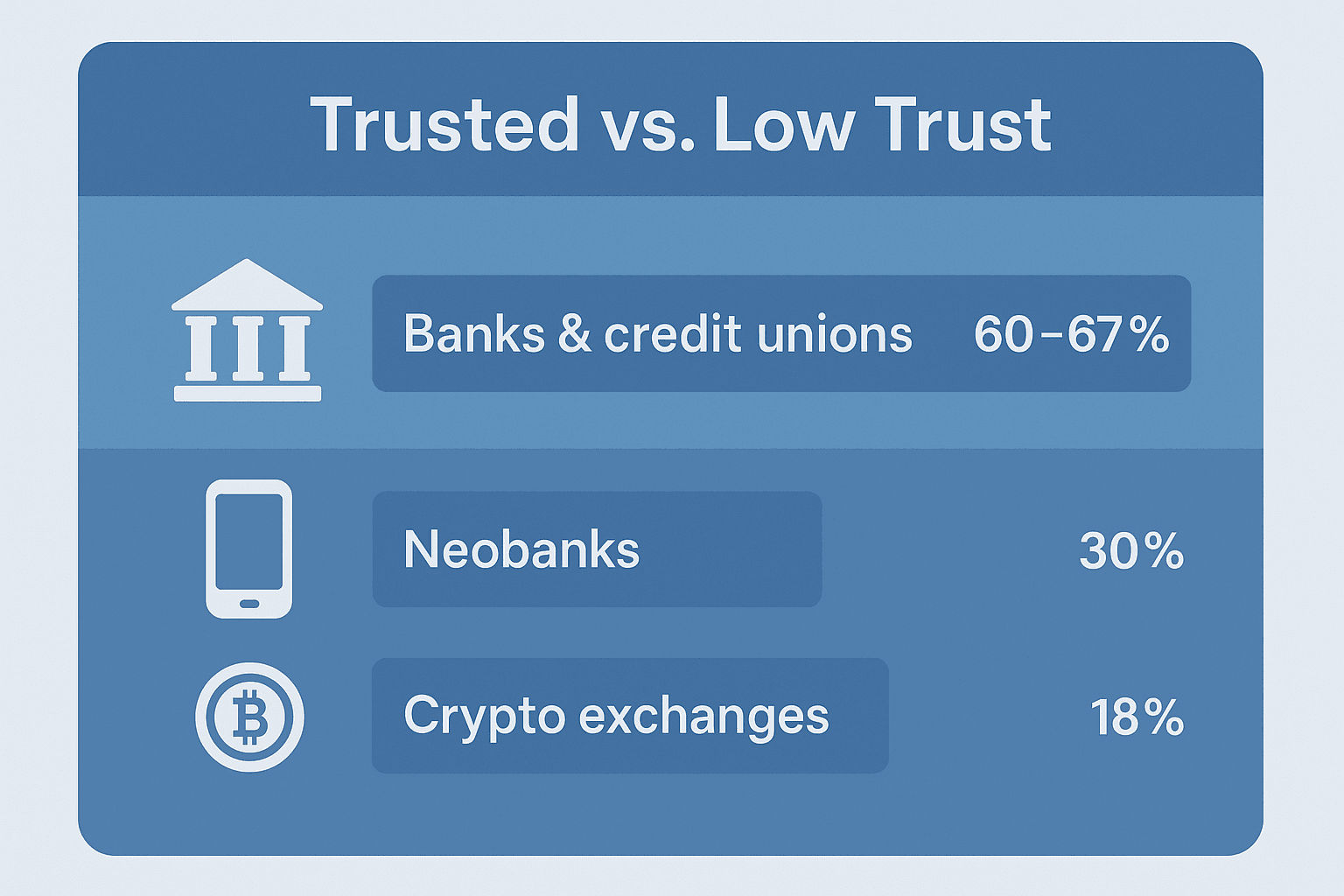
Consumer surveys highlight a striking divide. Regional banks (67%), community banks (61%), and large national banks (60%) continue to enjoy relatively high levels of trust. Meanwhile, neobanks are trusted by only 30% of consumers, and cryptocurrency exchanges sit at the bottom with 18% (Plaid/YouGov, 2024).
The gap is not simply about technology. It reflects the psychological comfort of legacy institutions. Nearly half of consumers say they avoid digital-only platforms because of security concerns, while another 45% cite the lack of human interaction.
Trust as a Measurable Business Driver
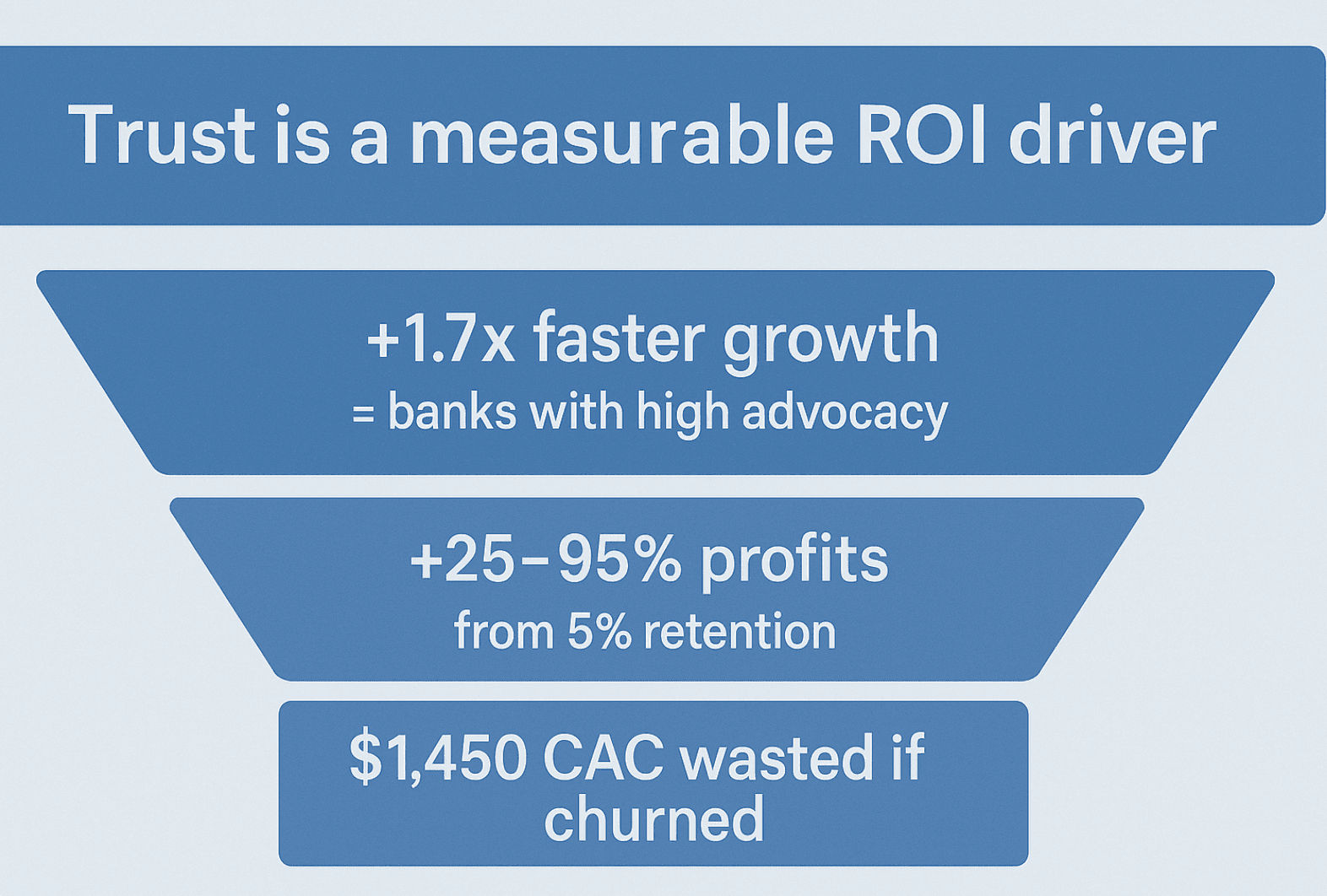
Trust is not abstract — it directly impacts performance. Banks with the highest customer advocacy grow 1.7x faster than their peers (Accenture, 2025). Improving retention by just five percent can boost profits anywhere from 25% to 95% (Experian).
By contrast, fintech providers lose nearly three out of four new customers within the first week, despite spending an average of $1,450 to acquire each one. For Forex brokers in particular, credibility is a matter of survival. Explore 5 ways Forex brokers can build trust with retail investors to strengthen credibility and retention.
Regulation: The Foundation of Credibility
Global Regulators Tighten the Rules
Regulators worldwide are aligning around a common theme: trust through accountability.
- UK (FCA): Consumer Duty reforms require firms to deliver measurable positive outcomes.
- Cyprus (CySEC): Suspensions in 2025 for non-compliant firms underscored the cost of poor disclosure.
- US (SEC): Crypto enforcement actions hit $4.98B in 2024, including record settlements.
- EU (MiCA & TFR): New rules raise anti-money laundering and transparency standards for crypto.
The Regulated vs. Unregulated Divide
The credibility gap has never been clearer. In the UK, the FCA publicly lists unauthorized firms, warning that they offer no Ombudsman or compensation protections. In the US, unregulated offshore brokers expose clients to fraud and legal uncertainty.
In payments, compliance is a non-negotiable trust factor. For practical steps, see Creating trust in payment gateways: A checklist for 2025.
What Customers Now Expect: Modern Trust Signals
The New Checklist of Credibility
Consumers in 2025 evaluate trust based on visible, verifiable signals:
- Licensing & Regulation: FCA, CySEC, ASIC, MAS, or SEC authorization.
- Security Measures: Two-factor authentication, encryption, third-party audits.
- Transparency: No hidden fees, clear disclosures, open pricing.
- User Experience: Seamless cross-channel consistency.
- Social Proof: Verified reviews and testimonials.
- Corporate Values: ESG and diversity commitments.
For Forex brokers, a verified profile is now one of the strongest signals of legitimacy. Learn more about how verified profiles increase credibility for Forex brokers.
Transparency and Peer Validation
The financial sector’s history of scandals has left customers wary. Today, independent proof is essential:
- 75% of US consumers say fee transparency matters most — but only after validation by third parties.
- In BNPL, Affirm gained trust by reporting loans to Experian.
- In trading, investors demand verifiable track records and authentic reviews.
- For crypto, trust is lowest, making transparency and peer validation essential. Read why trust is the key to crypto exchange success.
Lessons from the Field: Successes and Failures
Trust Builds Leaders
- Coinbase: Compliance-first approach positioned it as a mainstream gateway.
- CoinDCX: Voluntarily applied KYC/AML rules, educating millions in India.
- Stripe & PayPal: Built reputations as the trusted backbone of digital payments.
Trust Collapses Quickly
- My Forex Funds (MFF): Despite a favorable ruling in 2025, trust was eroded after fraud accusations and frozen assets.
- Crypto Hacks (2023): $1.7B lost across 231 incidents highlighted that growth without security destroys trust.
The Future of Trust (2025–2026)
AI: Trust Builder and Risk Factor
AI enhances fraud detection and risk management but also fuels synthetic identities, deepfakes, and bias. By 2025, 21 US states had introduced AI governance standards, signaling new oversight.
Blockchain: Radical Transparency
Blockchain is moving beyond speculation into enterprise trust solutions like R3 Corda and Hyperledger Fabric. Combined with AI, it creates systems that are transparent and intelligent — a market projected to exceed $700M in 2025.
How Financial Firms Can Operationalize Trust
- Embrace Radical Transparency: Clear fees, real-time account visibility, no hidden terms.
- Turn Experience into a Trust Premium: Deliver consistent, personalized service.
- Move Beyond Compliance: Use governance models and tech to prove fairness.
- Secure the Ecosystem: Strengthen vendors, supply chains, and product security.
Conclusion: Trust as a Strategic Growth Engine
Trust is no longer just a moral responsibility. It is a measurable business asset that drives growth, boosts retention, and reduces regulatory risks.
Financial companies that embed trust at every level — from licensing and compliance to user experience and social proof — will lead the industry.
With TrustFinance Business, firms can strengthen credibility by verifying profiles, showcasing licenses, collecting authentic reviews, and building a TrustScore that serves as a visible, competitive advantage.
Written by
TrustFinance Research Team
Official TrustFinance research and editorial team, sharing insights, analysis, and best practices to help financial companies and traders build transparency, credibility, and growth.
Best pick of the Week
Related Articles


20 Apr 2026
How LMP Can Help Your Brokerage Grow
