Loading
Related Articles
Fed Rate Hikes Are Back in 2026: What a Return to Tightening Means for the Dollar, Gold, and Traders
Related Articles
Fed Rate Hikes Are Back in 2026: What a Return to Tightening Means for the Dollar, Gold, and Traders

Thanakit Sutto
11月 23, 2026
8 min read
0

Which S&P 500 fund is good is a question you can answer by comparing 4 things in the fund documents: the master fund, the total expense ratio (TER), the currency hedging policy and the unit class. Most S&P 500 funds in Thailand are feeder funds that invest in a US S&P 500 ETF.
When several funds track the same index, their returns before costs are close. What makes results differ is fees and currency. This article explains how to compare; it does not recommend any fund.
Key points
|
An S&P 500 fund aims to return close to the S&P 500 index, which S&P Dow Jones Indices builds from 500 large US companies. Each stock's weight depends on its market value, so the largest companies move the index most.
Thai investors can buy in 2 ways: a Thai mutual fund that invests in a foreign ETF, bought in baht through an asset manager, bank or securities company app; or the ETF itself in the US market through a foreign stock account. See how to beat inflation for where index funds fit in a portfolio.
Many Thai funds name one of these 3 ETFs as the master fund. The master fund's expense is the first layer of cost investors pay indirectly.
| Master ETF | Issuer | Index | Expense ratio a year |
|---|---|---|---|
| iShares Core S&P 500 ETF (IVV) | BlackRock | S&P 500 | 0.03% |
| Vanguard S&P 500 ETF (VOO) | Vanguard | S&P 500 | 0.03% |
| SPDR S&P 500 ETF Trust (SPY) | State Street | S&P 500 | 0.0945% |
Source: ETF issuers' fund pages, checked 23 November 2026. Sorted by expense ratio, lowest first. Not a recommendation of any ETF.
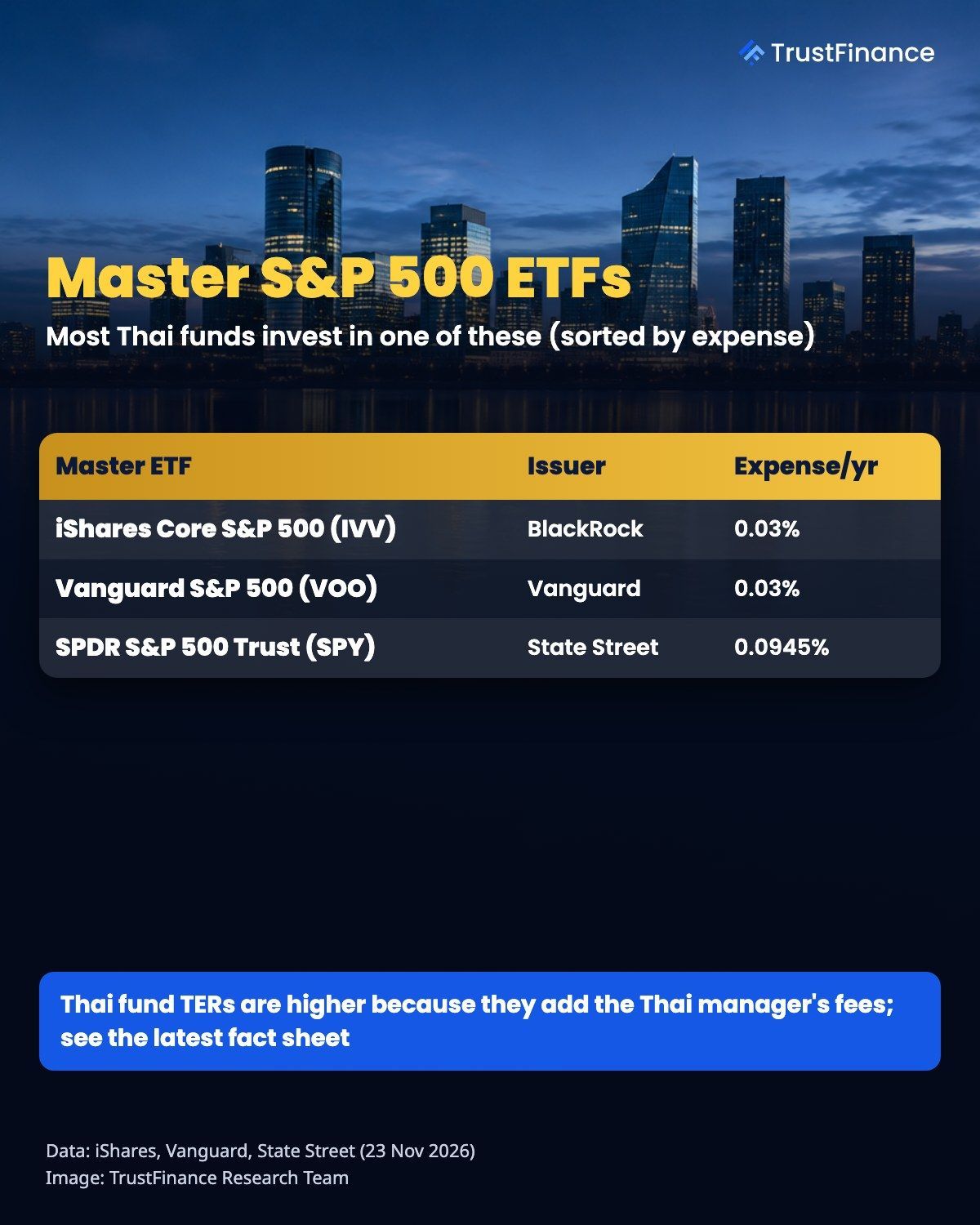
Master S&P 500 ETFs: IVV and VOO cost 0.03% a year, SPY 0.0945%
Data: iShares, Vanguard, State Street (23 Nov 2026) · Image: TrustFinance Research Team
A Thai fund's total cost is shown as the Total Expense Ratio (TER) in its fact sheet. It includes the management fee, trustee fee and other Thai fund expenses; some funds also show the master fund's cost separately. Besides TER there are front-end and back-end fees charged when you buy or sell units.
| Fee | When charged | Where to look |
|---|---|---|
| TER (total expense a year) | Deducted from assets daily, reflected in NAV | Fact sheet, fee section |
| Front-end fee | When buying units; many funds waive it | Prospectus summary |
| Back-end fee | When selling units | Prospectus summary |
| Switching fee | When moving to another fund of the same manager | Prospectus summary |
Example annual cost on 100,000 baht at different TERs (assumed rates, not any fund's): a 0.30% TER is about 300 baht a year, a 0.90% TER about 900 baht. The 600 baht gap repeats every year you hold, and grows with the amount invested; over many years it works like compound interest in reverse.
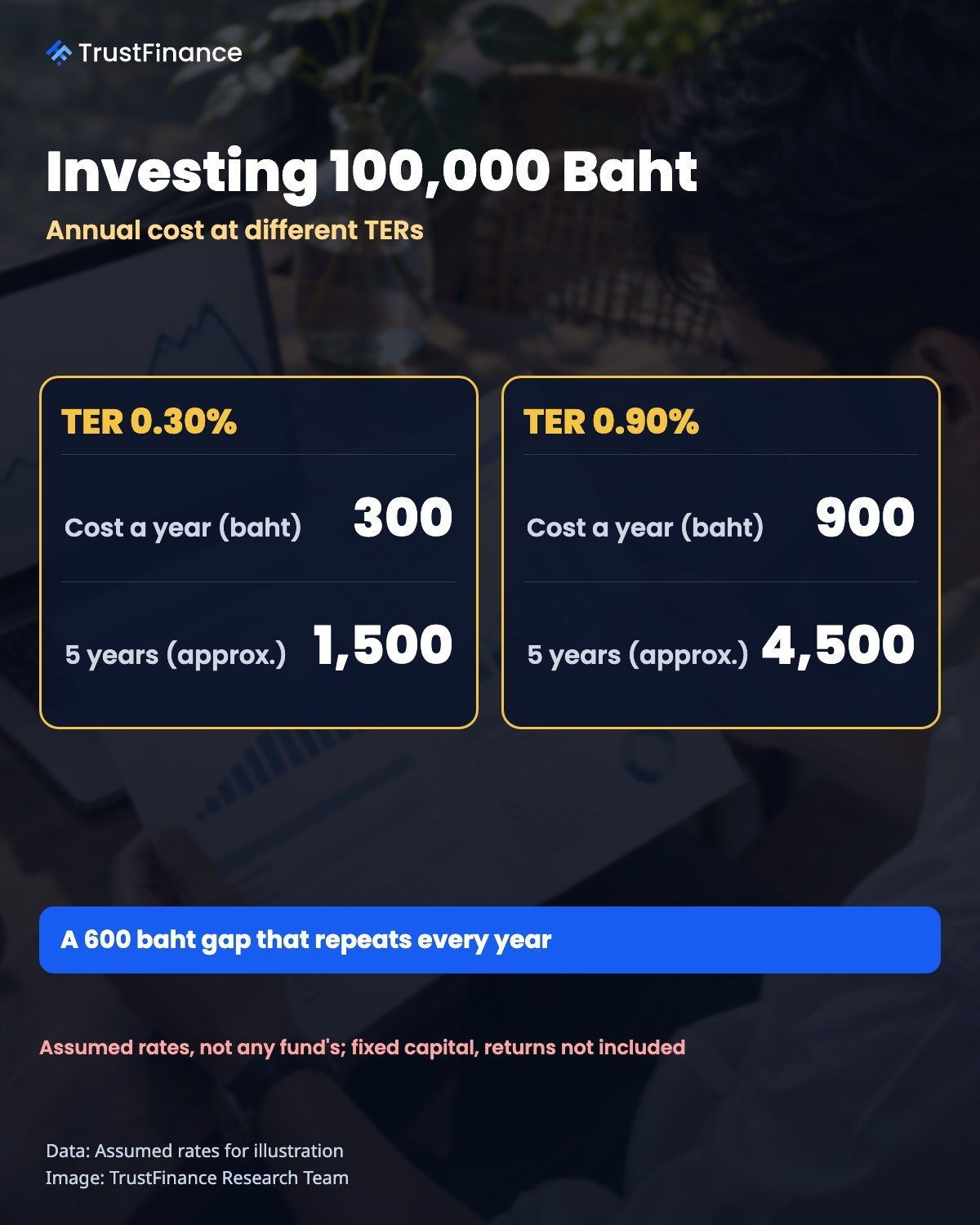
On 100,000 baht, a 0.30% TER costs about 300 baht a year and 0.90% about 900 baht
Data: Assumed rates for illustration · Image: TrustFinance Research Team
The S&P 500 is priced in US dollars, but a Thai fund's NAV is in baht, so the return you see also depends on the currency. If the baht strengthens while you hold, dollar assets are worth less in baht; if the baht weakens, they are worth more.
| Currency policy | How it works | Effect on investors |
|---|---|---|
| Unhedged | Holds dollar assets as they are | Full gain or loss from currency moves |
| Fully hedged | Hedges a high share with currency contracts | Less currency effect, with a hedging cost |
| Discretionary | The manager adjusts the hedge by view | Currency effect depends on the manager's decisions |
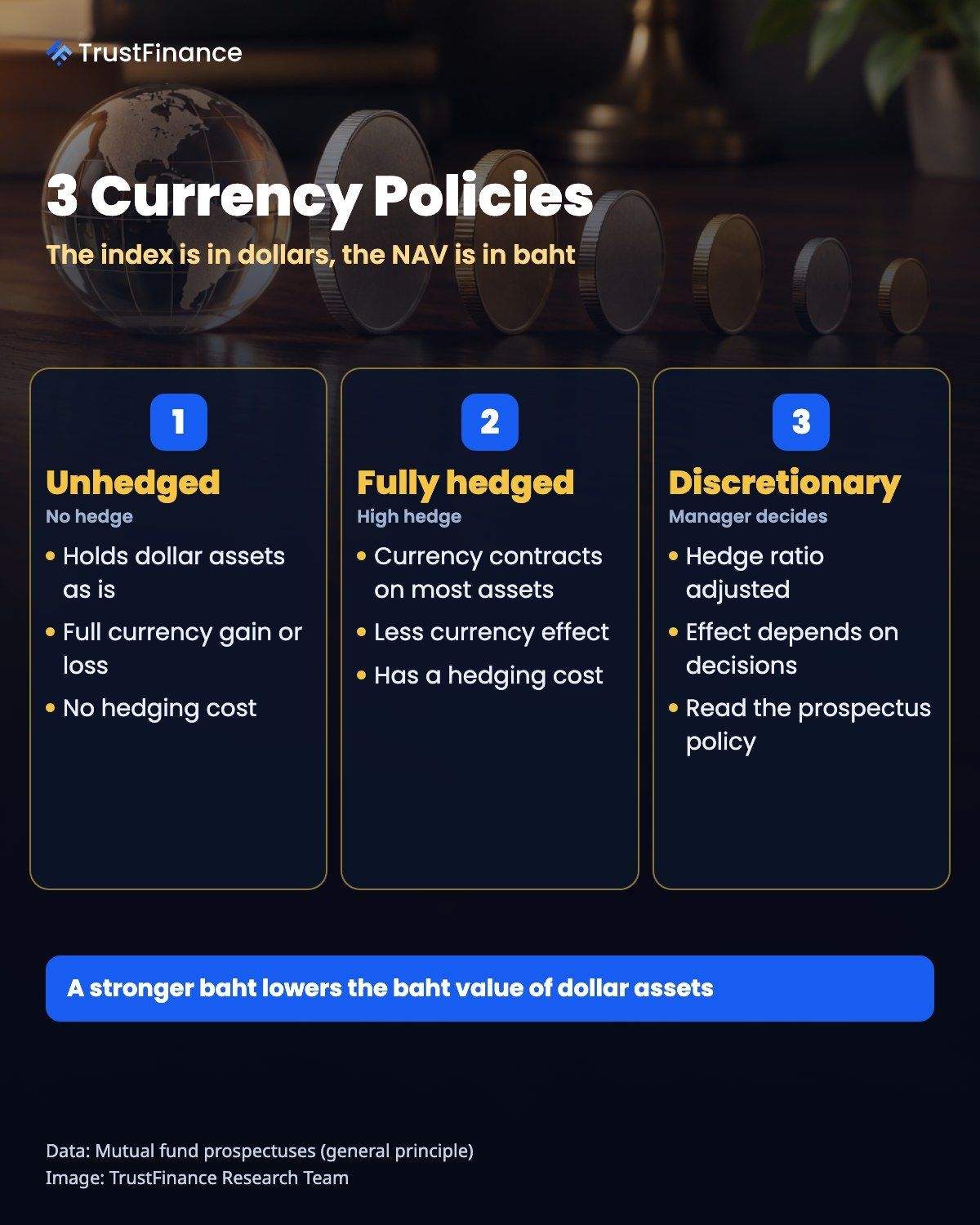
S&P 500 funds use 3 currency policies with different baht effects
Data: Mutual fund prospectuses (general principle) · Image: TrustFinance Research Team
Many S&P 500 funds have several unit classes, such as accumulation (no dividend), dividend and online-only classes. Some have SSF or RMF versions that track the same index but have holding conditions for tax deductions.
On tax, gains from selling fund units are exempt for individuals, while fund dividends have 10% withholding tax. Investors who do not want dividends often look at accumulation classes.
No single fund suits everyone. Funds on the same index differ in fees, currency policy and unit class; compare these from the latest fact sheets.
They differ in master fund (IVV, VOO or SPY), total expense, currency hedging and dividend policy. The index they track is the same.
Banks are selling agents for one or several asset managers. The same fund has the same fees whatever channel you use, so choose the fund first, then a channel that sells it.
No one knows the bottom in advance. Many long-term investors invest the same amount each month to reduce timing effects. This article does not give buy or sell timing.
Most Thai S&P 500 funds track the same index through IVV, VOO or SPY. What makes each fund's result differ is total expense, currency policy and unit class.
Before deciding, compare the latest fact sheets on the same day, and remember that equity funds can lose capital.
This article is for education only. It is not investment advice or an offer to buy or sell securities, digital assets or derivatives, and no return is promised. Readers should study the information and assess the risks themselves before deciding. |
Other references: S&P Dow Jones Indices (S&P 500 methodology), Thai fund fact sheets and prospectuses, Revenue Department (tax on fund dividends)
Fact-checked by TrustFinance Research Team · Information as of 23 November 2026
Thanakit Sutto
Content & PR Lead at TrustFinance. A finance writer who makes investing easy to understand.


