Loading
Related Articles
Fed Rate Hikes Are Back in 2026: What a Return to Tightening Means for the Dollar, Gold, and Traders
Fed Rate Hikes Are Back in 2026: What a Return to Tightening Means for the Dollar, Gold, and Traders
Related Articles

TrustFinance Research Team
11月 23, 2026
8 min read
0

A Ponzi scheme (แชร์ลูกโซ่) raises money from the public by promising returns higher than financial institutions can pay, without a real business that earns enough. It pays earlier members with new members' money. When new members stop coming fast enough, it collapses, and those who joined last lose the most.
In Thailand, Ponzi schemes are an offence under the Emergency Decree on Fraudulent Borrowing from the Public B.E. 2527 (1984), and the Department of Special Investigation (DSI) takes cases with many victims. This article explains how they work, a worked example, the warning signs and what to do if you suspect one.
Key points
|
A Ponzi scheme starts by paying returns on time to build trust. Members who get paid invite people they know. The payouts do not come from business profit but from the money of newcomers.
When new money cannot keep up with what is owed, the organisers delay payments, blame a system problem or disappear. As Thai PBS reports, the law targets businesses that use new members' money to pay old members and cannot pay the returns they advertise.
Say someone invites you to invest 100,000 baht at a promised 5% a month. Compare it with the top 12-month fixed deposit rate in the Bank of Thailand table as of 20 November 2026: 1.40% a year.
| Item | The offer: 5% a month | Fixed deposit: 1.40% a year |
|---|---|---|
| Return per year (simple) | 60% | 1.40% |
| Promised payout in 12 months | 60,000 baht | 1,400 baht |
| Times higher than a deposit | About 43 times | - |
| Who pays | No business you can check | A bank in the deposit protection scheme |
Source: deposit rate from the Bank of Thailand, as of 20 November 2026. The 5% a month figure is a hypothetical example.
No normal business can guarantee 60% a year paid every month with no risk, so an offer like this is the first warning sign. To see how real compound returns grow, read what compound interest is.
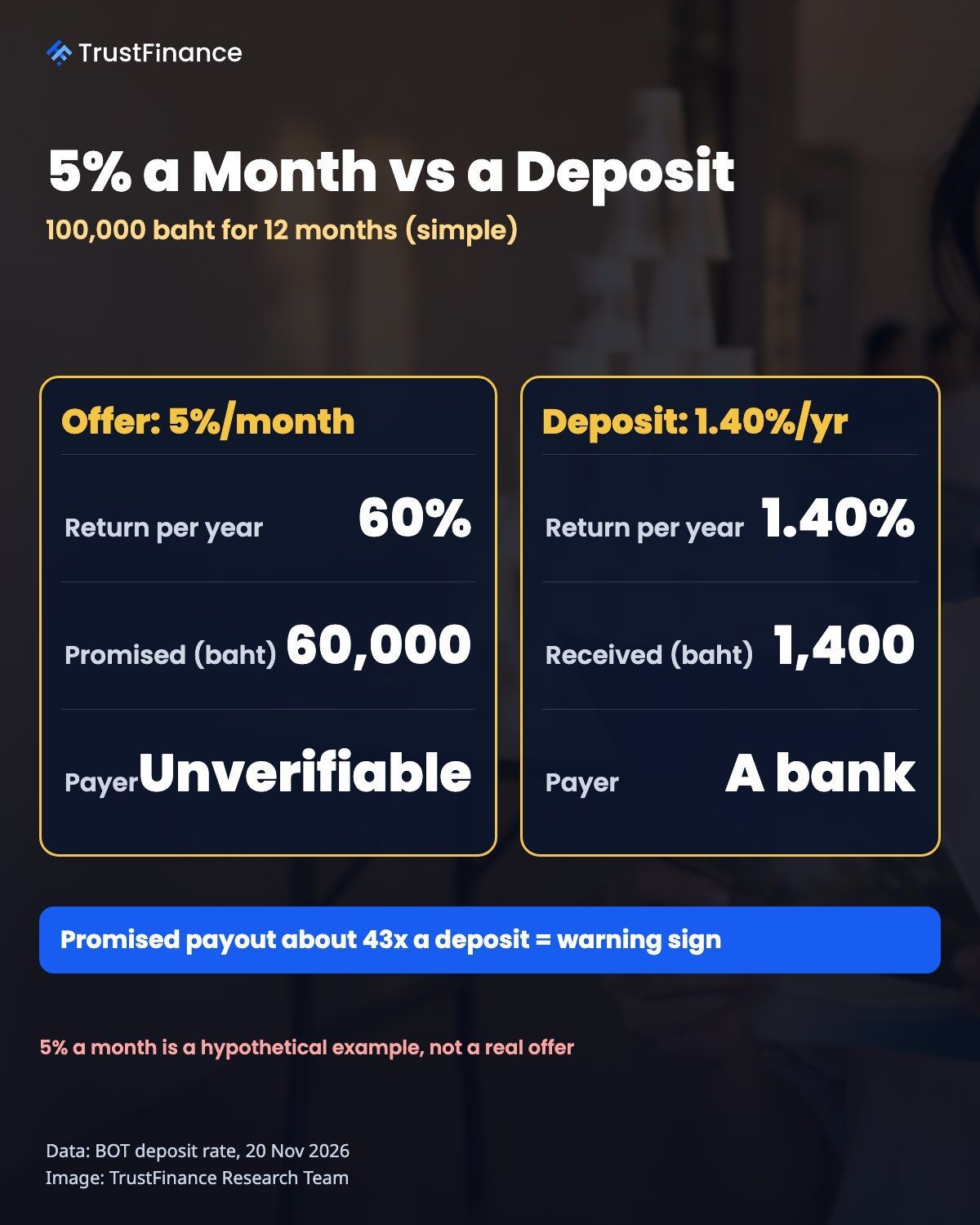
A promised 60,000 baht a year versus 1,400 baht from a deposit: about 43 times higher
Data: BOT (20 Nov 2026), hypothetical example · Image: TrustFinance Research Team
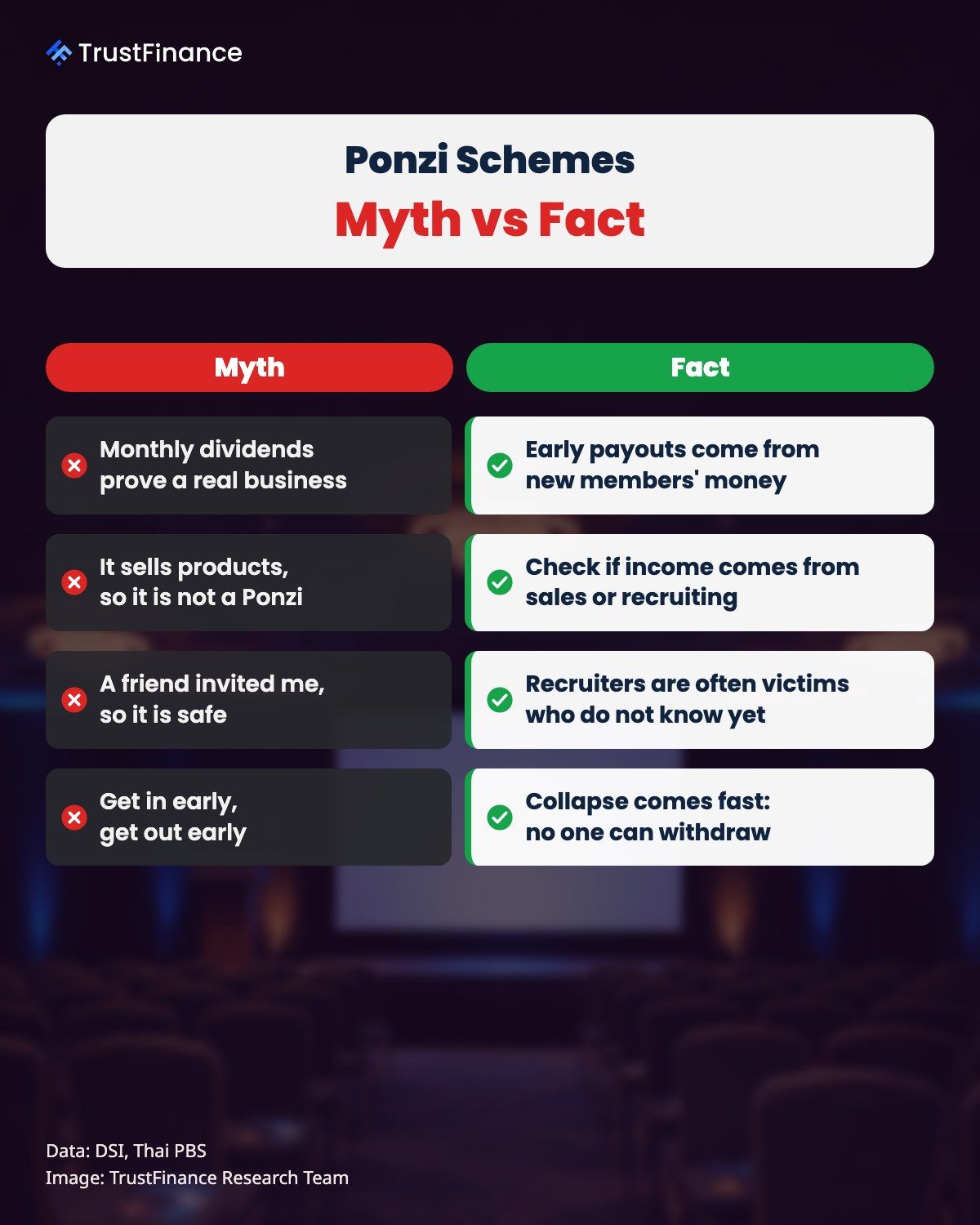
Getting paid at first does not prove a real business: Ponzi schemes pay on time so people recruit
Data: DSI, Thai PBS · Image: TrustFinance Research Team
| Item | Ponzi scheme | Legal direct sales | Investing via a licensed firm |
|---|---|---|---|
| Income from | New members' money | Selling products to real users | Performance of the assets |
| Returns | Promised high and certain | Depend on sales | Not guaranteed, with risk |
| Regulator | None | Direct Sales Act (Office of the Consumer Protection Board) | SEC, BOT or OIC |
| When no newcomers join | Collapses | Still sells products | Prices move with the market |
Source: summary based on the principles of the 1984 decree and regulators' information.
The Emergency Decree on Fraudulent Borrowing from the Public B.E. 2527 (1984) was issued to control informal fundraising and was amended in 1991. In essence, it bans borrowing from the public while paying or promising returns above the highest rate financial institutions may pay, in a way the business cannot actually pay.
Cases with many victims or large losses may be taken by the DSI as special cases. Organisers and accomplices face criminal liability. For penalties and details, see the law itself or ask the authorities. This article is not legal advice.
DSI complaint channels are on the DSI website, and past cases are summarised by Thai PBS (Thai).
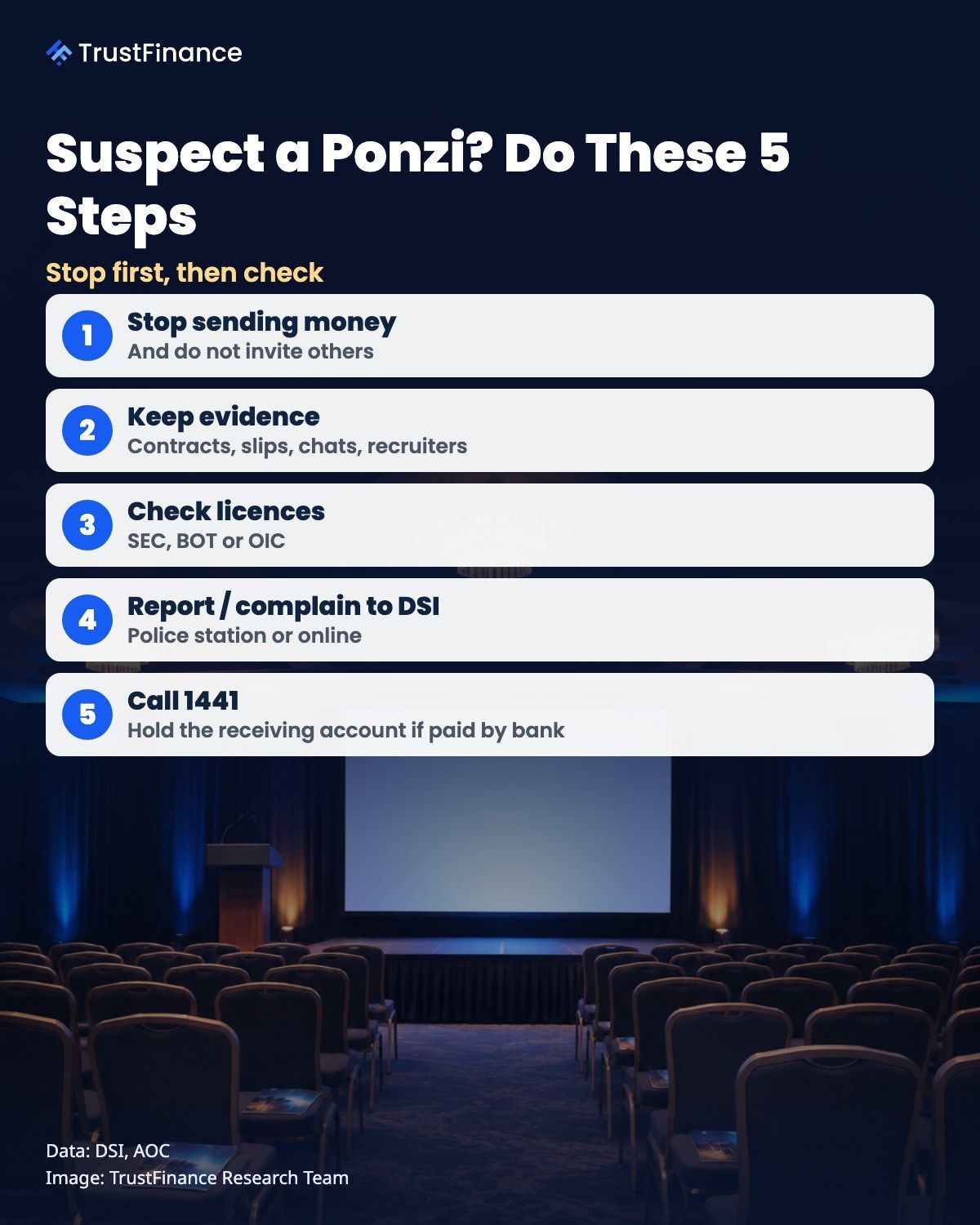
Stop paying and recruiting, then keep evidence before reporting
Data: DSI, AOC · Image: TrustFinance Research Team
New Ponzi schemes often claim Forex or crypto. See more warning signs in warning signs of fake brokers.
Yes. They are an offence under the 1984 Emergency Decree on Fraudulent Borrowing from the Public and may also be public fraud under the Criminal Code.
It depends on the facts, such as their role in setting it up or how they benefited. Anyone unsure should ask the authorities or a lawyer.
No. Ponzi schemes often pay at first with new members' money. Check whether the income comes from a business you can verify.
There is no fixed number, but promised, certain returns many times higher than deposit rates, such as 5% a month, need careful checks.
A Ponzi scheme pays old members with new members' money while promising high, certain returns no real business can deliver. In Thailand it breaks the 1984 decree on fraudulent borrowing from the public.
Before you invest, compare the return with deposit rates, check licences and ask where the income comes from. If in doubt, stop paying and contact the authorities.
This article is for education only. It is not investment advice or an offer to buy or sell securities, digital assets or derivatives, and no return is promised. Readers should study the information and assess the risks themselves before deciding. |
Other references: Emergency Decree on Fraudulent Borrowing from the Public B.E. 2527 (amended 1991), BOT deposit rates 20 Nov 2026, AOC 1441
Fact-checked by TrustFinance Research Team · Information as of 23 November 2026
TrustFinance Research Team
Official TrustFinance research and editorial team, sharing insights, analysis, and best practices to help financial companies and traders build transparency, credibility, and growth.